Time’s list of the top 200 inventions of 2024 dropped last week, highlighting the year’s most promising products and industrious ideas—including those from fashion industry darlings.
This year’s catalog was compiled from solicited nominations from Time’s editors and correspondents worldwide and through an online application process. Each contender was then evaluated on factors like originality, efficacy, ambition and impact.
“The result is a list of 200 groundbreaking inventions (and 50 special mention inventions)—including the world’s largest computer chip, a humanoid robot joining the workforce and a bioluminescent houseplant—that are changing how we live, work, play and think about what’s possible,” Time said in a statement.
Related Stories
As is traditional with the list that highlights innovations revolutionizing the world, this year’s roundup addressed industry hotspots felt throughout the year. From decarbonization to delamination, the winners are (hopefully) a sign of the times.
Ambercycle Cycora

Ambercycle took home a spot on the list for its efforts in tackling the textile waste problem. Cycora, the Reformation partner’s flagship fiber, employs a molecular regeneration technology—its proprietary “Ambercycling” process—that atomically separates and purifies post-consumer waste to produce regenerated polyester.
The resulting material’s quality is on par with its virgin foil, but releases fewer greenhouse gas emissions; the Ganni collaborator previously estimated that Cycora offset nearly half the emissions associated with virgin polyester production.
“We’re incredibly honored to be named among Time’s Best Inventions for 2024. This recognition shines a light on the growing urgency to decarbonize apparel and we’re thrilled that Cycora is leading the way in driving industry impact,” said Shay Sethi, co-founder and CEO of Ambercycle. “We hope that this acknowledgement will inspire more partnerships to bring Cycora to life across the industry and embed circularity as a core design principle in new products.”
Allbirds M0.0nshot Zero
Allbirds has been on Time’s radar for a minute now, considering the magazine named the San Francisco-based brand the most comfortable shoe on launch in 2016. Now, the FABRIC Act backer is on the list again, this time for its zero-carbon sneakers. The culmination of Allbirds’ ethos is the M0.0nshot Zero: a green shoe made from regenerative fibers, sugarcane-derived midsoles and natural rubber alternatives. Plus, Allbirds’ “blueprint” for the carbon-free kicks, RecipeB0.0K, is available to the industry at large as an open-sourced PDF.
“At Allbirds, we believe that Mother Nature is the ultimate innovator,” said Joe Vernachio, CEO at Allbirds. “M0.0nshot Zero, the world’s first net-zero carbon shoe, was made possible only because of what was available to us in the natural world.”
Carbonfact
In the 18 months since its seed funding round, Carbonfact onboarded more than 150 brands—like Armedangels and Carhartt—before raising $15 million in a Series A funding round in April to automate carbon reporting.
Dubbed “fashionably accountable” by Time Magazine, the carbon management software built for the apparel and footwear industry believes it can help brands overcome the emissions issue by offering them tools to measure, reduce and disclose their products’ emissions, in accordance with various regulations.
“It’s an honor to be recognized on this list; it really validates our belief that decarbonization is, at its core, a data problem,” said Jonathan Davies, product marketing and content lead at Carbonfact. “Being named among the best inventions of 2024 shows that using data-driven solutions to tackle emissions isn’t just impactful—it’s essential for building a sustainable future.”
TômTex Series M and Series WS
Sustainable biomaterial producer TômTex was spotlighted as the “sustainable luxury leather” winner in the fashion category.
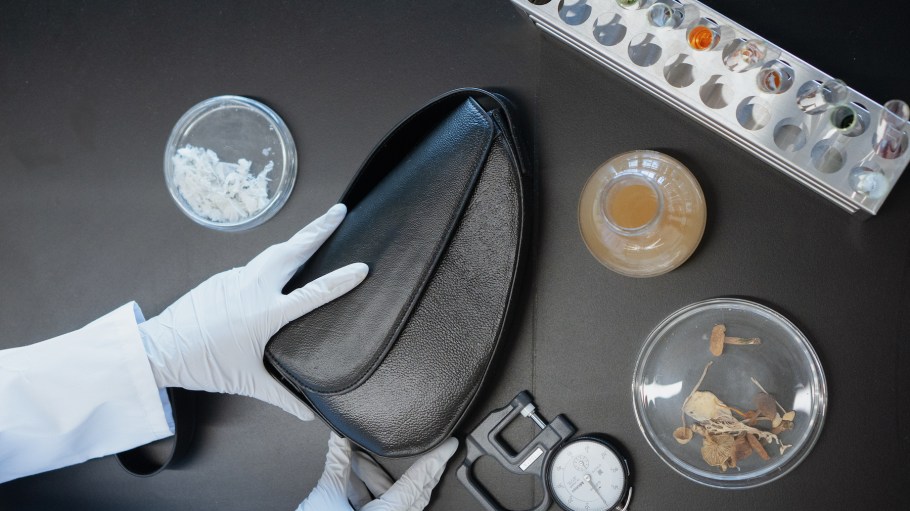
The three-year-old company (whose name mashes up the Vietnamese word for “shrimp” with “textile”) uses a biopolymer found in shell seafood waste and mushrooms to offer cruelty-free and naturally biodegradable textiles that mimic the properties of the likes of leather and latex. Chitin, a complex sugar polysaccharide, is converted into its derivative, chitosan. That natural polymer is mixed with other green chemistry ingredients through a 100 percent sustainable chemical process.
The resulting biomaterials—the Series WS and the Series M, respectively—are petrochemical-free, plastic-free and tanning-free, rendered into purses resembling prosciutto, among other things. According to Time’s nomination, the materials will be available in 2025 at $2.50 to $3.50 per square foot, on par with the cost of mid-tier animal leather.
“We started with a simple vision—to transform waste into something meaningful—and seeing it resonate on a larger scale gives us hope for what’s next,” founder and CEO Uyen Tran said. “It’s not just about creating a material; it’s about changing the way industries think about sustainability and what’s possible.”
Merrell SpeedArc Surge BOA
Time Magazine lauded Merrell for the SpeedArc Surge BOA, a slimmer-than-standard hiking shoe. Trade fair ISPO awarded the outdoor brand’s soon-to-debut shoe in May for “revolutionizing trail footwear” through “futuristic design, innovative materials and precise fit technology.”
The “hero” of the shoe is the platform technology, SpeedArc. It combines Merrell’s flexplate—a nylon-based material—and FloatPro+, a new, nitrogen-injected supercritical foam.
“We’re encouraged to continue developing products that meet the evolving needs of our customers and setting the standard for future hiking shoes. As the outdoor consumer evolves, so are we,” Ian Cobb, Merrell’s senior design director, said. “We’ve engineered this shoe to seamlessly transition from city streets to rugged trails with unmatched comfort and cutting-edge technology to redefine the future of hiking.”
For Merrell, the “prestigious platform’s acknowledgment” of its “most innovative hiking shoe yet” validates the brand’s internal efforts to redefine and modernize hiking.
“This recognition helps us reach a broader audience—inspiring more people to experience joy in the outdoors like never before,” said Ian Cobb, Merrell’s senior design director. “It brings a truly fun, unique underfoot experience to a mostly serious hike space.”
ThredUp AI Search
ThredUp believes technology can play a “powerful role” in making secondhand shopping more accessible, convenient and overall more manageable for the end-user.
That’s one of the reasons the platform released a trio of consumer-facing AI tools over the summer. The AI-powered search tool allows shoppers to filter through ThredUp’s 4.5 million pre-worn pieces by focusing on hyper-specific details, like desired vibe or destination.
“Our AI search tool is just one example of how we are using innovation to remove friction from the secondhand shopping process,” ThredUp’s co-founder and CEO, James Reinhart, said. “We are committed to continuing to invest in AI and other cutting-edge technologies to make it even easier for people to buy and sell secondhand clothing.”
That tool yielded a 38 percent year-over-year increase in the number of searches per session since its launch, as reported by Time magazine.
“To be included on this list alongside so many other incredible innovators pushing boundaries in their respective fields is truly inspiring,” Reinhart said. “This award is a testament to our team’s dedication to transforming the way people shop for secondhand clothing.”
Keen Targhee IV
Keen celebrated 20 years with a renewed commitment to the planet.
On the product front, the outdoor footwear brand is free of five of the six most harmful chemicals found in manufacturing and is actively pursuing the sixth (solvents) through innovations like Keen.Fusion, a direct injection construction method. In April, the brand launched the Targhee IV hiking boot, made with this technology—effectively introducing one of the industry’s first solvent-free mechanical bonds that fuses the upper and sole of the boot into one piece. This glue-free construction prevents delamination and resists compression.
“We’re honored to be recognized by Time as one of this year’s best inventions. Our goal was to create the most durable hiking boot yet—PFAs-free and crafted with Keen.Fusion, which fuses the upper and sole together for a longer-lasting bond without the use of glues and solvents, using 3.5 times less energy to create a pair of boots,” Scott Labbe, Keen’s senior vice president of product, said. “This innovative approach ensures that every step is sustainable for people and for the planet.”