Apparel and footwear brands spent Wednesday waving their eco-friendly flags and shared their environmental achievements with anyone who would listen. Timberland took it a step further.
The VF Corp. unit released its 2014 Corporate Social Responsibility (CSR) performance data, reporting its progress in pursuit of sustainability and highlighting a continued commitment to shrinking its ecological footprint.
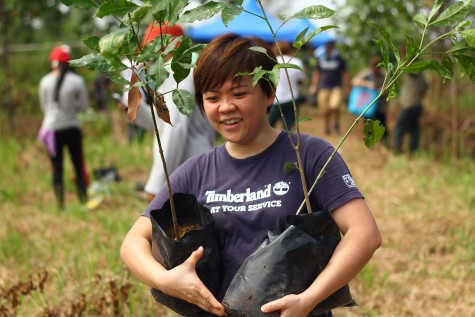
From celebrating its one-millionth volunteer hour served since launching its Path of Service program in 1992 to planting more than 1.5 million trees, last year was a lauded one for Timberland’s sustainability efforts.
“Our primary focus is on creating Timberland products in a more sustainable way and then letting the consumer vote with their purchase,” said sustainability director Colleen Vien. “We’ve done plenty of research with our target consumers and have found that they want to do business with brands they can trust, brands that operate in a responsible manner. We’ve found that it’s not the lead consideration—the product has to look great and perform—but it’s part of the equation for sure.”
Related Stories
Product-wise, Timberland stepped up the use of renewable, organic and recycled (ROR) materials in its footwear, incorporating ROR in 79 percent of its offering, up from 70 percent in 2013. More than 1.25 million pounds of recycled PET (the equivalent of 57 million plastic bottles) made its way into the brand’s shoes, while 6.9 million pairs featured outsoles containing up to 42 percent recycled rubber.
In addition, almost all of the leather (more than 99 percent) used in the brand’s footwear was sourced from tanneries that achieved a Gold or Silver rating from the Leather Working Group—which promotes sustainable and appropriate environmental business practices in the leather industry—and only 1.8 percent of total pairs shipped last year contained PVC, down from 8.9 percent in 2013.
Apparel, however, witnessed a drop in ROR content. The brand ended 2014 with 18.8 percent of all materials used incorporating ROR materials compared with 36.7 percent in 2013.
“Apparel has been a challenge due primarily to cost and this continues to be a priority for us to address,” Vien said. “While we’ll continue to focus on increasing our use of organic cotton, we’re also partnering with our parent company VF and other industry leaders to identify solutions for making traditional cotton more sustainable. If we tackle both sides of the equation, we’re confident we can make real progress in the coming years.”
While Timberland didn’t publish carbon emissions associated with its owned and operated facilities (that data will be reported separately in Q3), as of year-end 2013 it had halved its greenhouse gas emissions (based on 2006 baseline) and derived 26 percent of its energy from renewable sources.
The report also pointed out that at the close of 2014, 63 percent of its global footwear and apparel production had come from factories that had demonstrated effective environmental management practices (up from 59 percent in 2013) and 73 percent of production came from factories with demonstrated social/labor management systems (up from 70 percent in 2013).
Beyond compliance, Timberland partnered with Planet Water Foundation to build water towers in the Dominican Republic and teamed up with BSR HERproject to implement healthcare improvements in Bangladesh.
“While employees find value in all service experiences, we find the most passion for projects where volunteers have the opportunity to engage directly with the community members who will ultimately benefit from the work being done,” said Atlanta McIlwraith, senior manager of community engagement. “That personal connection makes a world of difference.”
“We’re deeply committed to our sustainability goals and proud of our accomplishments but we’re always looking at what’s next said,” Vien shared, noting that later this year, the company will set environmental standards against all Timberland product categories, not just footwear and apparel. As she explained, “By setting targets against all product categories, we expect to have an even bigger impact over time, as we strive to reduce our product-related environmental footprint.”