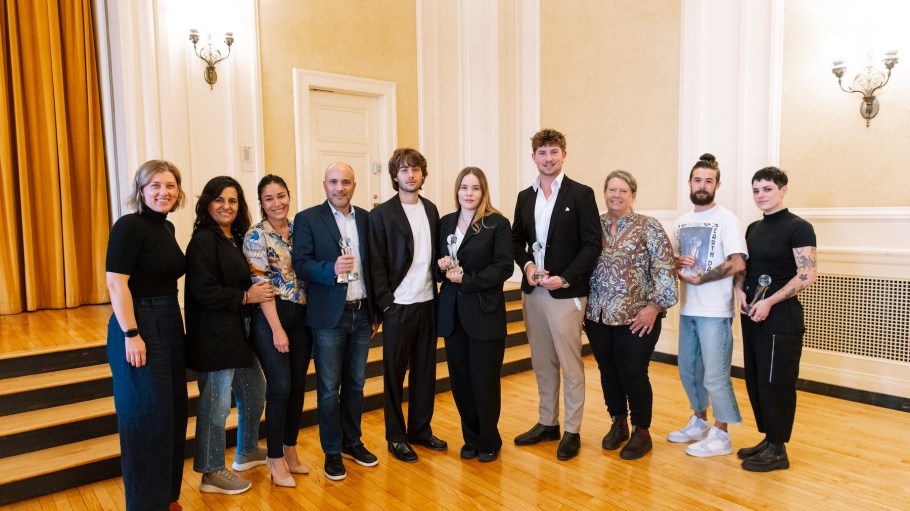
Textile Exchange announced the winners of its 2024 Climate and Nature Impact Awards during the sustainability trade group’s annual conference, held Oct. 28-31 at the Pasadena Convention Center in California.

In memory of Ryan Young, Textile Exchange’s late chief operating officer who led the development of the global nonprofit’s Climate+ vision in 2019, the Ryan Young Climate Leader award recognizes an “outstanding individual” who exhibits commitment, action and leadership in reducing fiber and raw material production emissions from the fashion, textile and apparel sector.
Related Stories
Ian and Dianne “Di” Haggerty, the founders of Natural Intelligence Farming (NIF), won the award.
The holistic and integrated program of cropping and grazing is focused on supporting microbial life to reduce dirt damage from salt-based fertilizers and soil amendments. Various Australian institutions have lauded the duo’s biologically based farming system throughout the years and recently resulted in a collaboration with Nativa and Stella McCartney, bringing NIF’s regenerative wool to the luxury label.
“Nature’s lesson is in reciprocity. For all to benefit and facilitate life, we must give back more than we take. So, I also feel a deep sense of possibility in this growing recognition of the foundational work land stewards play in nurturing nature’s magnificence—the integrity of our work underpins the entire textile realm,” Diane “Di” Haggerty said. “To this end, I feel grateful for the opportunity to be part of growing strong, trusted and respectful relationships with reciprocity front and center and the nurturing of life at their core. Our beautiful planet demands no less.”
On top of this now-individual award, Textile Exchange also updated its award categories to include “Project of the Year” accolades. The category celebrates four projects executing leadership in innovation (think recycling), climate (think greenhouse gas reductions), nature (think regenerative practices) and collaboration in action.
“By showcasing those going above and beyond to drive beneficial impacts in these four categories,” Textile Exchange said, “the Project of the Year award recognized project teams and aims to inspire others into action.”
“Innovation of the Year” celebrates projects demonstrating out-of-the-box approaches to reducing the industry’s “plastic paralysis” and synthetics addiction through efforts like textile-to-textile recycling, bio-synthetics and carbon capture technologies.
Keel Labs’ seaweed-based Kelsun fiber took home the award.
“Being awarded the Innovation Project of the Year by Textile Exchange is a profound honor, especially given the organization’s renowned industry standing and insight. It is inspiring and validating to know that the hard work we’ve put in for years to scale our technology is resonating and that its necessity is understood,” said Tessa Callaghan, co-founder and CEO of Keel Labs. “For the industry, it represents an important moment in time, where critical solutions like Kelsun are on the rise within the market to resolve the challenges textile supply chains have faced to date.”
“Climate of the Year” recognizes projects successfully demonstrating reduced emissions associated with raw material extraction and initial processing while also considering the ecosystems, landscapes and communities where fibers are made.
“At the core of our organizational strategy is guiding the industry toward greenhouse gas emissions from fiber and raw production by 45 percent by 2030,” Textile Exchange said on its Climate and Nature Impact Awards nomination landing page. “Beyond accounting for emissions, an interdisciplinary and interconnected approach is key to holistically look at sustainability.”
Manteco’s MWool and ReviWool fibers took home the Climate award for its commitment to recycling and circularity.
These reduced impact wools helped the Italian textile company save over 195,000 tons of CO2-equivalent emissions, 35.5 cubic hectometers of water and about 290 terajoules of energy last year. ReviWool, made of valuable co-product fibers from the combing process of virgin wool, generates 65.6 less CO2-equivalent emissions than its virgin counterpart. MWool, obtained from mechanically recycled post-consumer garments and pre-consumer waste, generates 99.2 less emissions.
“This win at the Climate and Nature Impact Awards represents an important step not only for Manteco, but for the entire textile industry,” said Marco Mantellassi, co-CEO of Manteco. “We are excited to continue working for a more responsible and sustainable industry, demonstrating that it is possible to combine innovation, quality and respect for the environment.”
“Collaboration in Action” highlights projects reducing environmental impacts through partnerships and engagement with relevant organizations, “inspiring others to accelerate industry action in achieving climate reduction targets and nature goals,” per Textile Exchange.
Materra’s Regenerative Cotton took home the award.
The British-Indian firm focused on designing scalable solutions to grow and source climate-resilient, transparent and equitable cotton’s Regen Cotton Program has been supported by the likes of Mango and Positive Materials as it provides farmers with traceability tools and 300-plus data points tailored for Tier 4 compliance.
“We are delighted that our work in forging strong partnerships between brands and the 4,000-plus smallholder farmers we work with has been recognized by Textile Exchange,” a spokesperson for Materra said. “Our mission is to help fashion set the template for radical supply chain transparency and verifiable impact, and we hope others will join us on this journey.”
“Nature Project of the Year” honors efforts executing regenerative agriculture practices, contributing to “beneficial impacts on biodiversity” as well as responsibly using water.
Swedish-Peruvian B Corp Bergman Rivera took home the award for its White Cotton Project.
This project is the “backbone” of the company, dating back to 1986 when some experimental farmers began exploring alternative growing techniques. Now, the project works with over 90 farmers in Southern and Northern Peru, managed by one of the producer’s partners, Ecotton.
“This is a recognition of the silent work that farmers have been doing for years, preserving ancient traditions, the environment and their biodiversity,” a spokesperson for Bergman Rivera said. “We accept this award on their behalf.”