For sustainability to work, it has to be a way of corporate life.
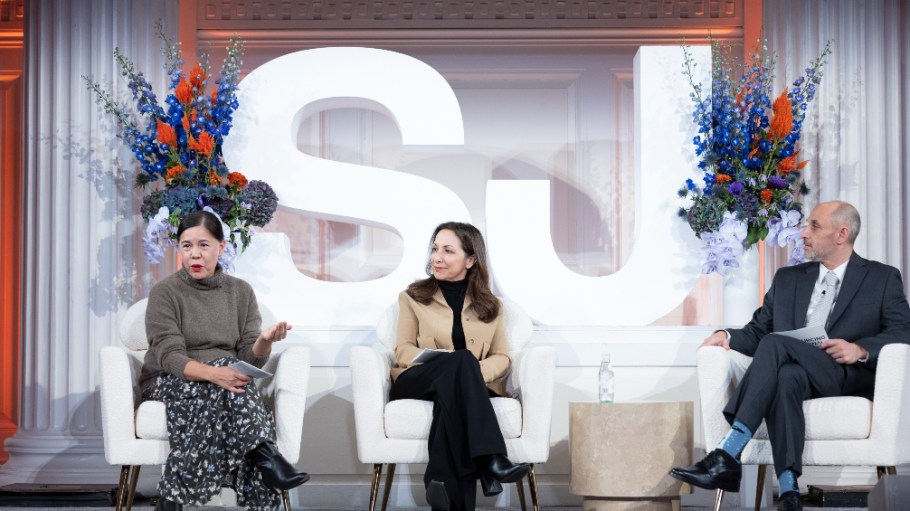
Hilda McDuff, president of Interloop North America, and Lisa Diegel, director, global sustainability, Faherty Brand, spoke on a panel at the SJ Fall Summit on “The Benefits of Visibility” that was moderated by editor in chief Pete Sadera. While Interloop, a Pakistani apparel manufacturer, and Faherty, an apparel brand, has each taken a different sustainability route, one thing that’s core is how sustainability remains the guiding force for all decision-making.
Related Stories
At Interloop, McDuff said reducing the company’s carbon footprint and water conservation are just two important components of the company’s operation. “Interloop as a manufacturer, [is] one of the largest manufacturers in Pakistan. And so what we do is important. We have to want to lead the way, the way we upgrade, the way we treat sustainability. And so all of these things are very important,” she said.
The company, which has four LEED-certified facilities, has set aggressive targets for reducing emissions. McDuff said the certification process “takes our interests and our commitment to another level” in terms of sustainable manufacturing practices. By 2032, Interloop will reduce two greenhouse gas emissions—Scope 1 direct emissions and Scope 2 indirect emissions—by 51 percent, with Scope 3 emissions reduced by 30 percent along its value chain. And as a vertically integrated supplier, Interloop will be the first large-scale business in Pakistan to do so.
While McDuff described the “very aggressive approach” as commitment from the organization, she said it really is “about leadership and about seeing everyone in the company as a stakeholder. We all own that process.”
At Faherty, which snagged B Corp certification earlier this year, the commitment to sustainability also starts from the top. “Our chief impact officer has a background in human rights, and is very passionate about intersectional justice and environmental impact. And so when you have leaders with that passion, it really trickles down into all parts of the business so we really have that as a base,” Diegel said.
She also said that being sustainable isn’t cheap. “We all know that [not] greenwashing is part of all of our jobs now to ensure that what we say is verified. And so that has to be prioritized with leadership, and it has to be put into the budget because it does take more time and it costs more to make sure that everything is verified,” Diegel explained.
But do customers care? Yes and no. “I think from what I see within our company, the answer is both, there is a section of customers that really care about sustainability, really looking for sustainable brands, and then there’s another section that really doesn’t care,” she said.
As for Faherty’s commitment to accountability and transparency, “Its definitely a great way to look deeply into your company in all departments,” Diegel said. She explained that the B Corp assessment isn’t just about the environmental impact looking at materials and waste, and it’s not just about the social impact in terms of human rights or engagement.
“How do you run your business? How do you treat your employees? How do you treat your customers? How do you get your customers? So I think B Corp really is a mission,” the global sustainability director said, adding that certification is becoming more of a reputable and recognizable assessment. And while some consumers may not yet know what the B Corp logo means, they’ve probably seen it at Patagonia or at another company and recognize that it means “something good,” she concluded.
Diegel described the certification process as “grueling” and “very challenging,” but emphasized that “it’s really an amazing way to figure out what’s going on in the business.”
The two panelists also spoke about the fashion industry working together to foster change. McDuff said working together with the same goals is a “recipe for success in terms of working groups,” adding that as her company works with their customers, Interloop is seeing how they are shifting to more sustainable materials. The company also has an initiative that allows farmers to provide input as their cotton goes through the different processing tiers and the supply chain. Diegel said for her firm, the key to fostering collaboration begins at the onboarding stage by choosing partners who care about the same values as Faherty.
The two also spoke about innovating fabrications that are also sustainable. McDuff said Pakistan produces 155,000 tons of bananas each year, which produces banana stem waste that Interloop has been able to process to create a fiber that’s branded to other fibers. Diegel said that at Faherty, the co-founders are “always creating and developing new fibers and fabrics and innovative processes,” with a company goal of 80 percent responsible fibers by the end of 2025, followed by 100 responsible fibers by 2030.