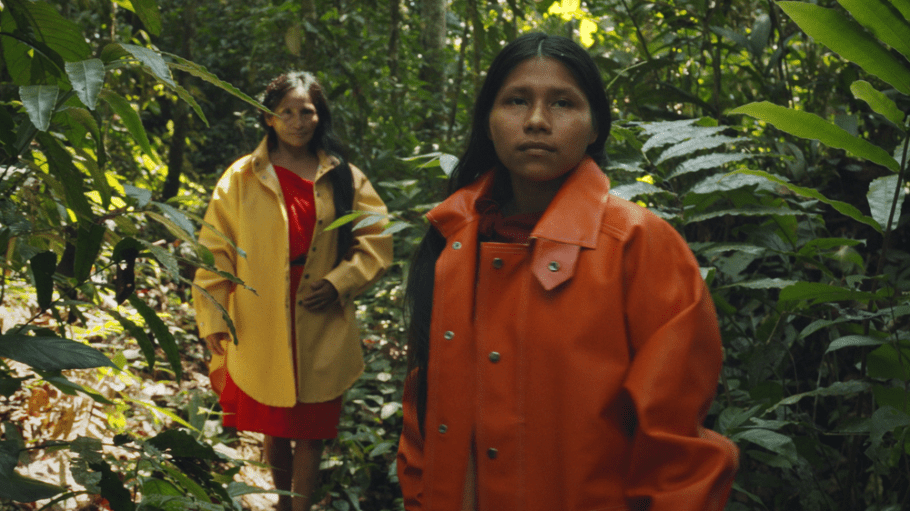
Not a word of English is spoken throughout the nearly 12-minute short film that is “Shiringa,” the first in a series of mini-documentaries by an Australian nonprofit that eschews the narrower concepts of “fair fashion” or “vegan fashion” for a system it calls “total ethics fashion.”
It’s a story that derives, after all, not from New York, London or the other fashion capitals of the world, but from the Awajún people of the Amazon rainforest, a biomaterials firm in Lima and a fashion designer in Peru. Together, they’ve been quietly using the latex of the shiringa tree to create an animal-free leather alternative that is naturally warm, supple and waterproof.
Related Stories
As Mozdeh Matin, who studied fashion design at the ModArt International School of Fashion in Peru, the material “works with the tree, it doesn’t take from it.”
Available to watch on WaterBear.com beginning this week, “Shiringa” opens with Doris Pape Petsa and Rosalia Manuic Taan, two Indigenous women who are seen picking their way through the rainforest, barefoot and with cutting tools in hand. They’re making their way to a shiringa tree, which is native to the Amazon basin and can soar up to 40 meters tall in the wild. Arriving at their destination, the women gently saw along a diagonal groove to release the thick, milky sap that is trapped behind its bark. The fluid drips slowly yet rhythmically into a cup.
“We carve into shiringa, it weeps sap and then we help heal it with soil,” Petsa says. “We make sure not to take too much and let each tree rest after. When we create, we create with nature, not against it. Conserving the forest, we live peacefully. We have a good life.”
For generations, the Awajún people have been mixing the latex with native Peruvian cotton fibers, coloring it with natural dyes like annatto (from the seeds of the achiote tree) and huito (a fleshy fruit) and then drying it on large wooden frames to produce textiles for clothing. The process is as low-impact as it gets, powered by elbow grease and the heat of the afternoon sun.
But the Awajún territories, like the rest of the Amazon, are being increasingly encroached upon by deforestation. The No. 1 reason for this is cattle ranching to satisfy the global demand for Brazilian beef and generate the leather that is a valuable byproduct for the luxury goods sector.
“Not everyone shows the care for the Earth that we do,” Taan says. “Across Amazonia, land is destroyed…the jungle is burned. The lives of the animals are not respected. They are abused while people lose our homes. We will not allow these cutting trees here.”
Jorge Cajacuri, founder of Caxacori Studio, first learned of the Awajún and their relationship with their shiringa tree through the United Nations Environment Programme. Today, he works with 59 Indigenous families across 7,602 hectares of the Tuntanaín Communal Reserve, a sprawling protected area in Peru, through a conservation agreement with the Awajún communities and Sernanp, the governing body of the National System of Natural Protected Areas by the State.
It takes “almost two days and a night” by river and land to bring the latex to Lima, where it’s dyed with agriwaste pigments like cocoa and corn residue, laminated onto 100 percent cotton fabric and heat-dried to mimic cowhide, he said through a translator. And while Caxacori uses a 25 percent blend of polyurethane to add the material strength most brands desire in the final formulation, it’s in the midst of a project that could allow it to lower that figure to 15 percent. Cajacuri’s goal, however, is to eliminate synthetics altogether.
The studio’s production capacity is still small, he said. It can churn out 400 meters per month but, with effort, reach 600 meters using 240-360 liters of latex. But equally important for Cajacuri is that the Awajún are compensated fairly, with a payout that’s roughly 50 percent higher than what the average latex collector in Peru receives.
”The most important pillar of our work is that families and communities from the jungle work with us,” Cajacuri said. “They have an income to improve the quality of life.”
There are many ways to ape bovine leather. Some companies do it with mushroom mycelium; others with cacti, bananas, or rice hulls. But the shiringa material stands out among them, said Emma Hakansson, founder of Collective Fashion Justice and the film’s director and producer. It combats land-grabbing for deforestation, supports communities that are in poverty and not only defends against the fashion industry’s problems but “actively provides a solution” for its reliance on animal exploitation, hazardous chemicals and non-renewable resources.
Hakansson admits that “Shiringa” is really a high-production pitch deck for the bio-leather. It’s still a niche product with a low commercial profile, she said, but it’s her hope that the short can drive brand awareness and adoption—and save more trees, livelihoods and perhaps even cows in the process.
“Every time a community shows the Peruvian government that they are capable of economic uplift from defending their land and working with the land, it provides a massive incentive for them to reserve more areas that are then safer from deforestation,” she said. “So there’s a really strong link between how much interest we can get from the fashion industry for this material and supporting communities that are currently in poverty, that want to have better education for their children, that want to be able to continue their culture on their land, as compared to being a part of work that destroys it or be moved on by people that are land-grabbing for deforestation.”
Still, there are potential wrinkles. A few outliers aside, material innovators have been struggling to bust out of lab or pilot scale. Bio-leather, which experienced a boom in popularity only a few years ago, drumming up enthusiasm from everyone from Gucci to Lululemon, is facing a more subdued reception in a time of immense economic volatility. Mylo, Bolt Threads’ pacesetter, was put on indefinite pause in 2023. Natural Fiber Welding, which produces Mirum, another leading contender, furloughed and then laid off what it described as a significant portion of its staff last year.
“I think part of it is just the impatience of the fashion industry,” Hakansson said. “We can’t expect to be able to effectively replace animal skins that have been used for millennia, that have been dealt with different chemical treatments for many decades, in a few years to the same scale. I also think the amount of investment, even though it has been significant, has not been that significant when you compare it to the amount of research and development funding that other industries put into innovation.”
And therein lies the message of “Shiringa”: co-existence, regeneration, sufficiency, patience. The Awajún believe that the rainforest is filled with guardian spirits alongside the plants and animals. They, too, must be given their due.
“If people really understood how fashion can destroy or protect life, we would all live better,” Taan says in the film. “Making the material helps our land and community. With it we can support ourselves while keeping shiringa trees standing and safe.”