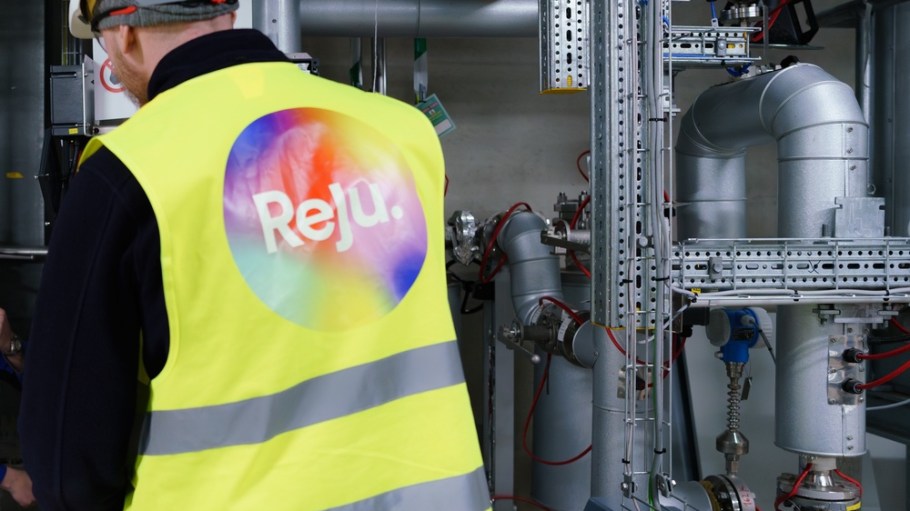
Reju is breaking ground in the United States.
The French textile-to-textile recycling firm announced on Tuesday the location of its first American-based commercial-scale plant: Rochester in upstate New York.
Sited at an 18.9-acre tract at Eastman Business Park, where Eastman Kodak used to churn out roll after roll of photographic and motion picture film, the $390 million “textile regeneration hub” plans to recycle the equivalent of 300 million castoff garments annually into the “building block” precursor to PET known as bis(2-hydroxyethyl) terephthalate, or BHET. That’s enough to generate 50,000 metric tons of the monomer a year for repolymerizing into polyester.
Related Stories
Reju scoured 30 different locations before putting its stake in Rochester, said Patrik Frisk, the company’s CEO.
The city, he said, has everything the company needs to thrive: access to transportation, ample feedstock from both the United States and neighboring Canada, and a “tremendous amount of engineering talent” from New York State’s fourth-most populous city, one of the country’s original boomtowns and now an expanding R&D hub.
Being in close proximity to Goodwill of the Finger Lakes, which has teamed with Reju and WM on a multi-year “collaborative model” for collecting, sorting, reusing and recycling textiles, doesn’t hurt either. Neither does the fact that the Empire State is actively mulling an extended producer responsibility scheme to hold manufacturers responsible for funding collection and recycling programs for end-of-life textiles through bills such as S3217A and A6193.
“How the state has begun to really think about circularity is also very important to us, so we feel well-supported in terms of the intent of developing those kinds of systems,” Frisk said. “Ultimately, we believe that EPR will be happening in this state because the textile waste is quite substantial.”
New York State will benefit, too, from the creation of “good-paying” jobs that promote innovation and sustainability, said its governor, Kathy Hochul.
“Reju’s ambitious project will create approximately 70 new jobs at Eastman Business Park, and will show how smart investments can turn waste into opportunity, further supporting our state’s overall green economy efforts and creating a brighter future for everyone,” she said in a statement.
The Rochester plant, which is expected to go online by 2029, will be the second of Reju’s “megafactories” to begin construction. Its first inaugural industrial-scale foray, announced last May, will start firing its pistons sometime in 2027 in Chemelot Industrial Park in the Dutch city of Sittard. The company also has a demonstration facility in Frankfurt, where it can crank out 1,000 metric tons of BHET on an annual basis.
But first, a couple of kinks to work out, Frisk said: remediating an “old industrial property” in order to prepare the ground for raising a new factory, for one, and figuring out where to repolymerize the BHET, for another.
“Maybe in New York State or in one of the other states,” he said. “That’s something that’s still to be decided.”
What Frisk is certain about, however, is that by the time the Rochester factory is up and running, EPR will no longer be a matter of debate but “something that we will need to actually do.”
“We’ve seen no decrease in the trajectory in terms of virgin polyester growth,” he said. “In combination with the ongoing and increasing conversations around nearshoring, reshoring and circularity, we need to be creating that new system for the future.”
Volume-wise, polyester fiber production increased from roughly 71 million metric tons in 2023 to 78 million metric tons in 2024, according to Textile Exchange. Polyester continues to be the most widely produced fiber, comprising 59 percent of the world’s total fiber output. While the amount of recycled polyester has increased on a volume basis—if not a market share one—the vast majority of recycled polyester today is derived from melted-down plastic bottles that critics say are better off being remade into more bottles. When they’re turned into clothing, however, they enter an “open loop” that, for the most part, is a circularity dead end.
Reju joins Syre, an H&M-backed circular polyester manufacturer, in having its sights on the United States, though the latter is in the process of constructing a 10,000-metric-ton blueprint plant in Cedar Creek, North Carolina, rather than a commercial-scale factory, which it hopes to square away in Vietnam.
But while Frisk thinks Reju’s investment in Rochester represents a “very big moment for textile-to-textile recycling in this region,” or indeed the United States as a whole, a “full systems build” is still needed to bridge what he describes as the “gap” between the aggregation of textile waste and its reintroduction into brand supply chains.
“This isn’t going to dramatically change how people need to source things, necessarily,” he said. “But what it does is it gives an opportunity to start the journey of having some of the production that you have de-risked, built for high resilience and more localized. It also gives opportunities to think differently about your business model, about your inventory planning, about your speed to market.”
Frisk is confident that Reju can make the knotty economics of textile-to-textile recycling work despite higher labor costs in the West—even though the firm is also planning to build plants in Asia, as well as expand in Europe and the Americas. The reason so much textile waste is being generated today is because of overproduction, he said. Circularity should then present an opportunity for the industry to plan ahead, rightsize inventories by making fewer but better products and “put your cash to work in a better way.”
In a similar vein, the Rochester reveal is more than an announcement. It’s an alert, Frisk said.
“Without us declaring what we’re intending to do, not a lot is going to happen upstream in terms of sorting and preparation facilities being constructed, because why would they?” he added. “What this does is it sends a message that circularity is coming.”