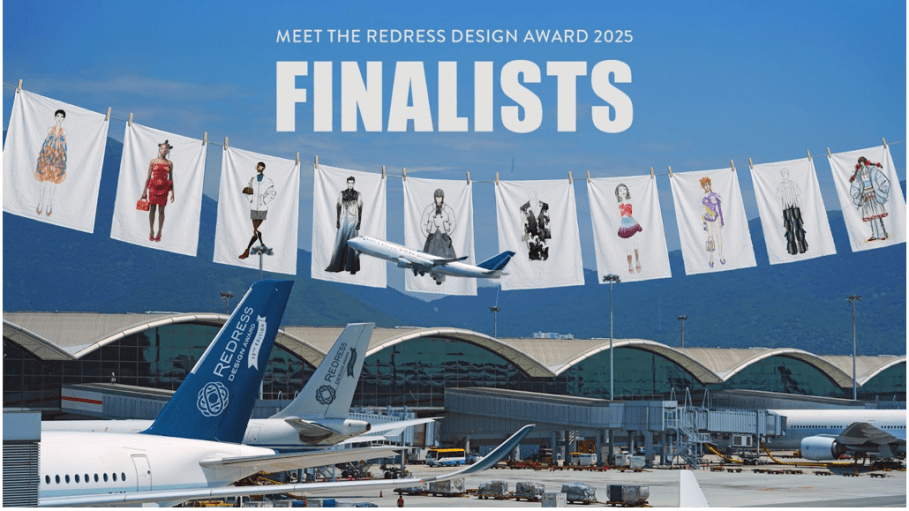
Asia-focused environmental NGO Redress announced the top 10 global finalists for its Redress Design Award.
Redress established the award with the idea that 80 percent of a product’s environmental impact is locked in at the design stage. The organization identified this year’s finalists as agents of change with their innovative use of waste textiles and circular design concepts. The designers were selected from a global pool representing 57 regions.
The finalists are Casbeth Tshegofatso Marobane of South Africa, Lucie Albert of Germany, Carla Zhang of Mainland China, Mara San Pedro of the Philippines, Hawon Park of Korea, Nathan Moy of Hong Kong, Heyun Pan of Mainland China, Wen Hanzhang of Canada, Hugo Dumas of France and Yixuan Nie of the United States.
Related Stories
“The fashion industry’s environmental footprint is a ticking time bomb. Every second, the equivalent of one rubbish truck of textiles is landfilled or burned, and this is worsening,” said Christina Dean, founder and board chair of Redress. “Redress’ role vitally brings together designers, academia and industry annually via our competition to encourage courageous acts to accelerate circular fashion.”
According to Redress, between 100 and 150 billion items of new clothing are produced each year, the majority of which is landfilled or burned at the end of the garment’s life. An estimated 92 million tons of textile waste are created annually from the fashion industry, and textile waste is estimated to increase by about 60 percent between 2015 and 2030.
The Redress Design Award competition was established in 2011 to help abate some of that waste by educating and empowering emerging fashion designers to produce sustainable and circular collections that combat the problem of waste rather than contributing to it. The award is presented in partnership with the Cultural and Creative Industries Development Agency (CCIDA) of Hong Kong.
“The Redress Design Award is a significant event for the fashion industry, showcasing the immense talent emerging from around the world and gathering them in Hong Kong for cultural and business exchanges,” said Victor Tsang, commissioner for cultural and creative industries, CCIDA. “Collaboration is essential to inspire a new era of sustainable practices that resonate globally.”
The 10 finalists will create and send their sustainable collections to Redress for a professional photoshoot in Hong Kong via DHL’s GoGreen Plus service, which reduces carbon emissions associated with international air shipping through the use of sustainable aviation fuel.
“We believe that the logistics industry can be a powerful catalyst for positive change, aligning with DHL’s sustainability aspirations to create a more sustainable future,” said Andy Chiang, senior vice president and managing director of DHL Express Hong Kong and Macau. “Through initiatives aimed at strengthening global supply chains and supporting sustainable businesses, we are dedicated to helping the fashion industry minimize its environmental impact.”
The finalists will present their collections at the Grand Final Fashion Show in September, after completing a 10-day educational bootcamp of workshops and challenges. During the bootcamp, the designers will visit the factory of TAL Apparel, a Hong Kong manufacturer that produces 55 million garments annually.
The winning designer will have their collection shown at Greenext Expo in Shanghai and also receive mentorship from designer Flora Cheong-Leen to develop a limited-edition upcycled item for retail. The winner also will receive a development fund of HK$50,000 ($6,000 U.S. dollars) from Redress and the Tian Art Foundation, which provides scholarships to students.