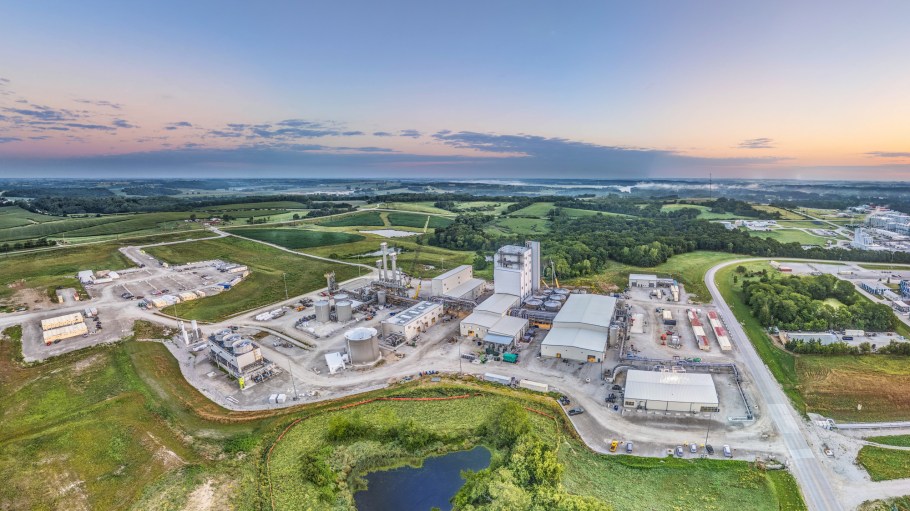
Qore, a joint venture of Minnesota-based Cargill and Germany-based HELM, is officially starting production of Qira, the world’s first large-scale 1,4-butanediol (BDO) made from locally grown dent corn. Qira is derived from annually renewable crops and serves as an impactful alternative to a fossil-derived equivalent used in the manufacture of consumer goods including stretch jeans.
Qore celebrated the grand opening of the $300 million facility located in Eddyville, Iowa-based facility with state officials, customers, farmer partners and industry leaders. The factory will produce 66,000 metric tons annually.
Related Stories
Qira is a key ingredient in The Lycra Company’s bio-derived Lycra EcoMade. Lycra and Qore teamed up in 2022 to enable the commercial production of the bio-derived spandex. Through this partnership, 70 percent of The Lycra Company’s spandex fiber content will be sourced from annually renewable feedstock, which is anticipated to yield a 44 percent carbon footprint drop, per LCA data.
Agolde introduced the first jeans made with bio-derived Lycra EcoMade in May. In addition to apparel, Qira can be applied to footwear, beauty and personal care products, automative and electronics and packaging.
“Qore is able to leverage the deep agricultural network and world-class fermentation technology expertise from Cargill and HELM’s global market reach to bring Qira to life,” said Jon Veldhouse, CEO of Qore. “By providing a reliable, renewable, and transparent feedstock, Qira helps global manufacturers and brands implement identical materials that reduce reliance on oversea supply chains, bringing more transparency to their product portfolios.”
Maintaining a local supply chain is a key element to Qira’s production. The bio-derived feedstock is made from field corn grown in a 100-mile radius of Qore’s facility in south central Iowa sourced chiefly from individual farmers. The farmers apply regenerative agriculture practices for growing dent corn. These practices are a holistic and inclusive approach to land management, meant to restore soil and ecosystem health.
Additionally, the proximity of the feedstock enables greater traceability and transparency throughout the supply chain.
“By offering a bio-based alternative to fossil-based feedstock, we are empowering brands to reduce their environmental impact and respond to consumer demands for transparency, more sustainable, high-performing products,” said Steve Kuiper, a fourth-generation Iowa farmer. “Our community is proud to play a vital role in making everyday products more sustainable.”