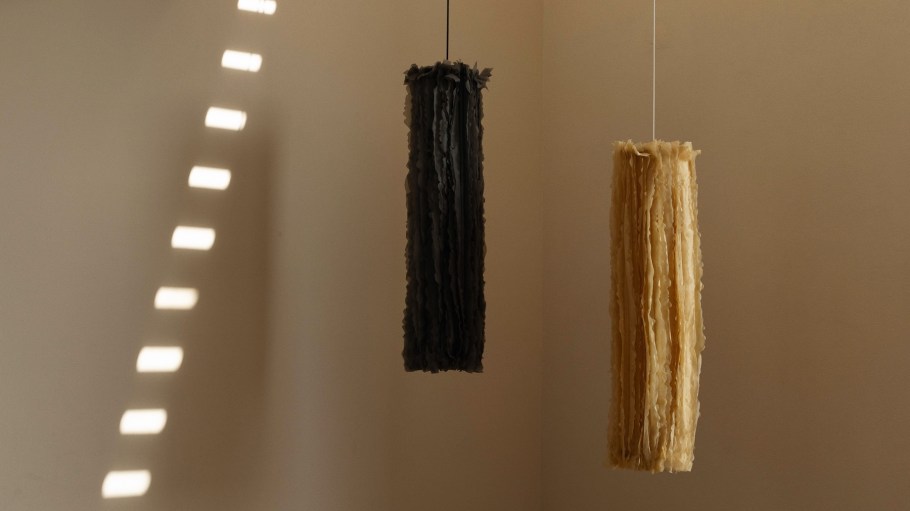
What would a lamp look like if it was alive? Are bacteria bright? Do light sources need space to take shape? New-generation biomaterials firm Polybion and Mexico-based design studio Natural Urbano had the same questions.
Polybion partnered with the Léon, Guanajuato-based brand, known for contemporary furniture and lighting, on the project, where “design and biology converge.” Following a year of joint development, the resulting creation is Lapso Celium: a sculptural and translucent lamp handmade from five sheets of cultivated bacterial cellulose.
Related Stories

“From the beginning, we wanted it to feel like a living piece,” said Sebastián Beltrán, founder and director of Natural Urbano. “The design grew from what the material allowed and what it is. It evokes a breathing skin, something evolving—a sculptural light that is more than a lamp, inviting you to pause and notice.”
The lamp is available in two shades; “natural” is a honey-toned hue, reflective of the material’s origin, while “humo” is a dyed-darker variation. Both versions are irreplicable, regardless. Given the way bacteria grow, they form cellulose sheets with unique patterns—not unlike snowflakes or fingerprints. Because Celium is cultivated and finished individually, natural variations in texture and translucency make every piece unique.
“By approaching Celium as a living material with its own behavior and constraints, Natural Urbano allowed the design to evolve through the material—not in spite of it,” reads the collaborators’ design statement. “The result is a reminder that design innovation often comes from listening, adapting and co-creating with matter itself.”
To create Celium, Polybion feeds the bacteria a steady diet of agro-industrial fruit waste. It converts the sugar contents into a cellulose structure as a metabolic by-product. Once this structure is formed, the 2023 Fashion for Good Innovation Program innovator said, its cell-based membrane undergoes a sustainable stabilization process. In turn, Celium develops attractive performance properties, like strength and breathability. The cultivated cellulose promises scalability with minimal infrastructure, leveraging existing fermentation technology to produce a versatile, vegan and organic textile.
Lapso represents the biomaterial’s first application to lighting design.
“We set out to create a presence that changes with light and context. With Celium, we worked with a material that responds to its environment,” said Lorena Márquez, co-founder and director of Natural Urbano. “Lapso holds a pause when off and becomes atmosphere when on—a functional object with sculptural intent.”
Following the operational success in March 2022 of Polybion’s solar-powered bacterial cellulose manufacturing facility in Central Mexico, the material science company’s leather alternative has been globally available since May 2024. The industrial-scale production plant in Irapuato, Guanajuato, is near the region’s fruit-packing industry, which provides Polybion with the aforementioned agro-industrial fruit waste used as a feedstock to make Celium.
Lapso was unveiled at the Biofab Fair by Biofabricate during the London Design Week, held Sept. 16–17. As of Sept. 23, the one-of-a-kind lamps are shoppable—complete with a certificate of authenticity—online through Natural Urbano’s website, with a lead time of two months for production, plus transit.
“It’s one lamp when it’s off,” per Natural Urbano, “and another when it’s on.”