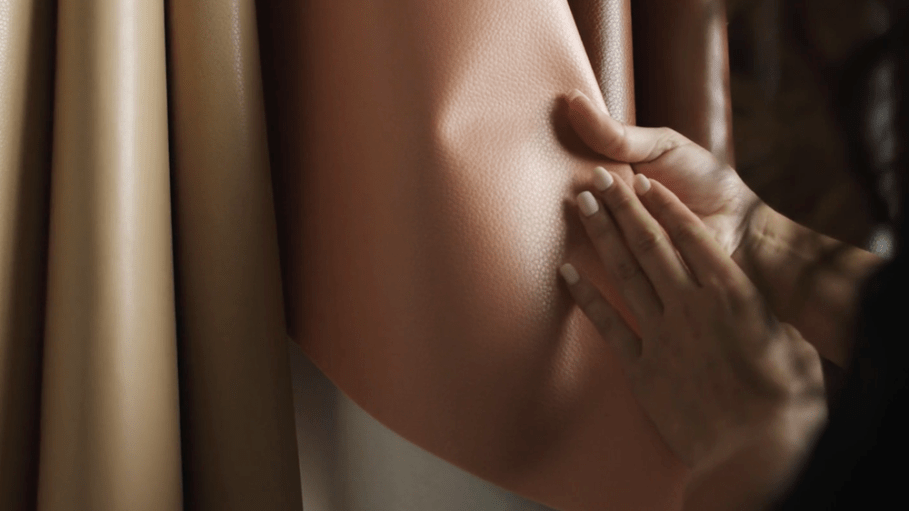
NFW, which once proudly touted its Mirum material as the only bio-based cowhide alternative that doesn’t contain a lick of animal matter or petrochemicals, generating fewer greenhouse gases while allowing it to be fully circular, is closing up shop.
The Peoria, Illinois-based innovator, also known as Natural Fiber Welding, has blazed a white-hot trail since it reared its head in 2015. This was in no small part due to its voluble founding CEO, the chemist and anti-plastics crusader Luke Haverhals, who wasted no opportunity to rail against the “nasty synthetics” that have permeated the planet and are disrupting biological systems—ours included.
Related Stories
2020, in particular, was a banner year for NFW, which attracted hefty investments from the likes of Allbirds and Ralph Lauren. What was meant to be scaling relationships with the two prominent brands, however, resulted in a single shoe design and a high-performance cotton polo, respectively. Allbirds and Ralph Lauren did not return emails requesting comment.
In a statement provided to the Peoria Journal Star—requests for comment to multiple individuals, including Haverhals, went unanswered—Steve Zika, the current CEO, said that NFW’s board of directors had voted to cease operations earlier this month.
“While we continue to explore all options, the board has made the difficult decision to begin the orderly wind down of the company’s operations,” he said. “This is not the outcome we want, but it is the most responsible path for our stakeholders at present.”
The news has been described by observers as distressing but not surprising. There were, after all, only so many times that the 2024 Earthshot Prize finalist could frame its layoffs—of which there were four waves in the span of two years—as cutting away the organizational fat. Haverhals himself resigned in October 2024 for what NFW said were personal reasons, though he remained on the board of directors.
In 2022, the company had a workforce of 300 employees that managed not only the production of Mirum but also materials such as Clarus, Pliant and Tumera, all based on the same concept of “plants, plants and more plants” that used ingredients such as natural rubber, coconut husks, rice hulls, vegetable oil, cotton, minerals and cork powder to mimic—and, ideally, supplant—incumbent leathers, synthetic foams and wicking fabrics.
“I think the writing may have been on the wall for some time,” said Will Verona, founder and designer of Purified, a footwear label that employs plant-based, next-generation innovations like NFW’s. “From my perspective, I think as they scaled, they perhaps overpromised in certain aspects; the roll-to-roll capacity of Mirum that was seen as a game-changer, never truly worked as hoped. That being said, from what I know, their outsole material, Pliant, has been growing in sales, and I will be surprised if this will be entirely discontinued.”
Verona, whose shoes were worn by no less than Prince William at the Earthshot Prize Awards in Cape Town, South Africa, in 2024, only heard about the closing when the news broke. While it’s obviously sad, he said, to see one of his key partners wind down, Purified has been trialing a number of new material solutions and processes. He thinks that bringing “100 percent natural” shoes to market is not only still possible but that opportunities for them are growing.
“Someone at NFW once said to me, ‘whatever happens, we will be on the right side of history,’ and I think it’s exactly that,” he said. “NFW broke ground as being the first true bio-solution to scale. I think this acted as a market signal that supported the growth of the entire biomaterials space, and there are a number of new solutions growing as a result. My hope is that this news does not prevent other solutions from scaling at a critical time. I do believe, for these biomaterial companies, it’s a case of growing in the right way, perhaps choosing the slower path with reduced risk.”
Larger forces are also at play with NFW’s closure, said Katrin Ley, managing director of Fashion for Good, an Amsterdam-based nonprofit that champions sustainable material innovation. Scaling next-gen materials, she said, requires patient capital, resilient supply chains, long-term commitments and collective rallying. Lose any of these and even the most promising solutions risk stalling.
“What we’re seeing with the closure of NFW’s facilities in Peoria is not just the story of one innovator, but a signal of the broader friction between breakthrough technologies and the pace at which the industry is able to integrate them,” Ley said. “These are not failures of vision, but reminders of the systemic barriers that still stand in the way of building a truly sustainable fashion value chain. Breakthrough tech means nothing without breakthrough systems to scale it.”
NFW’s collapse echoes that of another close-to-mature innovator, the once equally vaunted Renewcell, which declared bankruptcy in early 2024 despite being the only advanced textile-to-textile recycler to successfully make the leap from pilot to commercial scale. The industry wrung its hands over the Swedish firm’s demise, with plenty of ink spilled over sentiments like “how could we let this happen?” and “who is to blame?” Last June, Altor, a private equity firm based in Stockholm, snapped up Renewcell’s assets and rechristened the company Circulose after its dissolving pulp product. For now, the Renewcell 1 plant in Sundsvall, Sweden, continues to lie dormant.
Cashflow problems are a familiar tale of woe in the space. NFW alluded to difficulties bridging a funding gap last May, though it would say in December that it had NFW successfully closed an investment round that would stabilize operations and lay the groundwork for future growth “even amidst a challenging macroeconomic environment.” San Francisco’s Bolt Threads, which had appeared to had won over the likes of Adidas, Lululemon, Stella McCartney and the luxury conglomerate Kering with its mycelium leather, Mylo, likewise struggled to raise money, resulting in the material’s indefinite production pause in 2023 in favor of a surer bet: B-silk, a bioengineered yeast-derived peptide meant to replace silicone elastomers in beauty and personal care products.
In Finland, a financial wringer meant that Spinnova had to nix the plant it was building with Brazilian pulp manufacturer Suzano, though it has since bought out its former partner’s stake. In France, biotech firm Carbios postponed the construction of what it bill as world’s first industrial-scale enzymatic PET recycling plant, which would process waste like polyester, pending additional financing. Both rollbacks took place in 2024, when fears of a “sustainability retreat” in the wake of further geo-economic agitation, both in the United States and abroad, hadn’t fully coalesced.
“While NFW’s material is outside the scope of Canopy’s work with man-made cellulosic fibers, their journey echoes a pattern we’ve seen time and again with innovators in the MMCF space,” said Nicole Rycroft, founder and executive director of the Canadian forestry nonprofit. “The challenge isn’t just developing a groundbreaking material; it’s navigating an entrenched system where every player is waiting for someone else to move first. But when risk is shared across the value chain, momentum builds.”
It takes a “fashion village,” Rycroft said, to get a next-gen solution to succeed in a system dominated by legacy infrastructure. Doing so also requires clear C-suite mandates that prioritize the procurement of sustainable materials—beyond R&D and into commercialization—combined with long-term investment and smart government policy.
Verona, for one, said that he really enjoyed working with NFW’s team, and that he hopes to be able to do so again someday. But he also knows from personal experience that businesses need to assess the needs of the market more holistically if they desire a bigger impact.
“The barriers that made it so hard to launch Purified—time and upfront cost and lack of material knowledge—still exist and make it a large risk for new brands to enter the space,” he said. “Sustainable brands are already on the back foot from launch and this is something we are looking to address in the near future.”