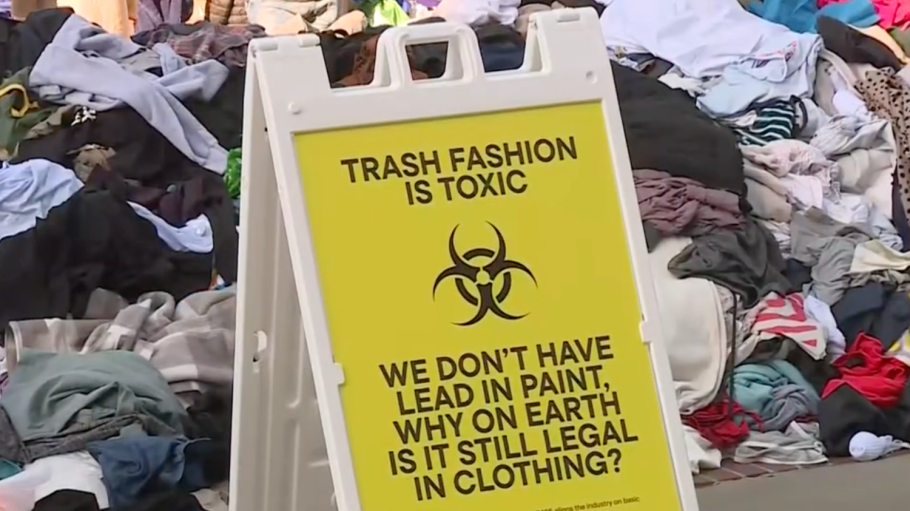
Global apparel industry think tank New Standard Institute threw its weight—specifically, 4,500 pounds—behind the push to pass AB405, The Fashion Environmental Accountability Act (The Fashion Act) in California.
The organization, in partnership with textile collection company USAgain, installed 4,500 pounds of discarded clothing outside the California state capitol building in Sacramento on Thursday, to illustrate one minute’s worth of textile waste in the state.
The Fashion Act bill was first introduced in the California state legislature last February by Assembly Member Dawn Addis, with the goal of addressing the fashion industry’s climate and chemical footprint. The policy puts responsibility on apparel and footwear companies doing business in California with a global revenue of more than $1 billion to address their emissions and eliminate toxic chemicals in clothing.
Related Stories
The bill puts the impetus on the fashion companies to pay for this work rather than shifting costs to the state, and analysis of the proposal found that substantial decarbonization in apparel would translate to only a few cents on a cotton t-shirt. According to bill backers, AB405 could lead to emission reductions nearing 1 gigaton, roughly the equivalent of taking 200 million gas-powered cars off the road for a year.
According to the New Standard Institute, the apparel and footwear industry contributes an estimated 4-8.6 percent of global greenhouse gas emissions, on par with the aviation sector. If left unchecked, the industry could consume 25 percent of the global carbon budget by 2050.
The efforts to pass AB405 have focused on the impact of fast fashion, in particular, which is cheaply made and designed to only last for a few wears due to quality and seasonality. The New Standard Institute said this disposable clothing has been found to contain hazardous substances such as lead, formaldehyde and phthalates, which have been linked to serious health issues and contamination of waterways.
“Disposable clothing is designed to be worn a few times and then thrown away, creating toxic waste that pollutes our environment,” Addis said when introducing the bill in February. “Additionally, chemicals used to create this fashion can cause real health issues for the workers who make them.”
California passed the Responsible Textile Recovery Act, the nation’s first extended producer responsibility bill specific to textiles, in 2024. The legislation stipulates that apparel producers in the state must have established a producer responsibility organization to create and fund a framework for the management of textile waste by 2026. This waste management protocol encourages recovery through reuse, repair and recycling rather than disposal of textiles.
Along with bipartisan support in the California legislature, brands such as Patagonia, Reformation, Eileen Fisher, Everlane, Rothy’s, Cotopaxi and others have endorsed the passage of AB405, according to the New Standard Institute. The group said environmental and public health groups such as the Sierra Club California, the Environmental Working Group and the Natural Resources Defense Council also support passage of The Fashion Act.