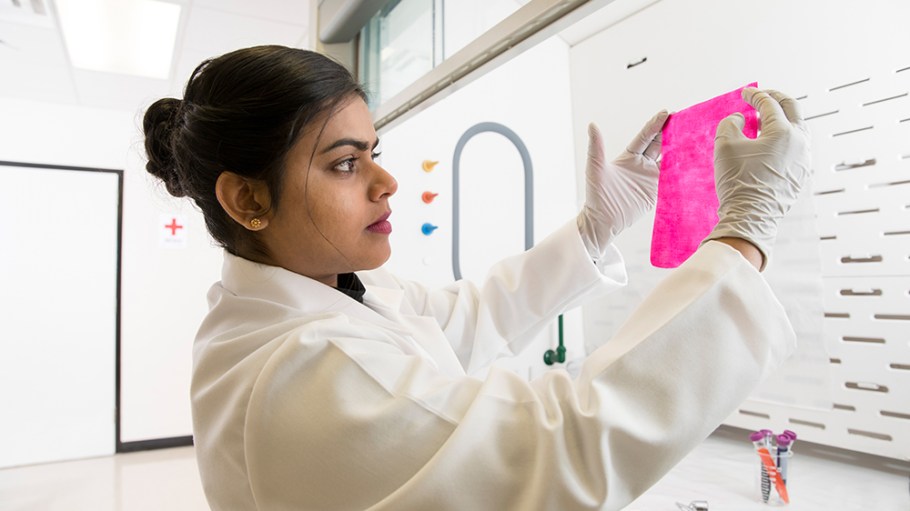
Researchers from the University of Georgia are exploring a new means of textile dyeing, one that not only “drastically reduces” the amount of water needed but also curtails toxic discharge.
Developed by Anuradhi Liyanapathiranage, a doctoral student from the College of Family and Consumer Sciences’ department of textiles, merchandising and interiors, along with faculty members Sergiy Minko and Suraj Sharma, the method involves the use of nanometer-scale cellulose fibers—a.k.a. nanocellulose—as a carrier for the dye rather than the fabric itself.
The key to the process, they said, is the conversion of cellulose, a polymer readily found in the cell walls of plants, into a Jello-like hydrogel through a process known as homogenization.
Related Stories
Because nanocellulose fibers have more surface area with high reactivity than their cotton counterparts, the researchers reasoned they would allow for more efficient attachment of dye molecules. Their hypothesis, as it turned out, proved correct. Using this technique, they were able to reduce the water needed to dye 1 kilogram of cotton from 19 liters to just 1.9 liters—a 90 percent reduction. In addition, they managed to slash dye discharge by 6o percent.
Liyanapathiranage expressed excitement about the research’s potential impact on the textile industry. The next step? Scaling up the technology to make it applicable to the industrial production process.
“With the emerging trends on environmental pollution and population growth, sustainable technologies are the key to accomplishing viable socioeconomic development,” she said in a statement. “I’m confident that our research projects will have a direct contribution to sustainable development, and that we will able to make a remarkable impact on the world with our innovations and discoveries.”
Textile mills, which generate one-fifth of the world’s industrial water pollution, employ more than 20,000 chemical, including heavy metals and other hormone-disrupting substances, according to the Natural Resources Defense Council. Textile production is also notoriously thirsty, requiring roughly 24.6 trillion gallons of water annually, per the Ellen MacArthur Foundation, and contributing to problems in water-scarce regions.