MycoWorks is shifting focus. The biomaterials technology company will stop growing mycelium and begin processing it instead, chief executive officer Matt Scullin shared on social media yesterday.
The news comes less than six months after Reishi’s first large-scale integration into the luxury furniture sector, as achieved with Erwan Bouroullec, and eight months after Fine Mycelium became directly consumer shoppable with the launch of the company’s e-commerce website. At present, an interstitial pop-up advertises Reishi as 25 percent off; purchasing six sheets or more unlocks 50 percent off.
Related Stories
In an open letter addressed to the California company’s partners (perhaps French family-run firm Ligne Rose) and stakeholders—and the mycelium materials industry itself—Scullin posted the following “tough, but clear choice” to his LinkedIn account on Oct. 16.
But before that, some context:
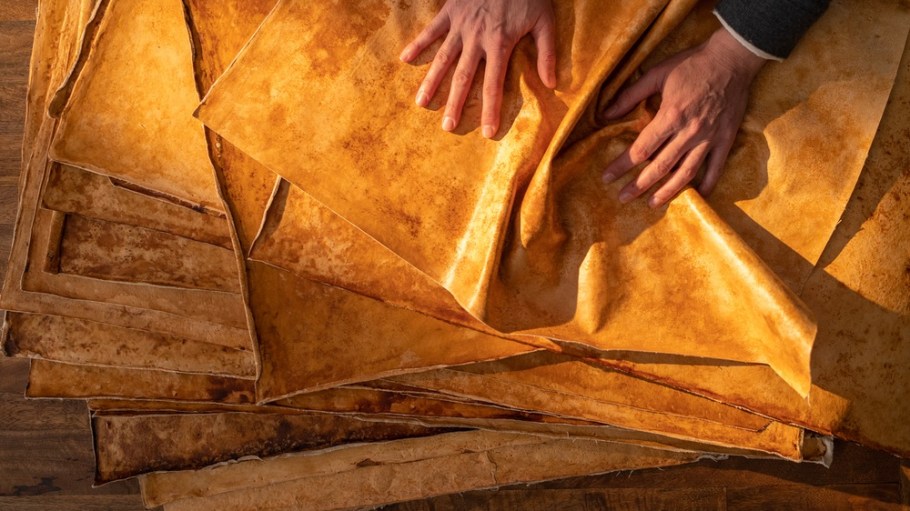
The company’s hero product, Reishi, is a mycelium-based alternative to traditional leather. The grain waste material differs from other “mushroom leathers” on the market in that it is grown as a biomaterial sheet like a hide, and does not depend on polymer films, fillers or backings to lend strength and durability.
In February, its San Francisco-based innovation center and Spanish tannery in Igualada—a region known for its traditional leather tanning technique—collaborated to create Rei-Tanning technology. That technology’s formula—a “nourishing process,” per MycoWorks—enhances the Reishi sheets’ performance consistency; something of necessity when working with mycelium. And, as Reishi was reportedly available at scale, specific re-tanning guidelines were available under license for use by clients’ facilities. The process was promoted in particular as helping “unlock” new applications within the luxury sector, which has struggled to incorporate biomaterials in the past due to such specific standards.
On Sept. 11, MycoWorks announced plans to supply its next-generation Reishi—something of a pun, given the last advancement to its proprietary Fine Mycelium process enabled the creation of Reishi grown and composed entirely of pure mycelium—directly to tanneries through a partnership model.
Now, the letter:
“For the eight years since I joined as CEO, MycoWorks has been laser-focused on a single product: Reishi, a leather grown with our proprietary Fine Mycelium technology and then dyed, strengthened, and ‘tanned’ with our proprietary Rei-Tan technology. Building both technologies simultaneously has been expensive, difficult, and necessary.
The result has been a product that is beloved. Our Rei-Tan process elevates mycelium to a level that has won the hearts of some of the world’s most discerning designers. What we have created is visually beautiful, has a hand feel arguably superior to any leather, and has a natural quality that forms an instant emotional connection. But mycelium—whether produced by MycoWorks or another startup—is not a drop-in replacement for cow or calf hides in production and has proven to have shortcomings as a leather alternative. It is not cow leather: it has a lower tear strength, a lower tensile strength and poor ‘ply adhesion’ or z-direction, strength. The question to both us and the brands and designers that use leather has become this: how can mycelium—any mycelium—get to an improved level of physical performance without sacrificing these unique properties that make everyone who touches it want to use it?
The answer is MycoWorks most recent innovation: a new version of our Rei-Tan technology that brings the tensile strength—a good proxy for the overall mechanical properties and durability of mycelium—from approximately 4 MPa to 18 MPa, or an improvement in strength of 4 to 5 times (and even an improvement in 2x over our versions of mycelium with an embedded fabric). In so doing, Rei-Tan elevates mycelium to a level that makes it not only emotionally and qualitatively great but also performant enough to be a drop-in for leather. This is a patented innovation that no other company in the mycelium space has managed to make.
Most critical to this innovation is that Rei-Tan can be employed on any mycelium, not just the Fine Mycelium made by MycoWorks in South Carolina. Rei-Tan can be seamlessly applied to mycelium being grown via other processes around the world at a much more favorable price per square foot than can be achieved in South Carolina. Additionally, the MycoWorks technology can be applied not only to the network of a dozen leather tanneries that we currently collaborate with but also to any leather tannery in the world, improving the quality and speed to market of all mycelium leather.
For this reason, MycoWorks is making a major (and obvious) decision to shift its business model from growing mycelium to sourcing and tanning mycelium. This logical transition comes with the tough decision to close our plant in South Carolina. This plant was ambitious and pioneering; the team in South Carolina solved infections, yield loss and the operational complexity of a brand-new biomanufacturing process. The result, however, proved to be too expensive for the world we currently live in. Whereas capital was abundant and cheap for innovators like MycoWorks just a couple of years ago, times have changed; amidst the backdrop of a slew of late-stage bio, food, ag, and alternative leather companies going under and seven straight months of decline in the United States ISM Manufacturing PMI, our factory in South Carolina now has a cost of capital that is too high to warrant, especially when cheaper sources of mycelium exist that can also be elevated with our Rei-Tan technology.
The field of mycelium materials is maturing; mycelium leather is widely recognized among fashion, luxury, and design brands, many of which have now experimented with it. Yet adoption is still low due to scale and cost. The future of this industry lies in collaboration, where complementary technologies and expertise come together to unlock commercial potential. The world needs many inexpensive sources of mycelium, such as those grown in Asia and Europe. Just as cowhide leather exploded in usage only after the advent of chrome-tanning in the 1980s because of the performance improvement that technology gave it, mycelium has needed this sort of breakthrough that Rei-Tan provides to turn it from an interesting raw material into a great product.
As part of this evolution, MycoWorks will now enter a restructuring period that includes shifting our production from South Carolina to utilizing other sources of mycelium. These changes will affect valued members of our team who have been instrumental in bringing us to this point, and we are deeply grateful to our employees, brand partners, and investors who have gotten us here.
This moment represents a reaffirmation of MycoWorks’ long-term commitment to advancing the new era of material design, and with these necessary shifts in our business model we will continue to lead the mycelium leather industry into an age of widespread adoption.”