Material World is a weekly roundup of innovations and ideas within the materials sector, covering what’s changing in how fashion is made, scaled or engineered from emerging biomaterials and alternative leathers to sustainable substitutes and future-proof fibers.
Uncaged Innovations

Uncaged Innovations unveiled the first wave of sustainable luxury launches from five brands within The Collective, featuring the materials innovation company’s flagship material, Elevate, as the foundation.
Related Stories
“Each piece represents a brand choosing to challenge convention and imagine a better future for luxury,” said Stephanie Downs, CEO of Uncaged Innovations. “These designers didn’t only adopt a new material, but they embraced a new way of thinking about the responsibility of this industry—Elevate was created to make that possible.”
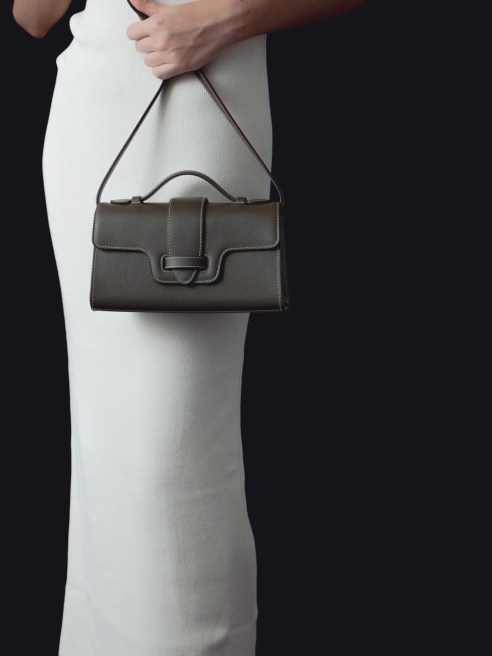
German label Melina Bucher released an East-West style handbag and a sculptural handbag, alongside existing styles that incorporate Elevate elements. The UK-based Watch and Strap introduced its Elevate watch straps. At the same time, New York designer and brand Kaila Katherine released “the Soho” wallet in the shade cherry. Canadian brand Via Gallo will launch the Avellino Collection, including a convertible clutch called the Andretta and a geometric shoulder bag dubbed the Bisaccia. In contrast, Spanish label Loué Studio launched the Mano Pochette bag.
“When looking for a new material, we focus on more than sustainability claims; we want to understand how it’s made and how its construction influences performance. That’s what stood out to me with Elevate—it’s proof that we no longer need to rely on outdated materials to achieve a high-end result,” said Elena Lisman, founder of Loué Studios. “Innovation like this allows us to move on from the cruelty and environmental cost of animal agriculture. It’s the kind of progress I want to be part of.”
Additional members of The Collective—including Stow, Marco Del Maso, Ittara and Humo—will drop their Elevate-made creations in Spring 2026.
BioFluff x JNBY Group
The Asian brand Just Naturally Be Yourself (JNBY) Group and BioFluff, the Paris- and New York-based biomaterials company, announced a strategic collaboration. The first stage of this partnership involves BioFluff adopting Savian within the group’s “Croquis” Spring 2026 collection.
Made from 100 percent renewable plant fibers and agricultural waste, Savian turns nettle, flax and hemp into fur, shearling and fleece-like fabrics using proprietary technologies. The LVMH Innovation Award nominee said the process “significantly” reduces CO2 emissions by 40-90 percent. Made in Italy, the vegan collection is free of GMOs and toxic chemicals. It uses fibers sourced and crafted in the EU. Savian is a nod to the brand’s inspiration, “rooted in the soft touch of nature’s fur.”
“This launch with Croquis demonstrates BioFluff’s move from innovation to scale. We have advanced beyond pilots and now collaborate with sustainability teams, buyers and designers on commercial releases,” said Luke Henning, interim CEO of BioFluff. “The key is our seamless integration: we disrupt animal fur and plastic production—not brand operations or business models. This validates market readiness, accelerates our pipeline, and establishes the foundation for further penetration into the Asian market and beyond.”
Inspired by the “structural elegance of a tortoiseshell pattern,” the limited-edition eco-fur vest is made entirely from Savian by BioFluff, in a grey/black hue, designed for both layering and standalone wear. The product drop marks the start of a broader strategic collaboration between JNBY Group and BioFluff, as facilitated by China- and UK-based textile specialists Idole, with plans to integrate the material into more collections in “seasons to come.”
Tintte
Argentina-based biotechnology startup Tintte has teamed with London-based multidisciplinary Laura Benetton on a unique material intervention—one powered by bacteria-derived pigments—as debuted at ISPO Munich.
“Both biotechnology and artistic creation experiment, iterate and engage with their surroundings to imagine what does not yet exist,” Benetton said. “At that point of convergence, color stops being a petrochemical byproduct and becomes a living language—a way to produce beauty without breaking the planet’s balance.”
As Tintte develops bacteria-based color pigments to mitigate excessive water use, the company (pronounced tin-tuh) uses pigment production and dyeing processes that are completely chemical-free, in addition to reducing water and energy consumption by 50 percent.
Tintte’s natural pigments are derived from bacteria (aka microorganisms), which generate color when subjected to a lab-controlled fermentation process. The biogenic pigment producer spent five years cultivating its “biobank” of over 130 microorganism strains, engineered through synthetic biology and controlled fermentation, to develop a diverse color palette for both natural and synthetic fibers.
For ISPO Munich, this powder, produced by a specific bacterial strain, was transformed into liquid paint. This approach, Tintte said, demonstrates how contemporary artists and scientists can collaborate.
“By transforming bacterial pigments into paint, I wanted to show how life itself can become a creative partner,” Benetton said. “This project is a reminder that when art and science meet, new materials, new questions, and new possibilities emerge.”
Spinnova
Finnish sustainable textile company Spinnova has signed a non-binding letter of intent (LOI) with Portuguese spinning mill (and key partner) Tearfil to “secure access” to Spinnova fiber volumes.
“Our brands and industrial partner’s support and expression of interest in future fiber volumes is valuable, as engaging all stakeholders across the value chain is essential,” said Pedro Brito, Spinnova’s senior commercial manager. “It’s also a key step for our future ambitions building partnerships with whom we can continue the important work towards scaling our fiber production.”
The LOI outlines a key step in Spinnova’s 2025-26 priorities—creating an ecosystem (see: consortium) to “enable the availability” of its branded cellulosic fiber for the textile materials market, the Scandinavian innovator said. Tearfil, a key partner in increasing the industrial adoption of Spinnova fiber across the global textile value chain, will introduce yarn blends incorporating Spinnova fiber to European textile players and the market.
“The Spinnova fiber is a significant advancement in sustainable materials, and we are proud to be at the forefront of its industrial adoption,” Maria de Belém Machado, CEO at Tearfil, said. “This collaboration not only enhances our product offerings but also aligns with our vision of promoting environmental responsibility and innovation.”