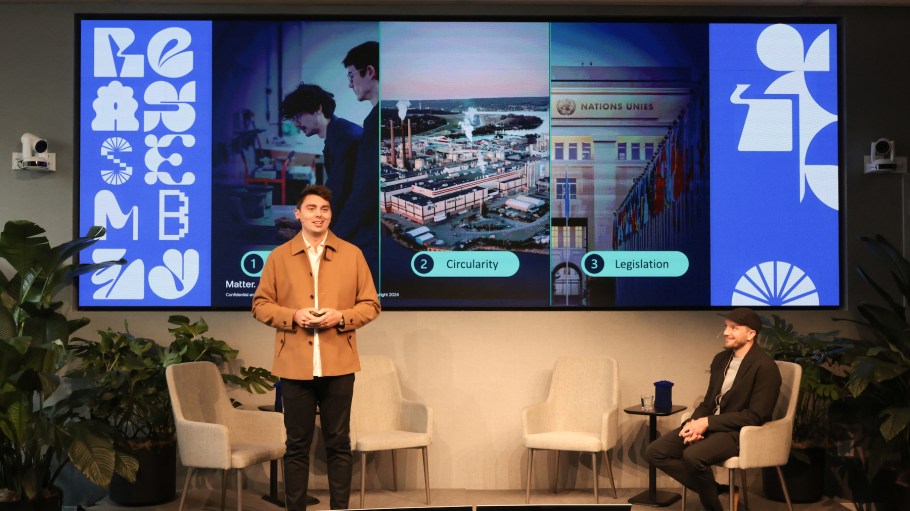
A project set to cut 120,000 metric tons of microfiber pollution while saving millions of kilowatt-hours of electricity a year at textile manufacturing hubs made its New York Climate Week debut.
Backed by climate-focused venture capital firm Regeneration.VC, this project hopes to get to the root of the plastics problem.
Paradise Textiles, the material science arm of global end-to-end textile company Alpine Group, has teamed with microplastics technology innovator Matter on the project. The firm will bring the Bristol-based B Corp’s technology, which stops textile production’s microfibers from entering waterways, to market.
Related Stories
This technology—which collaborators are calling the world’s first microfiber filter specifically designed for textile manufacturers—was unveiled during the Leonardo DiCaprio-backed climate-tech fund’s annual meeting in New York last week.
Dubbed Regen for Textile Production, this technology is set to be implemented at Alpine’s new low-impact fabric mill in Egypt. Paradise is collaborating on research and application of Matter’s technology, which is retrofittable as to reduce emissions as well as costs.
Once operational—the first installation is planned for the last quarter of 2025—it will serve as a “showcase” for manufacturers and brands alike to adopt a filtration system ahead of anticipated regulation. Per the partners, the solution could reduce microfiber pollution “across all 150,000 global textile factories” and essentially zero out the volume of microfiber waste estimated to be emitted annually.
Powered by Matters’ patented self-cleaning filtration technology, Regen is a low-energy, low-cost microfiber capture solution that offers effective wastewater filtration sans the carbon impact. Therefore, Regen could reduce carbon emissions by over 2,000 metric tons annually at each manufacturing hub, the duo said, as well as cut chemical use, lower operating costs and extend the life of water reuse systems. Furthermore, Regen allegedly helps a single manufacturing site to save up to 3 million kilowatt-hours annually and capture over 90 metric tons of microfibers, reducing over 2,000 metric tons of carbon emissions.
“We’re delighted to collaborate with Paradise Textiles on this groundbreaking project; it will show the fashion industry that a viable solution to this colossal problem of microplastic is within reach,” Adam Root, founder and CEO of Matter, said. “As this technology scales, there will be no reason and no excuse for letting microfiber pollution to continue.”
This collaboration has been “instrumental” in advancing Matter’s industrial program for textile manufacturing, the British climate-concerned company said. Leveraging its know-how in textiles and fiber pollution mitigation, Paradise “collaborated closely” with Matter on exploring how to scale and adapt Regen for the textile manufacturing sector. In fact, the Nanollose associate “recognized” the power of Regen and “proactively approached” the BSH partner to talk shop.
“At Paradise, we’re committed to collaborating with industry innovators and brands to make a material difference for the future of the fashion and textile industry,” Lewis Shuler, head of innovation at Paradise Textiles, said. “Matter’s microfiber filter presents us with an effective way to reduce the environmental impact of the textile and apparel manufacturing process whilst also reducing operational costs, which is a real game-changer for the industry.”
Over the past two and a half years, Paradise provided findings from those explorations to Matter, helping shape the startup’s Microfiber Assessment Program (MAP) to establish a service model and maximize fiber capture across Alpine Group’s 15 worldwide facilities.
“Having co-pioneered the MAP, which is already benefitting the rest of the industry, it’s an exciting next step to work on this project together,” Root said. “To cap microfiber pollution from textile production and drive further, much needed change toward a circular solution.”