Some of fashion’s biggest names have answered Textile Exchange and the Leather Working Group’s (LWG) rallying cry for deforestation-free leather.
Early adopters that have committed to sourcing cowhide from deforestation-free supply chains by 2030, if not earlier, include Adidas, American Eagle Outfitters, AllSaints, Michael Kors owner Capri Holdings, H&M Group, Gucci parent Kering, Mango, Marks & Spencer, Puma, Reformation, Roots and Kate Spade operator Tapestry.
Anne Gillespie, director of impact acceleration at Textile Exchange, described the call to action as a “powerful opportunity,” one that can align the efforts of brands and other leather stakeholders to drive the “industry transformation” necessary to protect forest ecosystems and safeguard human rights.
Related Stories
“The economic burden and risk should be shared across the supply chain,” she said. “This means that farmers must be supported to preserve their forests and rewarded for the environmental services they deliver. For these reasons, brand investment in deforestation [and] conversion-free cattle farms is a core component of the Deforestation-Free Call to Action for Leather roadmap.”
Besides reporting on their progress through the Textile Exchange Materials Benchmark, signatories will be required to establish leather sourcing requirements, set and meet specific targets, make investments, implement traceability and protect the rights of indigenous people and local communities.
Textile Exchange and the LWG announced the so-called Deforestation-Free Call to Action for Leather at the latter’s 2022 conference in Colorado Springs in November. Created in consultation with the World Wildlife Fund (WWF), the National Wildlife Federation and the Accountability Framework Initiative, the agreement aims to leverage the size and influence of leather-peddling brands to “catalyze change” in the leather industry, increase the availability of verified deforestation and conversion-free leather suppliers, provide better visibility into often long and convoluted supply chains, and improve transparency by reporting on the collective progress being made.
“Leather is a key material in many of our brands’ iconic styles and designs—it’s undeniably an important part of our business,” said Tapestry in a statement. Last year, the conglomerate’s philanthropic arm endowed the WWF with a $3 million grant to develop a way to improve the traceability of Brazil’s leather value chain.
“Because of the importance of leather to Coach, Kate Spade and Stuart Weitzman, Tapestry is committed to supporting verified deforestation and conversion-free leather supply chains,” Tapestry said. “The Textile Exchange’s Call to Action for Leather initiative advances the critical industry transformation that results in traceable deforestation and conversion-free hides becoming the market standard for the leather industry. Furthermore, this commitment aligns with work already underway at Tapestry, with like-minded brands and leading nonprofits, to support initiatives that minimize leather’s impact on natural resources.”
The timing of the pledge couldn’t be more apt. In April, the European Union passed a law banning imports of leather and other commodities if they have demonstrable links to deforestation. It requires companies to provide “verifiable” information that proves that their goods were not sourced on land deforested after 2020. They will also have to show that their products respect the rights of affected indigenous people. Failure to comply can result in “proportionate and dissuasive” financial penalties of up to 4 percent of their turnover in a member state.
While the cost of cowhide typically represents less than 1 percent of the value of the animal for ranchers, that doesn’t mean there “isn’t a shared responsibility,” said Fernando Bellese, the WWF’s senior director of beef and leather supply chains.
“We believe it would be naive to think that leather can change the beef sector,” he said. “But we believe that it can be part of the change. It can help in the dialogues. It can help by bringing important companies together to generate alignment.”
With the world’s population expected to increase by nearly 2 billion over the next 30 years, both the amount of beef and leather produced will increase. The “bottom line,” Bellese said, is to produce food, whether beef or soy or palm oil, with less social and environmental impact. That’s the tack the industry should take with leather, as well.
Then there’s the much bigger picture, one that directly affects fashion’s climate ambitions. Deforestation is responsible for roughly 10 percent of global greenhouse gas emissions. And it’s not just leather that poses an issue for the industry. The production of viscose is a contributor to tree loss as well.
“When you talk about deforestation, you are not [just] talking about deforestation, about [the] loss of biodiversity,” he said. “It has also a very important connection with climate change. We have a lot of research that shows that materials or products coming from areas with land use change [associated] with deforestation have emissions that are way higher than than the same materials and products that come from areas that are not involved in land use change.”
In short, brands will “never meet their climate change commitments if they don’t get rid of deforestation in their supply chain,” Bellese added. This won’t be easy—rooting out deforestation isn’t a matter of drafting a policy and telling suppliers that they have to comply. Some of the solutions, he said, aren’t even available yet. But there are pilots in the works to map hot spots and mitigate risks with the help of geolocation and satellite monitoring tools. The WWF is also mulling market incentives to impel farmers to improve their practices. Blocking “bad” suppliers might be beneficial from a reputational perspective, but it doesn’t necessarily lead to improvements.
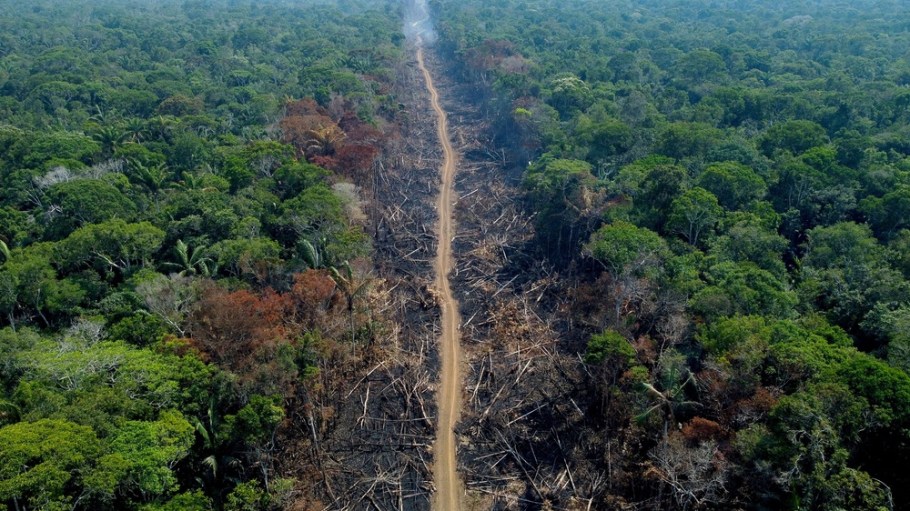
For many retailers, linking leather to deforestation is still a nascent issue. A 2021 study by Stand.earth found that 70 percent of the fashion firms it surveyed did not have any kind of forest degradation policy in place despite deforestation in the Brazilian Amazon reaching a 15-year high. Together with fellow advocacy group Slow Factory, Stand.earth tied more than 100 brands, including Adidas, Coach, H&M and Timberland owner VF Corp., to manufacturers and tanneries with known links to cattle raised on recently deforested Amazon land, even though some of them had divested their leather investments from Brazil after rainforest fires in 2019 prompted widespread outrage.
“Our research shows that, on the whole, the fashion industry continues to drive deforestation,” Greg Higgs, director of research and investigations at Stand.earth and one of the authors of the report, said at the time.
He noted that the LWG’s environmental certification, whose protocols all of the agreement’s signatories employ, is limited because it evaluates tanneries only on their ability to trace the material back to slaughterhouses, not to ranches, where the problem stems.
Even so, Christina Trautmann, head of the LWG, said she is heartened by the enthusiasm for the initiative, which opened for broader participation on Wednesday.
“The latest IPCC assessment report re-iterated the urgent need for a systemwide transformation to secure a net-zero, climate-resilient future—and brands, together with other sectors, play a pivotal role in achieving this,” she said. “The Call to Action provides, not only a milestone for signatories to strive towards, but also practical guidance on how to get there. It has been extremely positive to see the level of engagement of brands wanting to sign onto this voluntary initiative.”
Puma agreed that the world is “facing an environmental crisis.” It has dedicated one of its 10for25 sustainability targets to extenuating biodiversity loss due to the production process.
“Puma aims to end deforestation to protect wildlife habitat and biodiversity and preserve carbon stocks to mitigate climate change for bovine leather,” the sportswear maker said in a statement. “Puma will work in collaboration with the industry, its leather supply chain, Textile Exchange and the Leather Working Group to address the barriers to action, because only if we all join forces and support each other, we will be able to find solutions that will make a difference.”