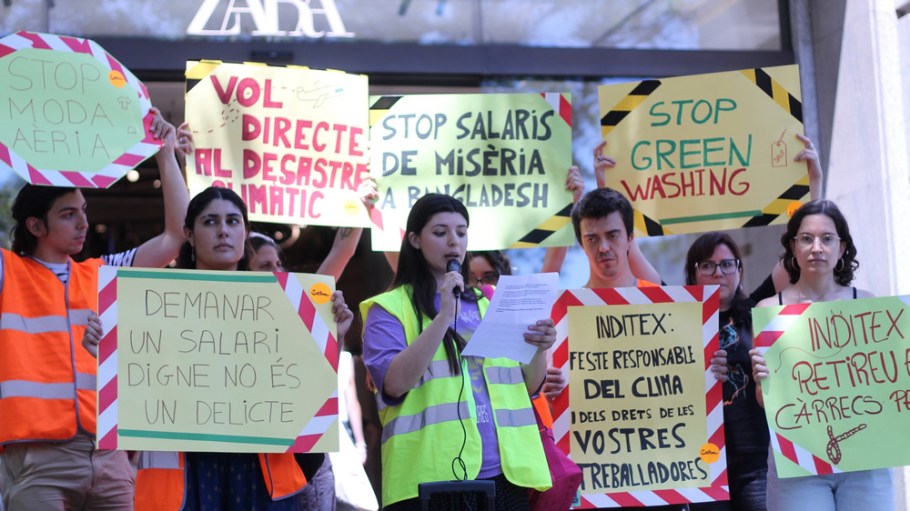
When a slew of labor and environmental campaigners converged outside Inditex’s annual meeting in the Spanish port city of A Coruña last week, it wasn’t to wish the Zara owner a happy 50th anniversary.
Representatives from Campagna Abiti Puliti, the Clean Clothes Campaign, Fair, Fondazione Finanza Etica, Public Eye and Sete—to name a few—were there, instead, to take the fast fashion OG to task for what they said are its “severe” environmental and human rights failures, including a reliance on air freight transportation and its alleged failure to get its suppliers to drop outstanding criminal charges against workers in who protested the insufficiency of Bangladesh’s minimum wage in 2023.
Related Stories
It’s the least that the Spanish conglomerate, which gleaned a record profit of 4.5 billion euros ($5.3 billion) in 2024, can do, they said. And though Inditex has since posted weaker-than-expected earnings in the first fiscal quarter of 2025—the result, it said, of a slower start to its summer sales because of cooler weather, along with overall economic uncertainty—it still managed to eke by with 8.3 billion euros ($9.7 billion), just a a hair short of the 8.4 billion euros ($9.8 billion) forecast by LSEG analysts. Net income also came in at 1.3 billion euros ($1.5 billion) for the quarter, a rounding error less than what was expected.
A spokesperson said that Inditex, which also operates Bershka, Massimo Dutti and Pull&Bear, declined to comment.
David Hachfeld, textiles expert at Public Eye, was among those calling Inditex to pull back on its “airborne fashion.” A report from the Swiss watchdog group said that the retail giant’s transport emissions jumped by 37 percent in the 2023 fiscal year. In 2024, Inditex’s greenhouse gas emissions from transport and distribution rose by another 10 percent, surpassing 2.6 million metric tons of carbon dioxide and making up 20 percent of the group’s total footprint. In contrast, H&M Group keeps air freight under 1 percent of its transport emissions.
“Inditex should publish transparent data on its cargo flights and set clear targets for a logistics model that functions without these climate-damaging practices,” said Hachfeld, urging the company to begin a phase-out that starts with “being honest” and extends into redesigning a logistics system that’s less reliant on flights.
Zipping clothing in the skies also has implications beyond fossil fuel pollution that leads to greater climate precarity, Public Eye said. It indicates that larger orders are being split into multiple smaller ones with truncated delivery times that can increase deadline pressures on workers, increasing the risk of forced overtime or subcontracting to shadier outfits. The practice is a hallmark of the “test and repeat” model that gauges how the first couple of deliveries perform before putting rush orders on popular styles. Unfair contractual conditions that leave no wiggle room for unscheduled delays, say because of last-minute change requests or other hiccups, can also lead to unplanned air transportation, Hachfeld said.
“Above all, Inditex is still uttering the refrain about its well-known climate target of net zero by 2040,” he added. “If the fashion giant does not change its course and start taking measures to protect the climate, air freight volumes at the airport are likely to increase.”
Likewise, Inditex could be doing more to address a pre-Sheikh Hasina crackdown on labor rights that hasn’t completely lifted, said Bogu Gojdź, public outreach coordinator at the Clean Clothes Campaign, the garment industry’s largest consortium of trade unions and labor rights groups. Nearly 3,000 workers in Inditex’s supply chain are still facing prison “simply for demanding livable wages,” she said, calling the threat of arrest on blanket charges a “brutal intimidation” tactic that the company has the leverage to stop.
“Its failure to do so makes it complicit in the repression of workers who make their profits,” Gojdź said.
More protestors took to the streets outside Inditex stores in cities such as Barcelona and Milan to wave picket signs. Social and climate justice are interconnected, said Deborah Lucchetti, president of Fair and spokesperson for Campagna Abiti Puliti.
“Activists and consumers are demanding clarity from the Spanish giant on its risk mitigation policies for truly responsible business conduct,” she said. “The demand for a living wage from the workers who make its clothes and the demand to abandon the reckless use of fossil fuels to transport them are two sides of the same struggle.”
But despite a request by Fondazione Finanza Etica, the Italian member of Shareholders for Change, a group of institutional investors engaged in progressive causes, to read a statement explaining why it voted against the 2024-2025 Consolidated Sustainability Report, this did not happen, the organization said.
In addition, none of the questions sent in writing before the meeting regarding an air-freight phase-out, protection of workers’ rights in Bangladesh and an independent review of Inditex’s business model received any response, said FFE analyst Mauro Meggiolaro.
“This is not how an AGM should function,” Meggiolaro said, using an acronym for annual general meeting. “It shows a lack of respect for concerned shareholders.”