Innovate Illinois has the potential to make the United States the biomanufacturing capital of the world, according to one scientist. The public-private coalition formed to drive the coordinated effort in securing federal funding—including the Bipartisan Infrastructure Bill, the CHIPS and Science Act, and the Inflation Reduction Act—announced its support for two projects seeking federal Economic Development Administration (EDA) Tech Hub Funding in the state.
And one of those projects, iFAB: Illinois Fermentation and Agriculture Biomanufacturing Tech Hub, could have major ramifications for the textile industry.
Related Stories
“Precision fermentation and biomanufacturing can be used for [multiple] different end products. The reason it’s called precision fermentation is that there are a lot of levels to pull, a lot of buttons to push, to change the black box where manufacturing is occurring—to tune the products coming out of the back end,” Beth Alexandra Conerty, associate director of business development for the Integrated Bioprocessing Research Lab (IBRL) at the University of Illinois Urbana-Champaign, told Sourcing Journal.
The hope, Conerty continued, is to use precision fermentation to create desired performance apparel outputs—moisture wicking and odor resistance, for example—to replace the use of PFAS, also known as “forever chemicals,” which are quickly losing public—and legal—favor.
“One option for the levers and the buttons to tune would be to use biology to make those same chemicals, but through biomanufacturing instead,” Conerty said. “So, you’re thinking about more of a plant-sourced nylon or a plant-sourced polymer. And that just the immediate drop-in replacement, but because there’s so much tenability in the black box process, the next step is actually improving the performance of materials and building block chemicals that could be used for higher-performing textiles or fabrics.”
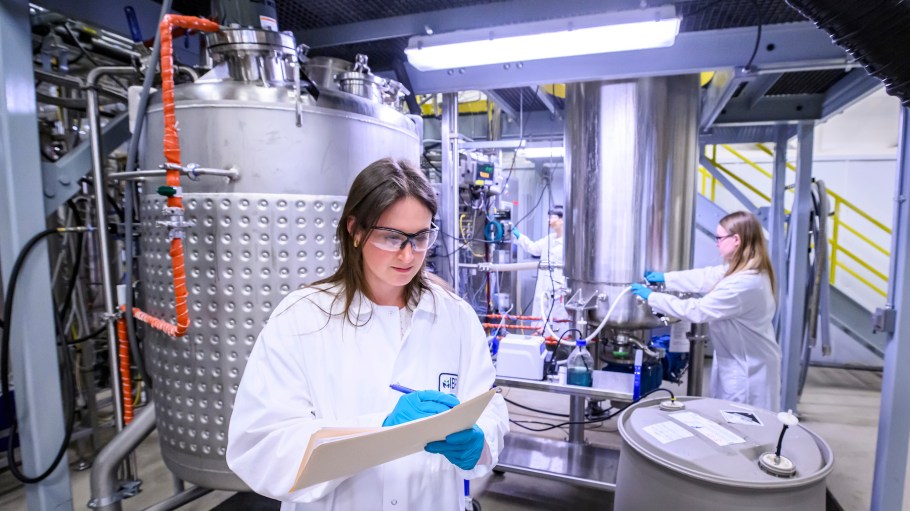
As a leader in biomanufacturing, Illinois is well-suited to grow the sector, iFAB said, through its support of the project, led by the IBRL in partnership with multinational food processing and commodities trading corporation, the Archer Daniels Midland Company; food and industrial products producer, Primient; and organic corn and soybeans producer, Clarkson Grain Company. This visionary proposal seeks to revolutionize synthetic biology and fermentation processing, driving economic growth and fostering innovation.
“Illinois is a top producer for corn and soy, and all of these precision fermentation processes have to be fed with something,” Conerty said, noting that precision fermentation works the same way as making alcohol: yeast needs to be fed some form of carbohydrate—a sugar—to create beer or wine. Most fermentation processes are provided with either corn-based sugar or glycerol, which is often a soy-derived product. Thus, Illinois—Decatur, in particular—is already primed and ready to serve as a feedstock hub for an “over-the-fence solution.”
“The University of Illinois is just 45 minutes down the road from this great infrastructure and in the middle of all this feedstock,” she continued. “There’s some great research and innovation [here] to continue to drive this industry forward.”
Synthetic biology, a burgeoning scientific discipline, focuses on engineering organisms with enhanced capabilities to tackle practical challenges, including pollution remediation and improved resource utilization. Precision fermentation processing, central to synthetic biology, harnesses cutting-edge technology to convert plant-based feedstocks into high-value commodities, including performance materials. The precision fermentation industry is projected to reach $11.8 billion by 2028, according to Innovate Illinois, with the potential to generate one million jobs by 2030, presenting an opportunity for the U.S. to optimize its resources and enhance global competitiveness.
“Innovate Illinois was designed to build a robust coalition that would pool its collective expertise to advance groundbreaking technologies,” Governor JB Pritzker said in a statement. “Illinois is on the cutting edge of bioprocessing and quantum computing. Our continued leadership in these spaces will help address global challenges and drive economic growth.”
If awarded the federal funding, iFAB would be looking at around $500,000 to start and, if designated as a tech hub, then it’s eligible to apply for a more significant EDA grant, which is an award between $50 million and $75 million, with an average award of $65 million. And ultimately, iFAB would accomplish something that Conerty equates to the Green Industrial Revolution.
“It seems unlikely that we’re ever going to compete with other countries for traditional manufacturing processes. Like, those aren’t going to come back to the United States,” she said. “But if we’re looking at the next generation of manufacturing by using new technologies and leveraging biology, nobody has necessarily claimed that yet. This is a great approach to reshoring manufacturing back into the United States.”