As it rolled out new employee uniform designs over the past couple of years, Ikea began to accumulate hundreds of pallets of castoffs bearing the outdated design. Rather than dumping the discarded uniforms in a landfill, the home retail giant looked for a way to give them new life.
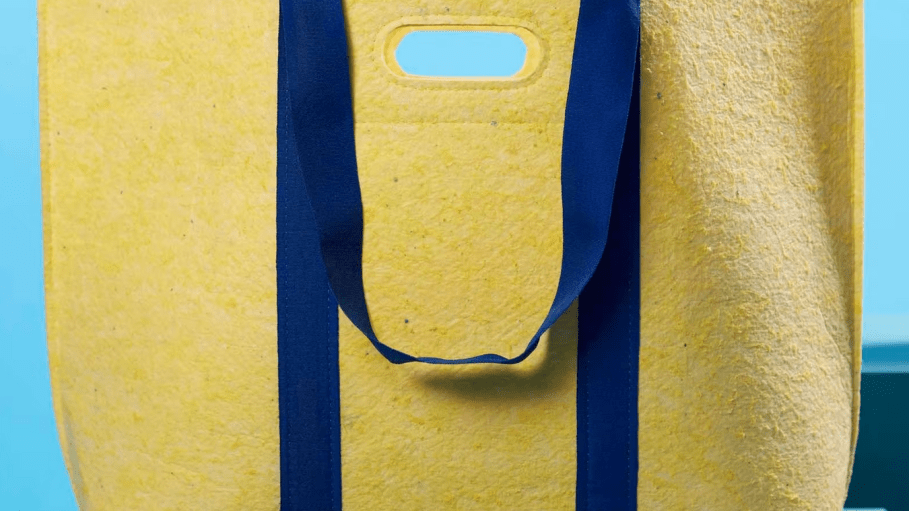
The result of that pursuit is Växelbruk, a collection of home goods and bags made of fabric constructed with fibers from recycled Ikea uniforms. The line is now available in certain European markets.
The collection of throws, cushion covers, curtains and bags represents 300 metric tons of recycled uniforms collected in European markets from 2020 to 2022.
Related Stories
“The fabric is shredded to make fibers, naturally making them much shorter than virgin fibers,” said Luca Clerici, business and innovation development leader at Ikea. “This means they have lower mechanical performance, but the performance in every other aspect is just as good as virgin material.”
Color presented a challenge, as Ikea didn’t want to add expense or chemical processing by dyeing the fibers. To keep them from only being the blue and yellow hues of Ikea uniforms, Clerici and his team found a solution that allowed them to recycle more textiles.
“We got a lot of good ideas from the supplier in the development process and ended up introducing other fabric colors from industrial textile surplus to create a different fabric,” Clerici said. “It helped make the yellow less yellow and the blue less blue.”
Clerici said navigating the logistical and regulatory ins and outs of creating a fully recycled product presented challenges. The European Union’s Waste Framework Directive outlines waste management principles that apply to recycling and repurposing materials designed to prevent risk to the environment or endangering human health, among other concerns.
“It was basically the first time we managed and repurposed our own potential waste within Ikea at this scale, so we had to learn to navigate quite a complex landscape in terms of requirements, legislation and logistics,” he said. “How to move the material, working with the right carriers with special licenses to receive and manage them. We studied all of these things very closely.”
During the development process for Växelbruk, Ikea discovered shirts from its new uniform line were too transparent, rendering them unusable for store employees. So Clerici’s team incorporated those pieces to make bags for the Växelbruk collection, combining the stretchy t-shirt material from the uniforms with low-melt fibers to create a woven feel.
“The low-melt fibers are made with virgin polyester, which is also what keeps the fibers together in the Växelbruk bags,” Clerici said. The tote bags are the only product in the collection not made fully from recycled post- and pre-consumer materials.
In recent years, Ikea has worked to shake its “fast furniture” reputation by rolling out a number of programs focused on improving the company’s sustainability and circularity. The retailer launched a “Buy Back & Resell” program aimed at extending the life cycle of its products, and last year the company made a commitment to source viscose for home textiles only from forest-friendly suppliers by joining the CanopyStyle initiative.
With the Växelbruk collection, Ikea looks to help alleviate the problem of textile waste in European countries. According to the European Commission, the EU generates 12.6 million metric tons of textile waste per year. Clothing and footwear alone account for 5.2 million metric tons of waste, equivalent to 12 kilograms of waste per person every year. Currently, only 22 percent of post-consumer textile waste is collected separately for reuse or recycling, while the remainder is incinerated or ends up in a landfill.
Clerici said the Växelbruk project has helped lay the groundwork for larger-scale recycling and circularity projects at Ikea.
“There were so many cross-disciplinary learnings, not only about textiles,” he said. “We’re sharing these across Ikea for people to use in everything from the supply chain to product development and design. Many good things have happened because of this project.”