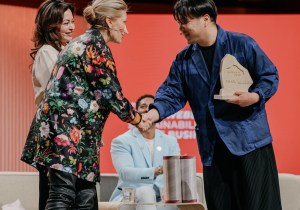
Even Queen Mary of Denmark had nothing to say at this year’s Global Fashion Summit, which has become the industry’s most boldface of sustainability conclaves.
The longtime patron of the Global Fashion Agenda typically delivers a brief speech to kick things off, usually along the lines of the need for collective action for transformation to occur. Or she might joke about her daughters stealing her shoes as a form of reuse. Somewhere between the opening smooth-jazz jam and an H&M Foundation-helmed panel on operationalizing circularity, however, the royal consort slipped away from her front seat at the Copenhagen Opera House, her exit barely announced by the fading click of her stilettos.
Related Stories
It was a stealthy retreat that, inadvertently or not, reflected the muted mood of the two-day conference, which one attendee described as “somber,” another as “a bit flat” and a third as evocative of a “palpable decline of interest.” Fewer high-level brands abounded, a consequence of throttled travel budgets, a fear of appearing overtly political—and potentially ticking off a certain White House inhabitant—and cannibalization by concurrent events such as SXSW’s first London foray and, we were told, an especially buzzy textile recycling expo in Brussels where shoulders were slapped and hands shaken over business deals.
For the thousand or so people who converged on Copenhagen, just a hair fewer than those who turned up for last year’s 15th anniversary, there was very little to feel celebratory about. Geopolitical turmoil, tariff uncertainty and environmental deregulation hung heavily in the air. Even attempts to put a positive gloss on corporate efforts that were already lagging before the rightwing shift in both Europe and the United States, but could now be actively backsliding, felt more perfunctory than usual.
The same week, a Stand.earth analysis of more than 40 apparel companies found that 40 percent increased their carbon footprint versus their baselines, outstripping those on a 1.5-degree Celsius trajectory by an almost six-to-one margin. In the latest iteration of the International Trade Union Confederation’s global rights index, data showed a “sharp escalation” in violations of fundamental labor rights, including freedom of association and collective bargaining.
“Apparently more was happening in the roundtables,” one attendee said of the closed-to-press executive-level sessions, which had the likes of Kering diving into what a just transition means in the age of climate change, Target speaking about moving production closer to consumer markets and The Fashion Pact hosting a conversation about corporate financial engagement in decarbonization. The more accessible stages—the concert hall, “action” and “ignite”—stuck to broader, more anodyne issues such as fiber innovations, resale, regenerative materials and the gender pay gap.
The biggest ripple in all that taut placidity was occasioned by Veja co-founder Sébastien Kopp, who described sustainability as a “bag of vomit.” Labor activist Kalpona Akter’s heartfelt description of garment workers’ struggles in Bangladesh produced little response and, by the time the “celebration dinner” rolled around, exactly zero offers of help that might relieve the severe truncation of her organization’s services due to the loss of funding from the U.S. Agency for International Development, or USAID for short. Designer Eileen Fisher’s call for everyone to “show up more and collaborate more” apportioned a burst of inspiration buoyed by her delightful earnestness. Things flattened from there.
“Some feedback I heard is that some people feel the brands are too restrained and they prefer the speakers that are more candid and speak more openly,” an attendee said.
But the event’s dour note was hardly unexpected. There is simply no way to spin the current climate, whether political, environmental or otherwise, no matter how many times someone insists that there is no business on a dead planet. For brands grappling with the immediate, not to mention existential, threat of increased tariffs, sustainability has dropped several rungs on the priority ladder as investment in something that provides intangible returns on the balance sheet becomes harder to justify to shareholders.
The Trump administration’s crackdown on so-called “woke” notions such as climate action or DEI in the United States isn’t even the half of it. In Europe, the omnibus package, a series of amendments designed to simplify—and many say water down—the corporate sustainability due diligence directive, the corporate sustainability reporting directive and other legislative instruments, threatens to unravel years of progress holding corporations liable for their environmental and social impacts. It’s still unclear how other forthcoming regulations involving extended producer responsibility, greener design requirements and traceability compliance will shake out.
“There’s a general backlash on sustainability in Brussels,” Lara Wolters, the Dutch politician who was the European Parliament’s lead negotiator on the CSDD, said at a pre-game policy masterclass at the Danish Architecture Center. “None of this is for a good reason, but maybe to take a step back. What the Commission has done is roll out a deregulatory agenda under pressure from a lot of large lobby groups in some of the member states. The intention, I think, is to give a political signal that we, too, are going to do things differently. I would even call it a sort of ‘Trump lite.’”
She said that the result of this reversal would be more paperwork and less impact, especially for small and medium-sized enterprises. For the politicians who have been clamoring for fewer guardrails, however, the “intention is to do things as fast as possible, never mind the consequences.”
Claus Teilmann Petersen, sustainability/stakeholder engagement and human rights manager at Bestseller, agreed, deflatedly. “We are now in a situation where we have to admit that Europe has failed,” he said. “We cannot deliver what we set out to do. Instead, we are now in a situation where we are scrambling, but I’m pretty sure that we will get into a situation where the simplification will be deregulation.”
Across the Atlantic, the Trump administration has pulled the United States out of the Paris Agreement (again), dismantled critical climate safeguards and obliterated other regulations governing clean water, toxic pollutants and wildlife. It has clawed back most forms of foreign assistance, including grants for programs that strengthened workers’ rights, combated child and forced labor and helped build manufacturing capacity.
“I spent a good chunk of my flight over breaking through President Trump’s proposed 2026 budget,” said Chelsea Murtha, senior director of sustainability at the American Apparel & Footwear Association. “And, of course, USAID is completely eliminated, and a lot of the functions that it had are not even fully being transposed over to the State Department. The U.S., in particular, was a very large funder of the [International Labour Organization’s] Better Work program, and all of that funding is gone now.”
The outcome has been a “sort of paralysis,” she said. Brands, squeezed by higher import costs, are hard-pressed to fill the breach. And while individual states could step up with rulemaking to counter the White House’s actions, there’s also only so much they can do.
“It’s not like they can’t step in and do things, but they’re constricted in their authorities,” she said. “They cannot negotiate trade deals, and they can’t control imports. They can pass EPR programs, because EPR programs regulate products within their state, but what they can’t do is institute something like an export ban.”

On the first day of the Global Fashion Summit, themed “Barriers and Bridges,” Federica Marchionni, CEO of Global Fashion Agenda, didn’t mince words, either, calling this an “extremely challenging time for sustainability” that is hampering fashion’s ability to be a “force for good.” At the same time, she said, the only certainty in an uncertain world is climate change. And a “strong absence” of leadership requires “collective courage” to build supply chain resilience.
”We are in a time of adversity,” Marchionni said. “That is why I ask that you become a beacon of hope for your peers. Courage also means being bold enough to communicate openly about your ambitions…and your missteps. It is easy to retreat and stay quiet when sustainability is being scrutinized. But true leaders will continue to be transparent about the actions they’re taking.”
Even so, the stakes can often feel less than mutual. The few suppliers who spoke alluded to challenges that could deepen depending on how conditions over the next few months evolve. They’ve found themselves in a position that is at once unprecedented and excruciatingly familiar as they continue to bear the financial brunt of the industry’s top-down approach.
“The volumes are lower than they used to be a couple of years ago,” said Attila Kiss, CEO of Gruppo Florence, an integrated manufacturing hub in Italy. “The brands are asking for lower prices because they have pressure on the margins. And from the other side, we have all the ethical issues, the social issues to manage.”
In a panel that discussed Arvind Limited and Fashion for Good’s plans for a “near-carbon-neutral” textile factory in India that would bring online tested and emergent solutions that could collective slash greenhouse gas emissions by as much as 93 percent, Abhishek Bansal, the former’s head of sustainability, said that most of the industry’s climate mitigation efforts either involve setting targets or pushing the supply chain to do so.
“Unfortunately, I have seen very little money going into helping build the hard assets that are going to actually reduce emissions,” he said. “If you honestly ask how many industry stakeholders have set aside funds to build plants or invest in technologies to achieve those targets, I think you can count them on the fingers of one hand.”
Even a project that breaks ground today will take at least two years to run at full strength, Bansal said, before adding, “It’s a big thing to say, but I don’t think we are going to meet 2030 targets.”
The dearth of representation—from suppliers, from economists, from investors—was noticeable, more than one attendee said. Speaking to an audience, Tara St. James, senior director of sustainability at the Canadian retailer Moose Knuckles, said that brands could take more responsibility for fostering inclusion by bringing their suppliers to conferences or having them speak on panels with them or in their stead. Others agreed, desiring more profound conversations.
“We talk about making changes in our supply chain, which is where most of the impact is, but then we don’t invite suppliers into every conversation,” one attendee said. “And when we do, it’s usually farmers and manufacturers, which is great, but I want to hear from a mom-and-pop mill, a dye house. I want more doers on the panels. And that includes more brands.”
Yayra Agbofah, founder and creative director of The Revival, an organization that tackles global textile waste in Ghana, including through the Global Change Award-winning Revival Circularity Hub, said there’s a difference between being ready for change and showing readiness based on actions. Fulfilling the second part requires reexamining fashion’s business model, which he described as a failure because it doesn’t recognize communities like Accra’s secondhand Kantamanto Market as stakeholders.
“We are dealing with the waste we didn’t create, and not having a decision on how to deal with this crisis is a big problem,” he said. “We need to be part of the decision-making. We shouldn’t be left out and be an afterthought.”
It was during the Q&A portion of Agbofah’s panel that Brooke Roberts-Islam, a sustainable fashion journalist and consultant, nearly leaped out of her chair. Just minutes before, Golnaz Armin, vice president of color and materials at Nike, was speaking about the footwear giant’s efforts to “imagine and create meaning” with post-consumer waste. She said that Nike’s size was both its advantage and disadvantage.
“Kantamanto is the only example of a scaled circular economy,” Roberts-Islam said. “It seems so strange to have this framing of ‘Why can’t we scale this up for Nike because we’re such a large organization?’ and, you know, a lot of Nike products end up in Accra. Kanatamanto has tens of thousands of businesses that do this. They know the answer, and Nike says you’re trying to find the answer, so can you, Yayra, give Nike the answer?”
Perhaps the biggest question of all was this: Can fashion do things differently? Any kind of response is still fraught with baggage tied up with maintaining business as usual behind what can appear like a facade of progress. “It Takes Many,” a report that Zalando unveiled during the summit, homed in on the “attitude-behaviour gap” that prevents consumers from making more sustainable choices. But the retailer might as well have been speaking about the industry at large.
“Someone told me once that a wall lying down is actually a bridge,” said Christiane Dolva, head of innovation, research and demonstration at H&M Foundation. “I think that some of the barriers that a lot of us feel that we’re running into, which literally can be like running into the wall, can be part of the solution if we shift our perspective. We need to shift our perspective.”