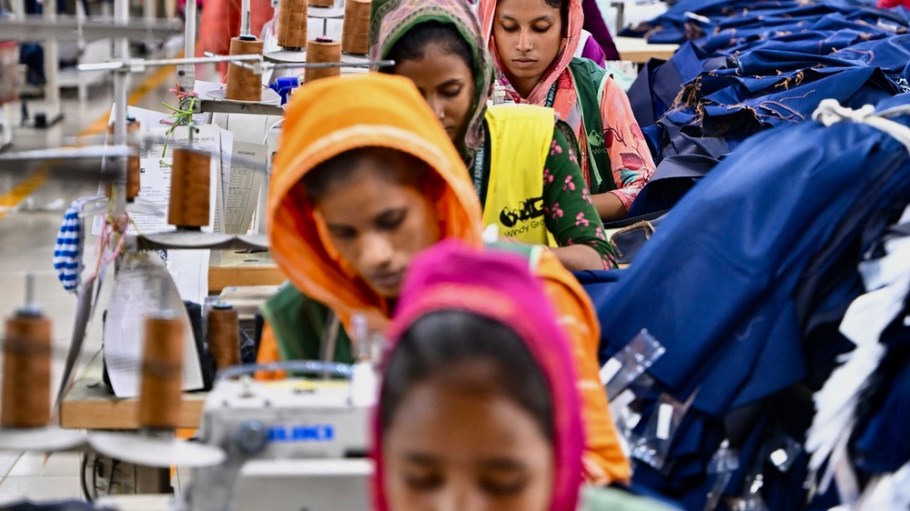
When Vidhura Ralapanawe, a former climate researcher, first joined the garment industry more than two decades ago, one of the worst epithets you could throw around in the global South was “sweatshop.”
As human-caused global warming continues to exacerbate the dangerously high temperatures that bake swathes of South and Southeast Asia for months at a time, the term is more literal than ever, yet the regulatory and reputational risk is something that “has completely not been factored into our thinking,” the Epic Group executive vice president said.
Related Stories
The problem is that climate adaptation isn’t “particularly lucrative,” Ralapanawe added. Climate mitigation is something that’s easy for the industry to invest in because reductions in carbon emissions are easily quantifiable, while adaptation has a murkier ROI, which makes justifying the limited funds available a harder sell.
“It is not something you can see immediately and there’s no immediate payback,” he told an audience at the Cascale annual meeting in Hong Kong in September.
But the warnings aren’t getting less urgent. A recent World Bank study found that Bangladesh, where Epic Group operates four factories, lost 25 million workdays to extreme heat in 2024, resulting in an estimated economic loss of up to $1.8 billion, or 0.3–0.4 percent of the nation’s gross domestic product.
“Extreme heat is not just a seasonal inconvenience. Its impact is far-reaching,” said Jean Pesme, World Bank division director for Bangladesh and Bhutan. “As we see in Bangladesh that the rising temperature is affecting our health and productivity, and the country’s prosperity.”
On Tuesday, the United Nations Environmental Programme said that an overshoot of the 1.5-degree-Celsius warming limit, long held by scientists as a critical threshold to sidestep the most severe impacts of climate breakdown, including intensifying heatwaves, storms and wildfires, is all but inevitable over the next decade.
It’s also something that will be difficult to reverse, requiring a “step change” in ambition and action to lower greenhouse gas emissions and blunt the intensity of the climate crisis. Ten years of the Paris Agreement may have spurred climate action, the report said, but ambition and implementation still “fall short” of what’s needed ahead of climate negotiations in Belém in Brazil later this month.
Even if all existing government policies are fulfilled, which is unlikely with the United States’ announced exit from the Paris Agreement, the world is still staring down at a 2.8-degree Celsius hike. And emissions aren’t just increasing, but they’re also increasing faster, with each year over the past decade smashing the past one’s record.
“Nations have had three attempts to deliver promises made under the Paris Agreement, and each time they have landed off target,” said Inger Andersen, executive director at UNEP. “While national climate plans have delivered some progress, it is nowhere near fast enough, which is why we still need unprecedented emissions cuts in an increasingly tight window, with an increasingly challenging geopolitical backdrop.”
Defusing the ‘carbon bomb’
For Ralapanawe, all this presents an “impossible challenge” that can pit one strategy against another.
“We cannot build factories in the way we used to build,” he said. “We should not be building any factory that is not net zero by design, and we should not build a single factory that is not designed for climate adaptation, not designed for heatwaves. If you don’t do that, the retrofitting will become a carbon bomb, and we are sitting on a carbon bomb because most of the factories in the world will have to be air-conditioned within the next three or five years, and that will really blow all our carbon targets.”
A University of Sydney study published last month, however, found that solutions could be both affordable, scalable and not necessarily involving air conditioning.
By testing various cooling alternatives in a simulated garment factory inside a climate-controlled chamber that replicated the hottest recorded conditions in Dhaka, where indoor temperatures can reach as high as 40 degrees Celsius, researchers found that even simple interventions such as insulated reflective roofs, electric fans and free access to drinking water could make a significant difference to core body temperatures, heart rates and dehydration risk.
Electric fan use, combined with access to drinking water, could even claw back much of the heat-related productivity losses seen in high-intensity tasks like ironing, said Ollie Jay, director of the school’s Heat and Health Research Centre and the study’s senior author.
“We found that heat stress alone was responsible for a 15 percent reduction in work productivity in our study,” he said. “And what we found is that you could reclaim a big chunk of that without having to use air conditioning.”
Garment workers have said that their employers crack down on drinking water breaks because they fear it will interrupt the flow of work. This is “probably a wrong assumption,” Jay said.
“The reason is that when you get hot, you slow down, you make more mistakes, your productivity goes down,” he said. “We found that moving air doesn’t do much on its own, but if you allow people to have a bottle next to them, stopping very briefly, having a bit of a drink and then carrying on, we’re reclaiming about a third of the lost productivity due to heat stress. And it’s not making it worse than it already is as well, and it’s much better for your employees, which is a really important point of view.”
Changing the roof can achieve a 2.5-degree Celsius reduction in indoor temperature, his team found. It’s much better to do “two really easy things” than “one really hard thing,” Jay said.
In a survey that was conducted in mid-2024 by Mohammad Golam Sarwar, a doctoral researcher at SOAS University of London, nearly all—that is to say, 98 percent—of the 1,000 workers who participated across Rampura, Ashulia, Chittagong, Gazipur and Narayanganj in Bangladesh said they experienced “noticeable changes” in workplace temperatures over the years. Their productivity, they said, has also taken a hit, with 27 percent reporting a “sharp decline” and another 29 percent saying it was “slightly reduced.” Some 46 percent of workers also said they were forced to take a leave of absence due to heat and dehydration-related health issues such as headaches, vision loss, excessive sweating, dizziness, vomiting and urinary tract infections.
One thing that struck Sarwar during his research was how much climate change dogged workers from one place to another. Many of them fled to the cities from their rural, coastal home villages because the increasing frequency of disasters like floods, riverbank erosion and cyclones, also due to climate change, made their already fragile livelihoods untenable. Even in their new urban environs, however, global warming has proved inescapable. Those earning poverty wages have to resort to taking out loans to buy medicine or make up for lost time from work, extending the cycle of poverty they tried to escape.
“Female workers are also disproportionately affected in terms of productivity because they are overburdened with household work in addition to their workplace work,” he said. With unionization rates at a dismal 5 percent in Bangladesh, few are able to seek help to advocate for themselves. And when heat stress escalates pressures on the production floor, violations such as forced and unpaid overtime and gender-based violence and harassment can see a similar surge.
Seeking accountability
Writing in a position paper published in October, the Clean Clothes Campaign, the garment industry’s largest consortium of trade unions and civil society organizations, called on fashion brands, suppliers and governments to take action, through a gender-sensitive and worker-led lens, to prevent what it says are the “inevitable and dangerous consequences” of oppressive temperatures on garment workers globally.
“Workers face a double burden,” Kalpona Akter, executive director of the Bangladesh Center for Workers Solidarity, a workers‘ rights nonprofit and Clean Clothes Campaign affiliate, said at a Climate NYC event in September. “Brands are pushing for short lead times and low prices, which makes factories cut costs. And when factories cut costs instead of investing in climate resilience, it creates a vicious cycle of climate risk and exploitation at the same time.”
While a business case can be made for addressing deadly temperatures in factories, there should not need to be a business case for saving people’s lives, said Sonia Mistry, climate and labor justice director at the Solidarity Center, a nonprofit based in Washington, D.C., said at the same event.
“We know that heat stress kills people,” she said. “I don’t want people to walk away from this saying, like, ‘Great, there are measures in heat stress agreements that can save people’s lives. So we’ll just put fans in factories, and it’ll be fine.‘ It’s not enough to say we have codes of conduct or the physical infrastructure. Whether or not that physical infrastructure saves lives could very much depend on whether or not workers are able to join independent unions and bargain with their employers for accountability.”
Epic Group has suggestions on how factory owners can build differently in a case study that will come out in a couple of months, Ralapanawe said. But the question is not so much whether the industry has the money to pour into improvements but rather if it can manage the transition equitably so that it “doesn’t become a manufacturer burden,” particularly when the insurance systems they relied on are no longer viable.
“Far too often, decarbonization, whether it’s in farms or factories, has been the suppliers’ responsibility,” he said. “And sometimes, when I speak to others, they think, oh, we are asking for handouts from the bands. That’s not the path we want to take. Don’t come and work with us thinking that we want handouts. Come and work with us because we are one value chain, one industry, and we need to be that industry that looks after the people and the planet at the same time.”
Do nothing and the problems will only compound, not only from a moral perspective but an existential one, too.
“These heatwaves are going to disrupt your efficiencies in your factory, so you’re not going to have the same efficiency that you had two, three years ago when the heatwave hits,” Ralapanawe said. ”Climate risk is actually a business risk.”