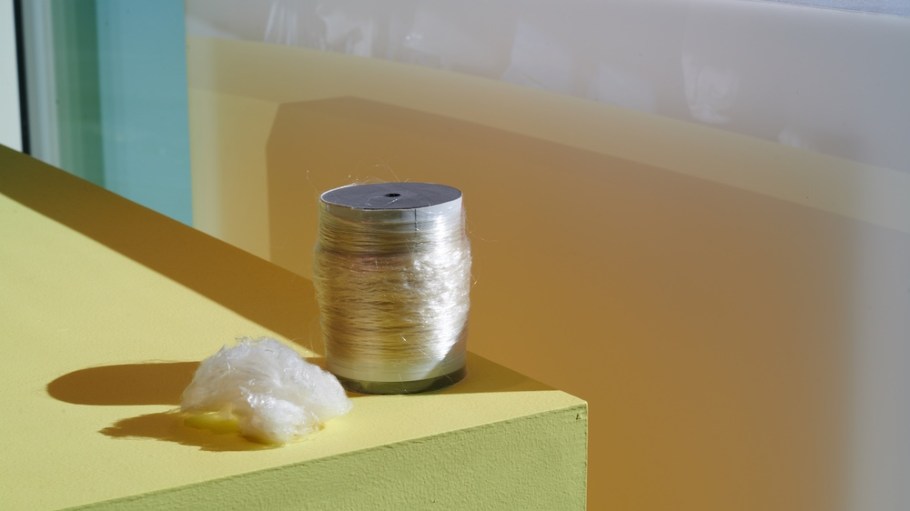
This bit of fluff may not look like much but it’s the start of something potentially much bigger.
The brainchild of California-based startup Rubi Labs, the yarn comprises lyocell derived from carbon dioxide captured from manufacturing waste streams. Scaled up, it could change the way garments are produced by sequestering greenhouse gases instead of pumping more of them out. It could even result in the creation of truly climate-neutral products—no complicated accounting or controversial offsets necessary.
Related Stories
While the future is still some distance away, the possibility is an enticing one, particularly for Ganni boss Nicolaj Reffstrup, who showed off samples at the Global Fashion Summit in Copenhagen on Tuesday.
He has every reason to be excited.
The Danish brand, which poured money to pilot the material earlier this year, will be the first fashion purveyor to trial fabrics made with Rubi Labs’ technology. Reffstrup, who came across founding twin sisters Leila and Neeka Mashouf through his work at Giant Ventures, a London-based venture capital firm on whose board he serves, described Rubi Labs as a “dream come true” and a “natural extension” of Ganni’s carbon insetting strategy, which involves cutting emissions in its own supply chain rather than somewhere completely divorced from its operations. He has since transferred the stake to his own venture fund, Look Up Ventures, which invests in deep-tech solutions to the climate crisis.
Rubi Labs, which describes itself as a “symbiotic manufacturing” company, uses enzyme-powered biochemical processes to gobble up carbon dioxide, discharging pure cellulose pulp in its place. Reffstrup said he envisions—in time—installing carbon sequestration equipment across the brand’s myriad manufacturing nodes, from dye plants to yarn spinners, creating a zero-waste pipeline from emissions generation to feedstock production. But he knows not to get ahead of himself. The first step is to put Rubi Labs’ lyocell through the paces by blending 20 percent of it with the industry-standard stuff. Then will come the trials, likely lots of them, to make sure it aligns with Ganni’s parameters, including look, feel and durability, as well as applicability.
“We then look at product development, like how can we use this material? What kind of product doesn’t make sense for us?” he said. “With cow leather, for instance, it has a broad range of applicability because it’s kind of it’s a heavily commoditized product that we know how to use. Whereas innovative materials might, in the beginning, have a more narrow scope. We don’t dare to do a full jacket or skirt, so we figure out what’s most viable.”
It’s only then that Ganni works with a company like Rubi Labs to develop specific offtake agreements to take those products to market. Initial investment is important but so are more enduring commitments, Reffstrup said.
Ganni is by now an old hand at working with materials that are on the knife edge of commercialization. Through its Fabrics of the Future initiative, it’s collaborating with some 30 innovators, including Bolt Threads, which manufactures Mylo, a mycelium-derived cowhide alternative, and Renewcell, whose Circlulose material stems from 100 percent textile waste.
Textiles are a key pillar of Ganni’s sustainability strategy. More than 70 percent of the It Girl brand’s collection is currently made with certified organic or recycled materials. By 2025, it has committed to sourcing at least 10 percent from Fabrics of the Future.
“Sixty-five percent of our carbon footprint is derived from the materials that we put into the product,” Reffstrup said. “So they play a major role in bringing down our footprint by 50 percent by 2027. We can’t do that without fixing our use of fabrics.”
One thing Ganni doesn’t one to do is hoard them, even ones with which it has played an integral role in incubating. Rubi Labs, for instance, has offtake agreements with H&M Group, Patagonia, Reformation and others, which was how it was able to cobble together $8.7 million in seed funding to get off the ground in the first place.
Excluding others from innovative solutions would be a “disaster,” Reffstrup said. “Without profits, you won’t scale, without scale, you won’t have impact—that’s our mantra.”
That doesn’t mean Ganni can’t have first dibs, which it does with Rubi Labs’ lyocell, he said with a grin. That, in his opinion, is where the “arms race” lies.
Reffstrup doesn’t know when the first Rubi Labs-infused garments will roll off the line. A “real world” ramp-up of a previously lab-scale technology isn’t the same as simply churning out an extra 10,000 T-shirts, he said. Making sure something has legs is also important.
“The thing is also we’re careful not to do kind of fringy projects,” he said. “We don’t want to launch like a tiny wallet or something like that. Just to be able to announce that we’re doing it.”
With Rubi Labs, the idea is to look at what kind of existing fibers its lyocell can replace and then generate enough volume to be able to accomplish that. Otherwise, Reffstrup said, it will just be a “game of claiming sustainability” without making a difference. Rubi Labs may not be able to produce “insane” quantities of its material at the moment, but it’s getting “closer and closer,” he added.
And the harsh reality is that change—meaningful change, anyway—takes time.
“If you want to reconfigure an industry that’s mostly dominated by commodities produced at scale, it’s a big job, whether you’re fermenting proteins for food or replacing cellulose-based materials,” Reffstrup said. “I’m sometimes surprised that people are surprised [by this]. We might not be at a perfect stage yet, but we’ll get there for sure. Just ask Elon Musk, right? You start out with a really silly electrical car and you end up with a Tesla. That’s the biggest car at the moment in China.”

Neeka Mashouf, CEO and co-founder of Rubi Labs, said that Ganni was an obvious partner.
“We created Rubi to ensure our planetary future by restoring Earth’s ecological balance with reimagined supply chains that are symbiotic with the planet—starting with fashion,” she said. “Ganni has been instrumental in helping us to bridge the relationship between brands and manufacturing partners in order to build a future where entire manufacturing plants can truly be reinvented.”
Other companies are looking at carbon dioxide as a raw material. In December, Illinois-based Lanzatech feted a party dress collection with Zara using polyester made by turning waste carbon sources into ethanol. (Lululemon also has its eye on the technology.) Newlight, another California firm, touts AirCarbon, a bioplastic made by mixing captured greenhouse gases, such as methane, with microorganisms in a bioreactor. To demonstrate the material’s potential, it sells a range of purses, wallets, sunglasses and smartphone covers under the label Covalent.
Reffstrup sees this as a way of turning a problem into an opportunity. There’s an excess of carbon dioxide everywhere, which is why the planet is in the trouble it’s in. We need to figure out what to do with it.
Ganni may not describe itself as a “sustainable” brand, but it wants to be a responsible one. Reffstrup admitted to having a few sleepless nights. Faced with the polluting nature of fashion, he and his wife, Ditte Reffstrup, who serves as the company’s creative director, once considered walking away from the business altogether.
“But then I realized that fashion is here to stay, right?” Reffstrup said. “So doing better than most of the others every day and ensure that [we] make progress—that’s the moral compromise that I had to enter into with my kind of better self. We recognize that we’re not sustainable yet, but that’s the ultimate aim. We want to be a fashion company that does no harm.”