At 17, Jaivir Gulati should be spending his downtime doing what most 17-year-olds do: hanging out with friends or hacking and slashing at virtual foes—ideally, both things at once.
Instead, the 11th-grade Swiss boarding school student is two years into running a social enterprise that takes surplus fabrics from factories in his native India and, with the help of more than a dozen of the country’s women artisans, upcycles them into voluminous children’s jackets that double as sleeping bags.
Related Stories
The idea for Fabrecreate, as the company was later dubbed, started to take form one chilly night in 2023 when Gulati was watching the news in the school mess hall. He was struck by the images of displaced children from Russia’s invasion of Ukraine and wanted to do something to help, though he didn’t know how. But one thing he was certain of: they looked cold.
“It’s wintertime, but they barely have any clothes,” he said. “They’ve lost everything in their lives, parents, brothers, sisters, their homes; they literally have nothing left. They don’t even have basic clothing.”
With the help of his grandfather, who runs a garment business in Delhi, Gulati got in touch with a few factories in the area. He noticed, during his visits, the mounting piles of textile waste gathered from their cutting-room floors. Perhaps something could be done with them?
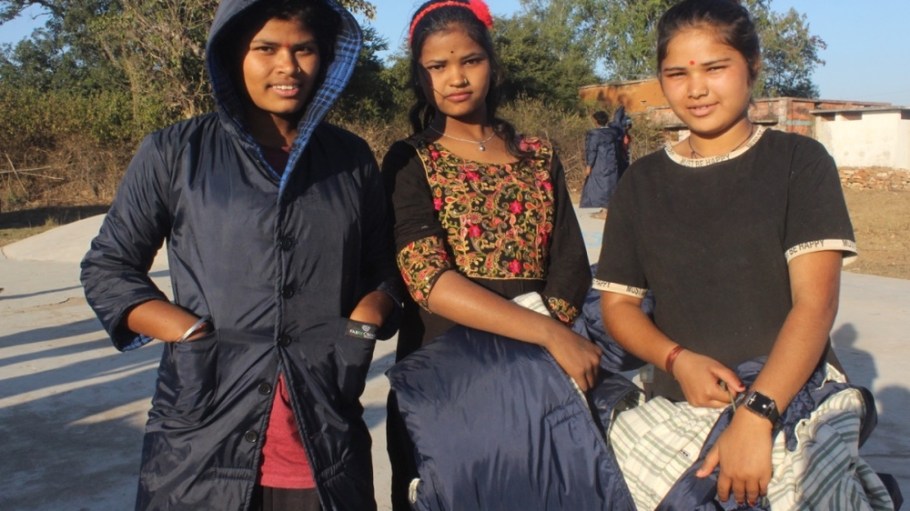
Next was figuring out what the jacket would look like. Gulati knew it had to be warm, waterproof, multifunctional and easy to tote around. He reached out to a women’s self-help group to create a small batch of test jackets with a wicking outer layer and a flannel inner one for local distribution. Later iterations of the jacket added a hood, internal pockets for personal belongings, and a drawstring that cinched the bottom hem to create a more all-encompassing space. The number of sizes increased from an initial three to five.
There are now two versions in a “bunch of sizes” for ages 8 to 18: one rated for 0 degrees Celsius (32 degrees Fahrenheit) and another for at least -10 degrees Celsius (14 degrees Fahrenheit).
“First, we tested the fabrics, and then we made the jackets,” Gulati said. “Nothing beats actual feedback from the people who are using it. It’s a simple idea, but we missed a lot of things.”
To date, Fabrecreate has distributed 7,000 jackets, at no charge to the charities that receive them, to remote villages in India’s mountainous states of Madhya Pradesh and Himachal Pradesh, to United Nations refugee camps in West Delhi and to Myanmar following the devastating 2025 earthquake, which displaced tens of thousands of people in a country already fractured by the military coup four years earlier.
Gulati was even able to get a shipment to Ukraine with the help of Nova Ukraine, which took a shipment of jackets by road through Poland to Kharkiv and Sumy near the Russian border, where the most intense fighting was taking place.
Importantly, Fabrecreate’s recipients say, the jacket works.
“The quality of the product astonished us,” said Aman Batish, a trustee of the Amrit Foundation, which received 1,000 jackets to distribute to children in the disaster-prone city of Rishikesh in the foothills of the Himalayas. “People sometimes, you know, have this thing in mind, that since they are doing it for charity, maybe they can compromise with the quality. They even provided Velcro to make adjustments to the size of the jacket.”
Even so, Batish was surprised by Gulati’s age—or lack thereof. “Children of this age usually don’t even have much awareness of what’s going on in the world and what people need,” he said. “It’s quite commendable.”
Winter starts early in India’s higher altitudes, where resources are often scarcer, said Rajni Barasia, a past president of the Rotary Club Bombay Bayview. At first, the children in regions such as Ladakh, where the community organization volunteers, didn’t understand what the jacket did.
“Then they were impressed,” she said. “They can use it 24/7. In the daytime, they can wear it as a jacket, and at night, they can just open it and use it as a sleeping bag. It’s such a novel idea.”
Fabrecreate’s aim, Gulati said, is to “help as many kids as we can.” There are at least 2,000 jackets ready and waiting to be shipped; it’s only a matter of identifying the places with the most need. At the same time, he estimates having saved 40,000 meters of fabric—or nearly 44,000 yards—from the landfills over the past year.
Gulati said that Fabrecreate, more than an outlet for doing good, has helped him understand how to push through obstacles. How to get jackets to Ukraine was a big one, not only because it took finding the right partner but because it cost more to ship them to Poland than to make them.
“Which didn’t really make sense to me, because we could have made double the amount of jackets and helped double the amount of kids,” he said. “But we figured it out. We found a smaller courier that agreed to lower the price, even though we’re not officially an NGO. But it took months to first find the courier and then get them to agree.”
Gulati raises funds for Fabrecreate by holding dinners and other events at his school. The most recent one was a pizza night, which was popular because “everyone would much rather eat a pizza” than whatever’s on the school menu.
“So we charged like 30 francs per person, which is like $30-ish, and bought pizzas for 12 francs and Cokes for 2-3 francs,” he said. “And like 110 people came to that.”
A Diwali dinner that Gulati organized as president of the Hindi club—it included a dance competition—raised 6,000 francs, or over $7,500. He’s also going to try his hand at crowdfunding.
Gulati hasn’t nailed down what he’s going to do when he graduates from high school, though a stint studying business, finance or maybe psychology at university is likely. He still intends to keep Fabrecreate going, no matter where he winds up, he said. There’s no final goal because “we can just keep helping and keep helping.”
One more thing: he does play video games, just not as much as he used to. His favorite is Gran Turismo 7, an auto-racing sim.
“I also like playing Minecraft a lot,” the teenager said.