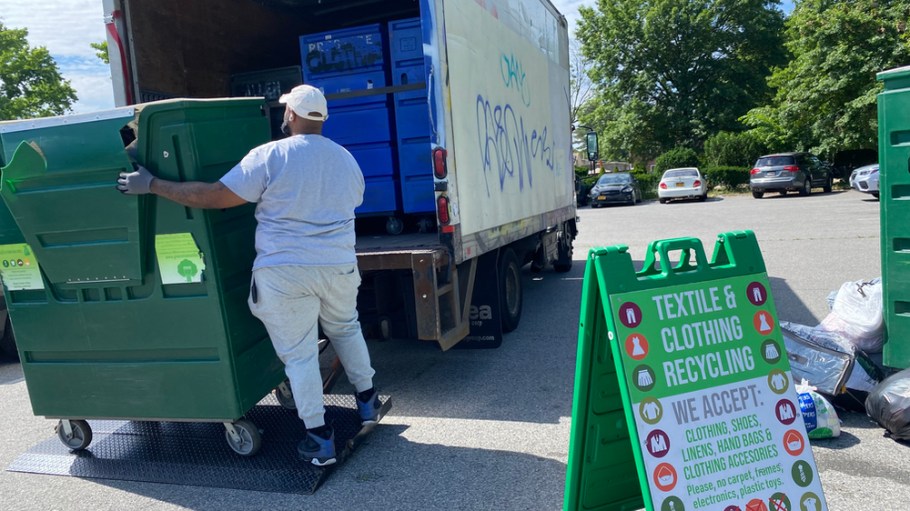
Turning clothing waste in the United States from a large—and largely unaddressed—challenge into an opportunity won’t be easy, but it’s also a critical necessity, according to an upcoming report that bills itself as the first comprehensive assessment of what it’ll take to scale textile-to-textile recycling in the world’s largest consumer destination.
Compiled by the “action-oriented” nonprofit Accelerating Circularity, together with business and technology consultancy Accenture, “Rags to Revenue: Unlocking Post-Consumer Textile Recycling in the U.S.” describes a domestic textile-handling system that is economically at odds with market and regulatory realities. Simply put, the heavily manual nature of the work, plus the lack of mandated systems like curbside pickup or deposit schemes, makes collecting, sorting and preparing textile waste more expensive than it’s worth.
Related Stories
Then there’s the fact that the current collection infrastructure is typically set up for reuse, with a fragmented and diffuse nature that makes it difficult to muster enough usable feedstock that meets textile recyclers’ strict input specifications. Coupled with existing recycled fibers’ price premiums, quality concerns and limited traceability, it’s no wonder then that even the biggest, sustainability-touting brands are reluctant to commit to more than token amounts, hampering the long-term viability of a scalable, circular textile supply chain.
“It’s a bit of a chicken-and-egg problem,” Eileen Mockus, chief operating officer at Accelerating Circularity, said of the pilot mode that the United States appears to be stuck in. “Resale—that is the money maker. That’s what sorters primarily built their facilities to support.”
But the problem textile waste presents to the United States is very acute. Together, the 50 states generate 15.4 million metric tons of used material every year, yet less than 1 percent is recycled into new clothing. At the same time, the glut of ultra-fast fashion, driven by throwaway culture, is overwhelming waste management capacity. Done right, post-consumer textile-to-textile recycling offers a “compelling opportunity” to reduce landfill use, curb carbon emissions and shore up a domestic circular supply chain that can fortify sourcing resilience and bolster economic growth, in line with the Trump administration’s much-vaunted aims.
“There’s a lot of interest in what is possible in the U.S. that is higher-value-add-type work that puts more of an industrial economy back in the country,” Mockus said. “And some of what needs to happen to make the textile-to-textile recycling streams work can be very tech-heavy.”
What this means is that the industry needs to expand and modernize its collecting, sorting and preprocessing infrastructure by investing in things like automation, which can offer faster throughput and more accurate fiber identification. At the same time, emerging innovations such as AI and near-infrared fiber analysis or robotic “pick and present” arms require large, aggregated volumes to improve efficiency and profitability. This creates a need to expand collection networks, boost consumer participation and design for textile-to-textile recyclability. Most of all, the United States must create the capacity for advanced recycling that is seeing investments happen mostly overseas. Think Circ in France and Reju in the Netherlands—at least initially—despite both of their technologies originating stateside.
“We’re a leader in what’s possible, but we’re not currently the leader in putting the facilities in place,” Mockus said.
And it’s not just legislation like extended producer responsibility, which is gathering steam in states like California, that can stoke progress. It costs very little to landfill products in some regions of the United States, she said, so what if those costs were higher? A number of brands have certain material strategies that incorporate recycled materials. Could something on the policy side encourage greater adoption through public procurement targets and long-term offtake agreements?
Another problem, Mockus said, is that there’s a dearth of in-depth knowledge about how post-consumer textile recycling works, particularly the “bunch of steps that have to be done” just to get materials detrimmed and prepped. It’s Accelerating Circularity’s hope that it can educate the industry—while urging a little bit of a leap of faith.
“But then also, one thing that Accelerating Circularity can focus on, because we already work on it, is what are the ways that we can show that the quality can be better than what you may see today?” Mockus said. “How do we get the quality of the materials and the trust in those materials, the traceability, the details that make a big difference for brands getting some of those put into place? How do we make that workstream more visible, understandable, and at the same time, something that the industry can coalesce around?”