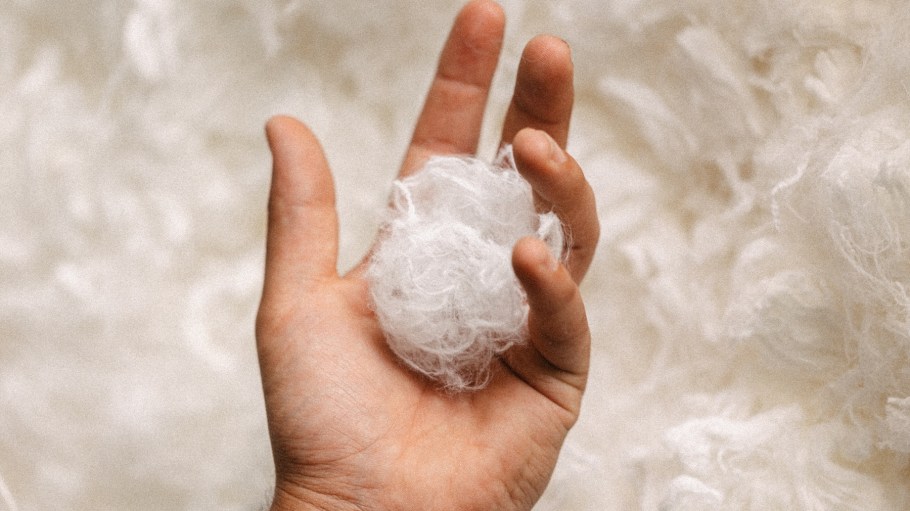
From third-generation textile entrepreneur Simardev Gulati and polymer scientist Michael Jaffe comes Everbloom: a supply chain—and eventual material—designed for circularity.
“We’re not just introducing a new fiber,” said Gulati, co-founder and CEO of Everbloom and Bloom Labs. “We’re redefining the supply chain—one rooted in regeneration rather than extraction and waste.”
The next-gen, deep-tech startup is forging future protein-based fibers by valorizing waste streams—namely, that of Keratin. Everbloom takes discarded proteins from existing supply chains to make the next generation of noble fibers using proteins, enabling local, U.S.-based fiber production with improved economics and climate outcomes, per the protein-engineering company.
Related Stories
“Very early on, my co-founder Mike Jaffe and I had zeroed-in on protein waste, just given the abundance of the feedstock; the challenge a lot run into is scaling because the feedstock is challenging to scale,” Gulati said. “I think brands oftentimes get a bad rep, but it’s not necessarily their fault. Innovators have to make materials that the brands can absorb.”
Using a patented protein melt-spinning process, Everbloom turns pre-consumer textile waste (industrial protein waste) into high-performance yarns. Of note, considering there’s an estimated 20 billion pounds of pre-consumer protein waste generated annually and growing at an 8 percent compound annual growth rate.
“Nature and human innovation have to come together—there will always be cashmere, there will always be wool and silk; it’s not about replacing them,” Gulati said. “It’s about how do we bring it together? So we have now the best of both worlds.”
Here’s how it works: The process begins with protein-rich pre-consumer textile waste, which is “meticulously sorted, purified and refined into its purest protein form,” the biotech startup said. “The proteins are then structurally enhanced and cross-linked to enable tunable fiber properties—things like softness, strength and stretch.”
Filati Biagioli Modesto, an Italian textile mill primarily owned by Prada and the Ermenegildo Zegna Group, handles the yarn’s final development. Located in the Montale commune in Pistoia’s province, the 106-year-old company specializes in producing carded yarns; what Biagioli Modesto calls soft and fluffy with “mostly disheveled” fibers.
“Their openness to innovation has been refreshing,” Gulati said. “I think that’s sometimes harder to find in these heritage industries.”
For Everbloom, the partnership offers two startup musts: speed and quality. As the mill is vertically integrated, the team can iterate on materials and maintain an adherence to quality without running the clock.
“There has to be a reason for them to kind off jump-in and absorb it; is it economically viable? Does it make sense for their business? All these sorts of dots have to connect,” Gulati said. “That was our reason; at our core, we’re a science company, so we want to work with mills that also have that level of expertise, but in dealing with downstream proteins.”
In turn, Everbloom is produced with up to 99 percent less water and land use, per Life Cycle Assessment (LCA) analysis, generating up to 80 percent fewer GHG emissions than traditional materials—aka cashmere, silk and wool—while retaining their expected softness, durability and thermal properties.
“Everbloom embodies the kind of breakthrough innovation the fashion industry urgently needs: science-driven, scalable and high-performing,” said board member Christine Goulay, founder of Sustainabelle. “Everbloom’s focus on valorizing waste and seamlessly integrating into existing supply chains addresses many critical pain points facing the fashion industry today.”
In tandem, the next-gen deep-tech startup also announced that Everbloom has raised over $8 million in funding to date, with by Pact-backer Hoxton Ventures leading the round. Fellow Californian venture capital firms including SOSV, Tuesday Capital and Clocktower Ventures participated, as well as Brussels-based angel syndicate Endgame Capital, participated as well.
“Everbloom’s innovative approach to upcycling protein-rich waste into high-performance, biodegradable fibers doesn’t just solve a sustainability challenge; it unlocks a new frontier in materials science,” said Huxton Ventures analyst Hussein Kanji. “Everbloom’s vision aligns deeply with our ethos of backing companies early—before they’re obvious—and helping them scale globally. We’re proud to support the team pioneer a category-defining platform for sustainable textiles, poised to redefine how the fashion industry sources materials.”
The startup’s next growth phase will see Everbloom’s proprietary, next-generation fiber in highbrow collaborations. As for when, however, is harder to say.
“It depends on how comfortable we feel with the quality of the material, working with the brand; it’s a joint effort,” Gulati said. “We’re feeling really comfortable with the track that we’re on. And hopefully it’ll be sooner rather than later.”