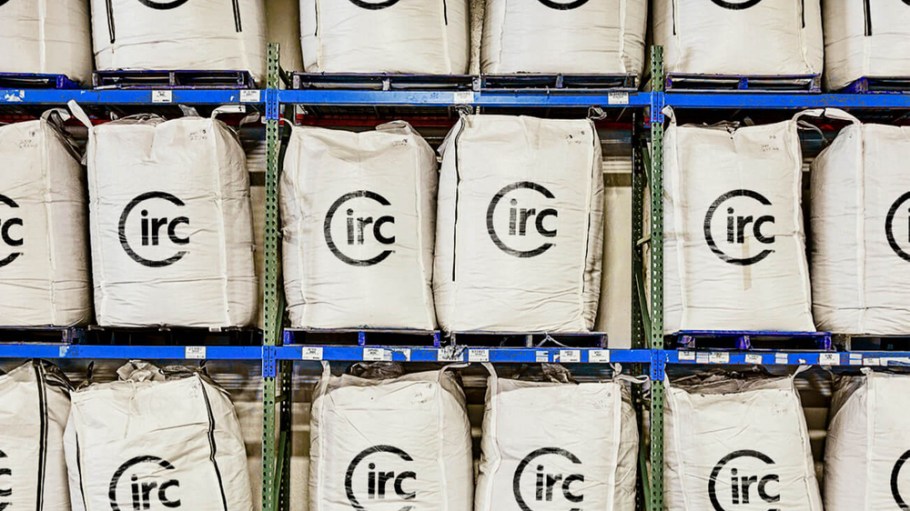
Circ is building its first industrial-scale textile-to-textile recycling plant in France. Reju is doing the same in the Netherlands. Two decades since Teijin launched the first commercial chemical textile-recycling process in Japan—and amid the planet’s growing deluge of clothing waste—is polyester recycling in Europe finally approaching a long-anticipated tipping point?
A preliminary and heavily caveated yes, according to a new report by the so-called “system change” advisory and investment company Systemiq. Despite advances in textile recycling technologies in recent years, adoption is still frustratingly embryonic, said the first-of-its-kind study, which was conducted in partnership with the likes of Arc’teryx, Eastman, Interzero, Textile Exchange and Tomra. To wit: A breakthrough in scale could happen, even ramp up the continent’s depolymerisation output from textiles by nearly tenfold by 2035, but not without significant policy action that can overcome two significant—if not downright intractable—constraints, Clara von Luckner, director and fashion lead at Systemiq said at a recent webinar.
Related Stories
The first is accessibility. While chemical recycling promises to squeeze more value out of clothing waste when reuse and mechanical recycling prove inadequate, touting virgin-equivalent outputs at a time when clothing castoffs are spiking in volume yet deteriorating in quality, access to suitable feedstock is a challenge because the current infrastructure is set up to divert textile waste in a mostly linear fashion: landfill, incineration or export to the global South. The second involves affordability. Producing recycled polyester from post-consumer textile waste in Europe costs roughly 2.6 times more than pumping out a virgin version in Asia. Even employing used PET bottles still comes out the better deal, fiscally speaking.
The lack of incentive to change is why, despite a flurry of innovation funding rounds, demonstration projects and technology partnerships, the uptake of textile-to-textile recycling has remained recalcitrantly in the pilot stage. So, how does one break free of this incremental growth pattern? It’s all a matter of gaining critical mass, von Luckner said. The uptake of new technology, she said, typically follows an S curve. History suggests that once a positive tipping point is reached, the new technology will be exponentially embraced.
Take cars, for instance. In 1900, just 4,000 cars were sold in the United States. Ten years later, the number hit 400,000.
“So a tipping point had clearly been reached,” von Luckner said. “A positive tipping point occurs when a clean technology meets three conditions: It’s more affordable, more attractive and more accessible than a conventional alternative, and accelerating the scale-up of clean technologies leads to lower environmental impact and earlier economic benefits for companies and regions.”
So far, only the last has been met by environmentally attractive and technologically sophisticated depolymerization technologies. And unless several things shift, the 1 percent of old clothing that goes on to be used to make new clothing will stay stuck at 1 percent, exacerbating a textile waste crisis that has already placed Europe’s collection, sorting and reuse businesses under considerable operational and financial strain.
Systemiq identified levers across four “essential” areas of intervention—improving access to appropriate feedstock, bolstering market demand, reducing production costs and closing the remaining cost gap— that can increase the European Union’s annual 30,000-metric-ton depolymerization capacity to 340,000 metric tons.
“While this would still only meet about 15 percent of Europe’s projected polyester demand in that year, it does mark a breakthrough and a sort of shift from pilot scale to a functioning, scalable recycling system,” said Leonard von Boetticher, a Systemiq associate.
The first area is within reach, he said, because the European Union requires all member states to establish separate textile waste collection systems, which can better funnel quality materials into reuse and recycling if the right standards are set. So’s the second if both brands and policymakers work together to send reliable signals that recycled polyester will be used at scale, allowing sorters and recyclers to “invest with confidence.” Even the third can be accomplished by lightening the burdens of energy and capital—perhaps through tax reliefs or lower grid fees—to make sorting and recycling in Europe more attractive than the disposal or export of textile waste. A heavy lift, but not impossible. Together, they could close 40 percent of the cost gap.
But the fourth area—narrowing the remaining 60 percent cost differential—can only be tackled through an ambitious extended producer responsibility, or EPR, scheme that is “really the linchpin” of all the levers because it can bridge some 55 percent of the affordability gap between recycled and virgin polyester, von Boetticher said. An additional “green premium” can cover the shipping costs needed to transport recycled polyester to yarn producers in Asia, where the bulk of them reside, and help bridge the final 5 percent.
“An unresolved cost gap can remain a critical threat in the scale-up because, in essence, it could reduce brand uptake to the bare minimum needed for recycled content compliance, and it could also shift away investment from Europe towards cheaper, less regulated markets,” he said. “Our finding is that the EPR scheme is really essential to make the business case work.”
Earlier this year, EU legislators adopted a requirement that all member states establish an EPR scheme, one that mandates that all domestic and international businesses placing textiles on their national markets shoulder the financial responsibility of collecting, sorting and recycling their products. Crunching the numbers, Systemiq proposes a 250 euro ($283) per metric ton EPR fee by 2028, increasing to 330 euros ($374) per metric ton by 2035 to cover the net costs of collection, sorting and recycling, plus a 55 euro ($62) per metric ton “green premium,” for a “cost uplift” of up to 385 euros ($436) per metric ton.
“It would actually only increase costs by 15 cents for a 400-gram jumper,” said von Boetticher, using the British term for sweater. “And I think this is quite a modest price, given that it could finally enable textile-to-textile recycling at scale.”
But more than a math exercise, Systemiq’s report is also a call to action, von Luckner said. And not just any action but collective action to address the 125 million metric tons of material that are consumed by the global textiles industry every year.
“Why do we care about this in the first place? What’s the matter with recycling textile waste? It matters because the global textile system remains extremely linear, and the waste crisis is worsening as volumes grow and quality declines each year,” she said. “2035 might seem a long time away, but we really need to start to see action right now.”
The price of doing nothing, like the stakes themselves, is high, von Luckner added.
“In the absence of policy or other mechanisms, so without targeted policy and industry action to address both affordability and accessibility barriers, depolymerisation will remain stuck in pilot purgatory, and the breakthrough to mass adoption will not happen,” she said. “The linear status quo will continue to deepen Europe’s and the world’s textile waste crisis.”