The fashion industry might be focusing on the wrong greenhouse gas, to the exclusion of everything else, in its collective effort to lower global temperatures, a new report claims.
While methane is roughly 200 times less abundant than carbon dioxide in the atmosphere, where it lasts in the ballpark of a dozen years versus centuries before breaking down, it’s also capable of trapping more than 80 times as much heat over two decades. It strikes hard and fast, versus carbon dioxide, whose heat-trapping particles, despite being less potent, are prone to loitering. This M.O. could be seized upon to climate change mitigation’s advantage much like an “emergency brake,” said Emma Hakansson, founder of the advocacy group Collective Fashion Justice and author of the report.
Related Stories
“If we reduce methane emissions now, we will very quickly see global temperatures drop, whereas it will take longer with carbon,” she said. “That doesn’t mean we shouldn’t reduce carbon. We obviously have to do that, but that’s more of a marathon, whereas methane mitigation is like a sprint, and given the stage of climate crisis that we’re in, that sprint is increasingly important.”
There are other differences between the two types of emissions. Carbon dioxide is largely derived from the burning of fossil fuels like coal, oil or gas. Methane, a large component of so-called “natural gas,” can unintentionally leak or intentionally vent from oil wells, storage tanks and pipelines. But it can also be released from ruminant livestock, wetlands and waste decomposing in landfills.
Both greenhouse gases matter, according to the United Nations Environment Programme. The Paris Agreement, under which world leaders vowed to limit the rise in average global temperatures to “well below” 2 degrees Celsius, or 3.6 degrees Fahrenheit, cannot be achieved without slashing methane emissions by 30-60 percent below 2020 levels by 2030, it said.
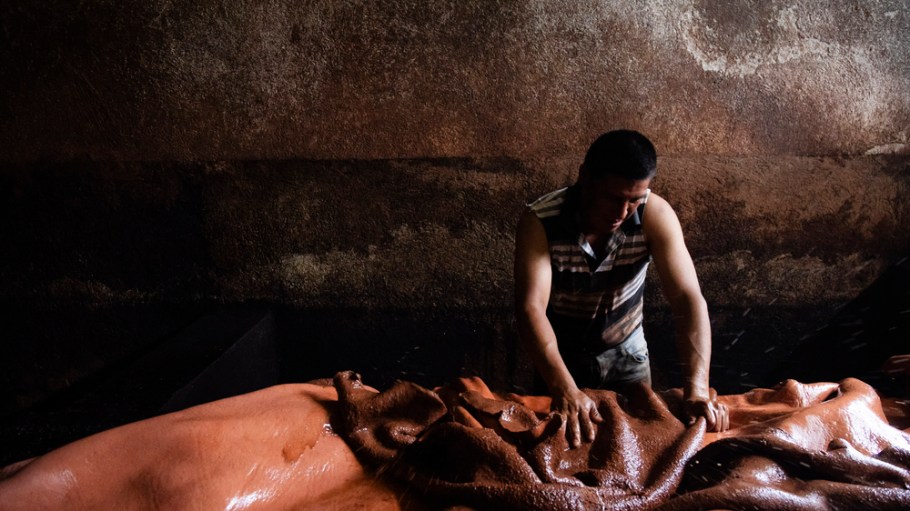
The problem, Hakansson said, is that the fashion industry is not only failing to prioritize methane, but it’s also overlooking its mitigation completely in favor of longer-term targets for curbing carbon dioxide. Despite making up just 3.8 percent of materials used in the fashion industry, she said, 75 percent of its annual methane footprint is linked to the creation and use of animal-derived leather, wool and cashmere. Leather alone accounts for 54.1 percent of annual methane emissions by materials.
Partnering with scientists from Cornell University and New York University to conduct a thorough literature review and life cycle inventory, Collective Fashion Justice worked out that the world’s clothing and footwear purveyors are responsible for an estimated 8.3 million metric tons of methane emissions every year, or nearly four times that of France.
Though methane is also associated with the production and use of synthetic materials such as polyester and nylon, particularly during the extraction of fossil fuels, the amount is “small in comparison,” Hakansson said. But while virgin animal-derived materials—at least from a methane perspective—are “objectively much worse” than petrochemical ones, replacing them with fossil fuel materials is also not the answer, she added.
It is, after all, fashion’s growing reliance on virgin polyester, which comprises 57 percent of total global fiber production, that drove its 7.5 percent emissions spike in 2023, the Apparel Impact Institute reported in July. At 944 million metric tons of carbon dioxide equivalent, the industry makes up nearly 2 percent of the world’s total carbon budget, it estimated. Natural gas extraction via fracking is also used to draw out the chemical precursors used to synthesize polyethylene terephthalate, or PET, the most common type of polyester.
“We need to be looking at recycled animal-derived materials, of which there’s an abundance that we could be working with, and investing in next-gen, plastic-free, animal-free materials,” Hakansson said. It’s reductive, she noted, to frame the conversation as a mano-a-mano between animal-derived materials and their fossil-fuel counterparts when there’s an opportunity to “look further beyond both of them.” Next-gen leather materials made from mycelium, bacterial cellulose or grain waste like Mycoworks’ Reishi or Uncaged Innovations’ protein leather, for instance, generate a fraction of the carbon emissions of cowhide leather or polyurethane.
“There’s very few good next-gen materials right now because there’s been very little investment in them, but there’s a lot of recycled wool that could be used, so that’s one of the big pushes that we’re going for,” Hakansson said. “Brands could much sooner swap to recycled leather or recycled wool than the more innovative materials, and we’ve seen that with brands like Ganni, who have effectively phased out all virgin leather, but they’re still using recycled leather, and that’s a really helpful at least for them, as an interim phase, while they invest in the future materials.”
Raw material extraction aside, the second biggest slice of fashion’s methane emissions pie by supply chain stage, at nearly 21 percent, involves the use of “dirty, outdated” fossil fuel energy sources to transform raw materials into textiles through dyeing and processing. The mining of coal, for example, unleashes massive amounts of methane into the atmosphere. And while gas energy is sometimes touted as a more sustainable alternative to coal, it is almost entirely made up of methane. It’s why the second leading recommendation in the report, after the animal-derived material transition, is to accelerate the shift to greener, renewable energy.
As a long-time vegan, Hakansson is fundamentally opposed to wearing animals, let alone eating them. (Depending on whom you speak to, leather is either a byproduct of the beef industry or a valuable incentive.) But this is a bigger problem than cow farts, which is another facile framing device, she said. Fossil fuel methane and biogenic methane function very similarly in the atmosphere. And on a chemical level, they are exactly the same. Collective Fashion Justice believes in something called “total ethics.” It means eschewing terms like “vegan” or even “sustainable” by demanding an all-encompassing responsibility to production and consumption.
“I’m aware that the meat industry in particular likes to talk about cow farts as something that they can fix,” she said. “There’s been all of the discussion about feeding seaweed to cattle and having that as a solution to methane, but that means all cattle need to be in feed lots, which is a whole new host of problems, and all of the studies show it doesn’t work that well anyway. And then there’s the other side that says we should be having like regenerative animal-based leather, which has great benefits for soil health and land management, but from a methane perspective, it does nothing.”
The report is only the first phase in Collective Fashion Justice’s efforts to turn the industry around. Coming next from the organization is a methane reduction program that can help brands track and tackle methane hotspots across their value chains. In the way that industry-wide consortia have coalesced around plastic pollution or microfiber leakage, Hakansson would like to see similar collaborative action rally around methane with fewer than five years left until 2030.
“We know that the climate crisis is already impacting the health of workers who are making clothes,” she said. “Even supply chain insecurity is coming for animal-derived materials because if we have higher temperatures, animals will get more sick and be able to produce less material. Addressing methane and mitigating methane helps to reduce global temperatures more quickly. It’s a future-proofing plan that will be able to lessen some of the climate burden on the fashion supply chain.”