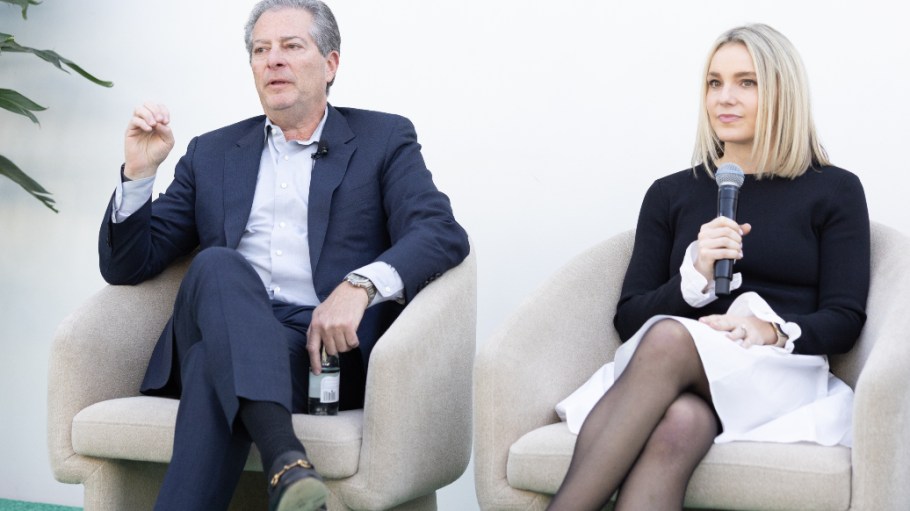
Working in partnership with Gen Phoenix, Coach found a way to take one of the most sustainable materials and recycle it in a way that’s both affordable and visionary.
“One of the most sustainable products is leather,” Todd Kahn, Coach CEO, told attendees at the Sourcing Journal Sustainability Summit on March 19, at the Tribeca Rooftop in New York, adding that “everybody wants sustainable product [but] nobody will pay more for it.”
Enter the concept of Coachtopia, originally Coach Lab. According to Kahn, its premise was twofold: “One, to learn and try new ideas, and [two,] eventually take those ideas and put them back into Coach.” He also emphasized that for the initiative to work, it needed to have a “commercial mandate” behind it in order for the concept to grow and eventually become a business that’s “hundreds of millions of dollars” targeting the youngest Coach consumers at an affordable price point.
Related Stories
Joining Kahn on stage was Elyse Winer, chief marketing officer of Gen Phoenix. She said the U.K.-based firm has a state-of-the-art manufacturing facility that can manufacture up to six million square meters of recycled leather a year from “wet blue” leather waste. Explaining that leather takes on a blue hue during the tanning stage, Winer said up to a third of the hide might go to a landfill due to irregularities or the removal of edges. After rescuing the leather waste, Gen Phoenix can break down the leather to the fiber level. Through the power of high pressure recycled water, it can “re-entangle those leather fibers back together so they can be finished as a fully recycled leather product.
“That recycled leather material has an up to 80 percent lower carbon footprint than traditional leather,” Winer said. Prior to its partnership with Coach, Gen Phoenix was creating recycled leather for the mass transportation seating category.
She added that Coach’s parent Tapestry made an investment into Gen Phoenix. And the two took their partnership one-step further. “Our collaboration was kind of rewriting the rules of a typical supplier-brand relationship,” she said.
Gen Phoenix let Coach’s leather experts into its factory, while the recycled leather manufacturer also visited Coach’s factories in Vietnam as the two teams collaborated on the final product. That allowed the teams to better understand the technical specifications of the new material, such as how it “doesn’t behave in the same way as leather” from a hide. By working together, that learning curve allowed the experts to understand how to “manage” the material and in turn “create great products from it,” Winer said.
“I think it was that spirit of true partnership and collaboration that got us to the finish line faster,” Winer said. She added that Gen Phoenix worked on integrating with the existing supply chain from day one, and noted that its recycled leather material comes on a role, which allows for waste savings and operational efficiencies.
“I am open to our partnership to become a standard in the industry,” Kahn said, adding that Coach has a “commitment to have a truly circular concept” even if it doesn’t yet have all the answers. And while circularity is a focus of the Coach brand, he’s open to sharing Gen Phoenix learnings with Tapestry brand sibling Kate Spade. He also emphasized to attendees that the commitment also entails iteration of product, as well as complete transparency because the last thing anyone wants is to be accused of greenwashing.
The Coach CEO noted that the processes used specifically for wet blue can be used for all recycled leather. He also said that as they cut the material for new product, the brand is creating waste that Coach can then “put it back into the [recycling] process and start all over again.” According to Kahn, that’s true sustainability because the system that’s been created “has almost no waste attached to it.”