Forever chemicals are everywhere: not just in clothing or other consumable commodities, but in the ocean, the soil—even the human body.
Recognized as a particularly pesky class of anthropogenic pollutants, per- and polyfluoroalkyl substances (PFAS) can take root in land once given the opportunity, according to the Interstate Technology Regulatory Council (ITRC). PFAS are known for their strong carbon-fluorine bonds, among the strongest in organic chemistry, making these chemicals exceptionally resistant to degradation. And the properties that make PFAS so pervasive are the same ones that make them hard to kill, the coalition said.
Related Stories
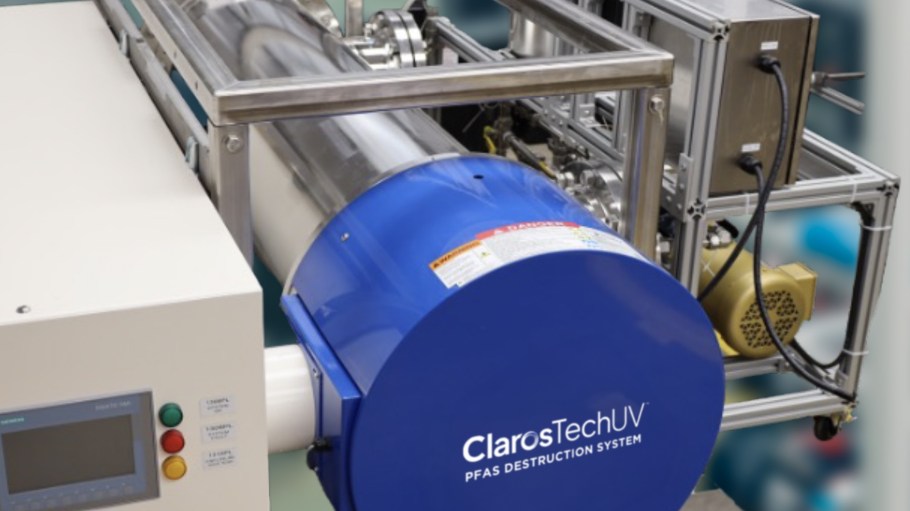
Working with Daikin America, the U.S. manufacturing arm of Japan-based Daikin Industries and one of the world’s largest PFAS producers, Minneapolis-based PFAS mitigation company Claros Technologies has completed a commercial-scale, in-field PFAS destruction run. This process utilized the ClarosTechUV system, which employs UV-activated radicals to effectively break the robust carbon-fluorine bonds in PFAS molecules, leading to their breakdown and destruction.
“This commercialization marks a turning point—not just for DAI and Claros, but for the entire PFAS landscape,” said Michelle Bellanca, co-founder and CEO of Claros. For municipalities facing costly disposal, this means a potential reduction in expenses and environmental impact through more efficient and effective solutions.
“We are on the cusp of delivering the most advanced commercial-scale PFAS destruction technology for high-flow industrial wastewater,” Bellanca said. “Proof that industry can lead the way in sustainable, high-performance and affordable innovation.”
The ClarosTechUV next-generation PFAS destruction system demonstrated high-flow capability of hundreds of gallons per minute—offering a compact footprint for seamless integration at a low-cost performance suited for industrial remediation applications, per the partners.
The system’s latest phase reportedly achieved around 99.99 percent destruction of long-, short- and ultra-short-chain PFAS species, while, in tandem, treating 170,000-plus gallons of industrial wastewater at high flow.
While not perfect, the destruction rate is significant, given regulatory benchmarks for drinking water.
“Over the past year, we’ve proven that complete PFAS destruction at an industrial scale is not theoretical—it’s happening now,” said David Hendrixson, executive vice president of Daikin America, Inc. “This milestone reflects DAI’s long-standing leadership in sustainability and our commitment to embracing innovative technologies that move the industry—and our customers—forward.”
It may very well be the largest and most comprehensive in-field PFAS destruction effort ever conducted, the partners said, moving the global conversation beyond capture and containment and “toward what actually destroying PFAS at global, industrial scale looks like—for manufacturers, regulators and industrial wastewater systems.
“Partnering with a company like Claros—whose ClarosTechUV system represents the most advanced commercially ready PFAS destruction technology —demonstrates how collaboration and innovation can deliver real environmental progress,” Hendrixson said.
With the milestone now under their belt, DAI and Claros are working toward engineering and system specifications for the first full-scale PFAS destruction commercial installation. At present, Claros has processed more than half a million gallons of PFAS-containing industrial process water at industrial facilities through collaborations with companies such as DAI, among others. Moving forward, DAI and Claros expect to expand their partnership to help manufacturers and industry partners close the PFAS loop.
Scientists across the Atlantic are equally seeking solutions to close the PFAS loop.

Researchers at the Federal Institute for Materials Research and Testing (BAM)—the research institute of the German Federal Ministry for Economic Affairs and Climate Action that sets (and represents) high standards for safety in technology and chemistry for Germany (and its global markets)—have now developed a compact sensor system that detects PFAS directly on site in aqueous samples.
The method can reportedly deliver results in less than 15 minutes, detecting even small amounts of these chemicals.
“With our technology, we are laying the foundation for rapid on-site analysis that will help authorities and companies monitor and remediate contaminated sites,” said Knut Rurack, an expert in chemical and optical sensing at BAM, noting that the organization’s goal was to create a robust, user-friendly and scalable system.
That system works with a combination of tiny fluorescent particles and a microfluidic platform—think of it as a pocket-sized mini-laboratory, BAM suggested. After preparing the water sample, the device shows a clear signal if PFAS are present. It’s mobile—meaning no need for complex lab gear—and reduces the analysis effort, too.
“The combination of materials science and microfluidics opens up new avenues for monitoring cleaning and remediation processes in the context of environmental management,” Rurack said. “Not only for PFAS, but also for other pollutants.”