As fashion brands work to reduce their environmental impact, a new report finds they still have a long way to go in embracing a circular economy.
The Circularity Gap Report, which was authored by global impact organization Circle Economy and funded by the H&M Foundation, found that only 0.3 percent of the 3.25 billion metric tons of materials consumed annually by the textile sector come from recycled sources. Most of those secondary materials come from recycled PET bottles rather than textile waste. And 70 percent of raw materials used by the textile industry are made with fossil fuel-based synthetic fibers.
Related Stories
According to the report, fiber production reached a record 116 million metric tons in 2023, up from 112 million the previous year. And that’s likely to increase, as the global textile market—which was valued at $1.8 trillion dollars in 2023—is expected to grow by 7.4 percent annually through 2030.
The report attributes a large chunk of that growth to fast fashion with mass market brands now releasing up to 24 collections per year, while also noting that even luxury brands have increased their output, introducing intermediate collections outside the traditional two-season format.
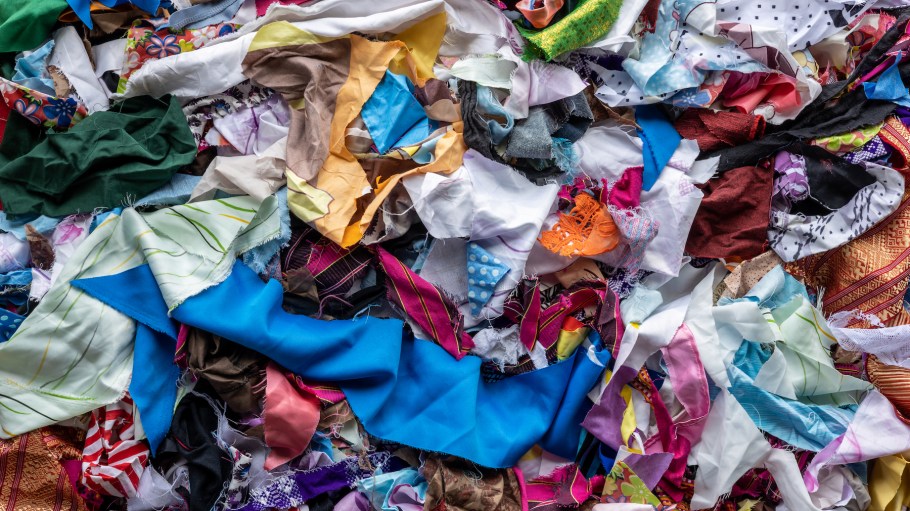
When those garments reach the end of their use by consumers, Circle Economy found that 61.4 percent of those items end up in landfills or incinerators. The report discovered that 8 percent of discarded textiles are reused or exported, with the volume of traded secondhand clothing growing nearly sevenfold over the past three decades. According to data from 2021, the European Union leads the world in used clothing exports at 30 percent followed by China at 16 percent and the United States at 15 percent. Those items are primarily imported to Asia (28 percent, led by Pakistan), Africa (19 percent led by Ghana and Kenya) and Latin America (16 percent, led by Chile and Guatemala). Ghana’s Kantamanto Market process more than 150,000 metric tons of textiles annually, importing $164 million dollars worth of used clothing in 2022, primarily from the UK, China and Canada.
Circle Economy found that 6.3 percent of textile waste ends up in cascading recycling, while 2.2 percent is lost during collection and sorting.
The report also looked at how the textile industry impacts climate change, finding that it accounts for 3 percent of climate impact in general, and 13 percent of impacts from global production and manufacturing. The industry also causes 6 percent of water scarcity from retail and 5 percent from waste management.
In regard to greenhouse gas emissions, raw material extraction for textiles accounts for 21 percent of emissions, while processing these materials into yarn or other textile-related products contributes another 15 percent. Material production, which includes making and finishing fabrics and trims, is the largest source of greenhouse gas emissions in the textile supply chain, accounting for 55 percent. Assembly and manufacturing of finished textile products adds another 9 percent to the industry’s overall greenhouse gas emission tally.
The analysis found that the textile industry accounts for more than 2 percent of global air pollution, and more than 3 percent of the world’s biodiversity loss. Around 17 percent of the biodiversity loss attributed to global production and manufacturing is caused by the textile industry.
The textile industry also has a significant impact on microplastic pollution in the world’s oceans. According to the report, 16 to 35 percent of microplastics entering oceans come from synthetic textiles, with 0.2 to 0.5 million metric tons of microfibers from textiles reaching marine environments each year.
Circle Economy outlines two core objectives in pursuit of increasing the textile industry’s circularity metric—the portion of material consumption derived from secondary materials. First, minimize resource extraction from the earth and ensure biomass production and extraction are regenerative. And second, minimize material waste while increasing reusability.
“Typically, we measure circularity by looking at materials flowing into the economy. In the case of the textile industry, we measure it by analyzing what materials flow through the global value chain, and how,” the report said. “This gives value chain actors an understanding of the current state, providing a jumping-off point for informed decision-making.”
The report offers four strategies for meeting these objectives: Narrow flows by using fewer materials (including fossil fuels) in textile production, slow flows by using textiles longer, regenerate flows by using cleaner alternatives to fossil fuels and other pollutants, and cycle flows by reusing textiles at the end-of-life stage.
“The Circularity Gap Report is groundbreaking as the first in-depth analysis to measure circularity within the textiles sector, highlighting the urgent need for solutions that transform the entire textile value chain toward a circular model,” said Hilde van Duijn, managing director, Circle Economy Foundation. “Only through concrete, scalable actions can the industry contribute meaningfully to a sustainable future.”
The H&M Foundation has supported a number of efforts recently aimed at improving circularity in the fashion and textile industries. Earlier this year, the foundation committed 5 million EUR to the Global Fashion Agenda’s textile circularity initiatives through the Global Circular Fashion Forum. Christiane Dolva, head of innovation, research and demonstration at the H&M Foundation, said the organization funded the Circularity Gap Report to provide the textile industry with actionable insights to reduce its impact on the environment through circularity.
“(The report) emphasizes the most impactful circularity efforts,” she said. “While not a complete solution, circularity can drive meaningful change. We hope these insights will support industry-wide transformation, benefiting both people and the planet.”