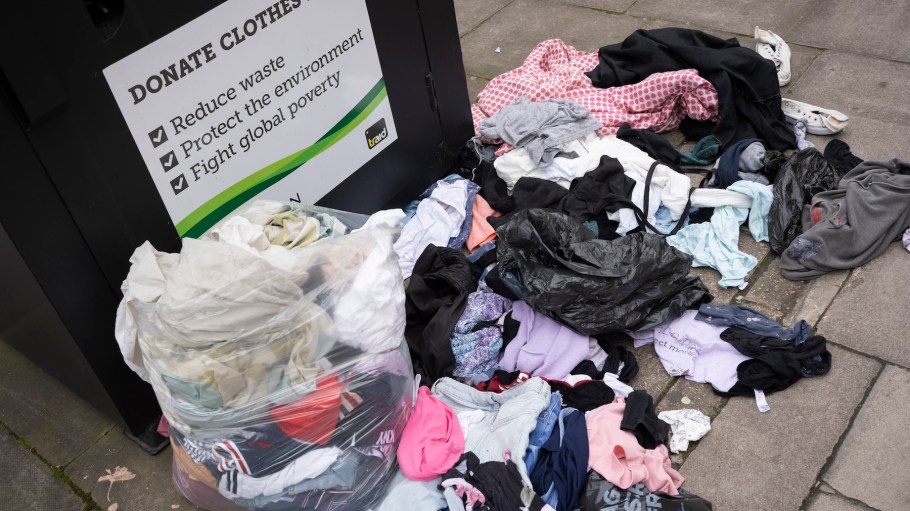
With an estimated 700,000 metric tons of non-reusable textile waste generated in the United Kingdom each year, the region is overdue for real solutions. Paris-based textile-to-textile recycler Reju and London’s Circle-8 Textile Ecosystems are betting that infrastructure—not intention—is what will make circularity possible.
The two partnered to launch a new automated textile sorting and preprocessing (ATSP) facility aimed at supplying high-quality feedstock to Reju’s regeneration network and, ultimately, further facilitate the UK’s circular textiles ecosystem.
Related Stories
That means Circle-8 will supply Reju’s future European “regeneration hubs” with post-consumer textile waste feedstock, processed at its inaugural digitized ATSP facility. The resulting material powers the production of Reju Polyester, an infinitely regenerable fiber with half the carbon footprint of virgin polyester.
“Working with Circle-8’s growing ecosystem and ATSP enables us to elevate the efficiency of the textile recycling process—making it easier and more precise—resulting in a premium product meeting Reju’s high standard for polyester,” said Patrik Frisk, CEO of Reju. “As more consumers and clothing producers become aware of the importance of keeping textiles out of landfills, it’s critical to have automated, streamlined processes and facilities in the places where the textile waste is.”
The new plant builds on momentum from Reju’s first demonstration site—Regeneration Hub Zero—which opened in Frankfurt last October with the capacity to produce up to 1,000 metric tons of recycled polyester annually. Also announced were the larger ambitions already underway: the Technip Energies-owned company is targeting both additional European regeneration hubs and a U.S. plant by 2027.
Ideally, this partnership can build the critically-needed infrastructure for fiber-to-fiber recycling, the partners said, “laying the groundwork for a scalable, transparent circular textile ecosystem.”
“Reju and Circle-8 share an unwavering commitment to unlocking true, indefinite textile-to-textile recycling here in the UK and around the globe,” said Cyndi Rhoades, co-founder and CEO at Circle-8, noting the partnership highlights the importance of cooperation and innovation in turning textile waste into a resource. “With global regulatory bodies enacting coordinated efforts addressing the issue, Reju and Circle-8 are dedicated to scalable solutions meeting regulatory demands and achieving a more sustainable future.”
In May, Circle-8 acquired a single-line sorter from Denmark waste management solution provider, NewRetex. This launched the circular network developer’s first 25,000-ton-per-year ATSP plant. The sorter is partially funded by the Autosort for Circular Textiles Demonstrator (ACT UK) project, supported by Innovate UK.
The same month, Circle-8 also shared plans to scale a system of ATSPs, intending to convert non-reusable textiles into feedstock for high-volume recyclers, while also forging the partnerships needed to accelerate fiber-to-fiber recycling.
Both announcements were made around the same time that Reju tapped Chemelot Industrial Park in the Netherlands as the site of its first industrial-scale regeneration center. Once operational, the Sittard plant should regenerate the equivalent of 300 million garments annually. It will also produce 50,000 metric tons of recycled PET (rPET) each year, which will be repolymerized into Reju’s proprietary PET and spun into Reju’s proprietary polyester.
The Chemelot facility is the Netherlands’ first large-scale textile-to-raw-material recycling plant, according to Deputy Prime Minister and Climate Policy Minister Sophie Hermans.
In June 2023, the UK Fashion and Textile Association (UKFT) led a 4-million-pound (roughly $5 million) project to develop and pilot an ATSP through the Autosort for Circular Textiles Demonstrator (ACT UK) two-year plan. As a major partner, Circle-8 received a good chunk of change from Innovate UK’s multi-million-dollar grant (alongside a consortium of 21 industry partners) to design and develop a blueprint for the UK’s first ATSP.
As a key member of ACT UK, Circle-8 works with value chain stakeholders to validate the circular textile systems economy. Through its independent collaboration with Tomra, Circle-8 pulls from the tech firm’s existing experience (Tomra was the main technology provider for the world’s first ATSP in Sweden) to develop solutions designed for this future ATSP in the UK.
ACT UK is building on sorting approaches that are coming to market in countries including the Netherlands—where regulations state that textile producers are responsible for what happens to their products after use—as well Sweden, home of Renewcell, and Spain, which recently saw apparel leaders like Inditex, H&M and Mango partner to form the Association for Textile Trash Management. The UK’s approach aims to innovate by combining and advancing existing technologies, while supporting emerging ones, to overcome the current barriers to material circularity.