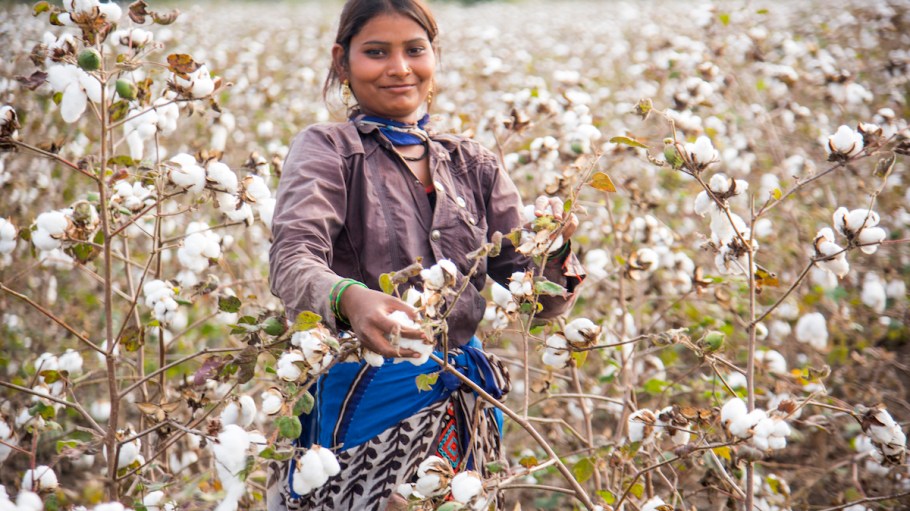
Better Cotton has released its 2023 India Impact Report which shows notable progress on reducing pesticides and water use, as well as marked improvements in farmers’ livelihoods.
Reflecting changes that occurred between the 2014-15 season and the 2021-22 season, the report showed multiple tangible benefits to the land and its farmers when a cotton crop is more sustainable.
The world’s largest sustainability program, Better Cotton has also announced the launch later this year of its first traceability initiative. This announcement was made at the World Trade Organization’s (WTO) Public Forum in Geneva at a Sept. 15 event titled “Traceability as the Key Enabler for Improving the Sustainability of Cotton Value Chains.” It was moderated by Jacky Broomhead, Better Cotton’s senior traceability manager.
Related Stories
The comprehensive new India report shows that pesticide use has declined among Better Cotton member farmers by 53 percent, using a three-season average of the years 2014-2017 as a baseline, then comparing that with the 2021-22 season. Better Cotton attributes the drop to better training on Integrated Pest Management and effective awareness campaigns.
The number of farmers using highly hazardous pesticides (HHPs) was also down, cut to 10 percent from 64 percent. Those using Monocrotophos, a pesticide considered highly toxic by the World Health Organization (WHO), dropped to 2 percent from 41 percent.
Water usage for irrigation was also down. It dipped by 29 percent between the baseline period and the final season measured. Excessive use of nitrogen, which drives greenhouse gas emissions when over-applied, fell by 6 percent per hectare.
Better Cotton launched its program in India in 2011, with tens of thousands of farmers signed on. It has since grown to have almost one million adherents.
Their livelihoods have much improved, according to the report. Between the 2014-15 season and the 2021-22 season, total cost per hectare (excluding land renting) dipped by 15.6 percent compared to the three-season average baseline. Better Cotton attributes this decline to lower costs for land preparation and fertilizer expenses. In addition, the farmers had a lint yield of 650 kg per hectare, or 200 kg per hectare higher than the national average.
Those farmers now count more women in their ranks of field facilitators across India. In the 2022-23 cotton season, some 25 percent of facilitators were women, up from 10 percent in the 2019-20 season.
The traceability initiative will soon begin to measure supply chain visibility for all industry stakeholders, feeding cotton through new Chain of Custody models that monitor product as it flows through the value chain. This will give stakeholders, fashion retailers and brands information on country of origin as well as the proportion of Better Cotton in their products.
Traceability will also connect farmers to the supply chain and serve as the foundation for an Impact Marketplace Better Cotton is developing. This will reward farmers for their transition to more sustainable farming.
Better Cotton is at a turning point in India where it will now shift focus from growing ranks to deepening its impact with an emphasis on identifying necessary improvements and development gaps. There is also a departure from the original brief where Better Cotton gathered information by comparing members with non-members to chart their progress.
“Since the first Better Cotton harvest in India in 2011, the country has been a pioneering force with the Better Cotton program,” said Better Cotton CEO Alan McClay. “We’re buoyed by the results in this Impact Report, which demonstrates the environmental, social and economic benefits of Better Cotton production, and remain committed to driving further improvements at the farm level.”
Last week’s traceability panel at the World Trade Organization’s Public Forum focused on how fashion and textile supply chains could benefit from traceability, particularly in the face of new due diligence legislation, investor pressure and heightened consumer expectations regarding the environment and sustainability. Better Cotton’s Broomhead noted how the organization will make a concerted effort to avoid favoring large, well-developed organizations but benefit the entire textile industry, including its smallholders.
Participants included Maria Teresa Pisani, officer-in-charge of the United Nation’s Economic Commission for Europe’s (UNECE) trade facilitation section, Gregory Sampson, solutions architect at the International Trade Center (ITC), Jeremy Thimm, organic production specialist at the Global Organic Textile Standard (GOTS), and Josh Taylor, traceability manager at Better Cotton.