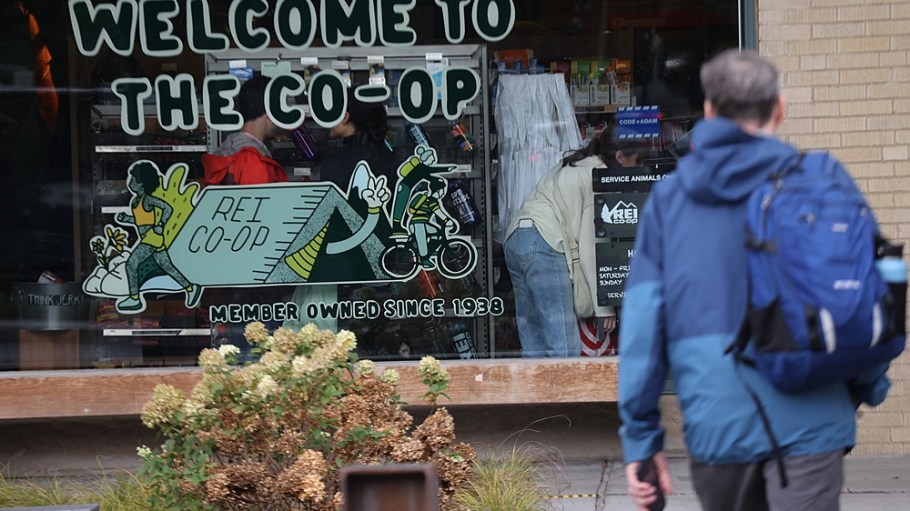
Ambercycle’s three-year offtake agreement with REI Co-op to scale its textile-to-textile recycled polyester, announced Tuesday, is a bigger deal than it appears to be, at least at first blush.
The Los Angeles-based innovator has already thrown in its lot with plenty of names, from the household—Athleta, Arc’teryx, Ganni and Reformation—to those with more insider recognition—Far Eastern Group, MAS Holdings, Shinkong Synthetics and Hyosung— to drive adoption of its Cycora material, which is “molecularly regenerated” from textile waste, including castoff clothing.
Related Stories
But REI isn’t just America’s largest specialty outdoor retailer, said Shay Sethi, CEO of Ambercycle. It’s also a marketplace that stocks a sprawling number of brands besides its own. That gives it the ability to bring Ambercycle’s take on “closing the loop” to a whole different echelon by “being a leader in the overall outdoor industry,” he said.
“The Patagonias of the world sell through the REI retail distribution channel,” Sethi said. “So we’re working through not only deploying into REI’s own products, but how we can work together with REI to build more of an industry leadership sort of viewpoint where REI can help transition a lot more of their supply chain base for their retail suppliers.”
While the financial details of the offtake agreement are still under wraps, what Ambercycle can reveal is that it establishes what it describes as a “phased pathway” for Cycora’s integration, another first for the innovator as it ramps up its volumes with its inaugural commercial-scale plant, the who, what, where and how much of which will be coming fairly soon. Until then, Ambercycle is able to pump out roughly 2 tons of Cycora per day at its demonstration facility in Wisconsin.
“What’s really important is taking things one at a time, and working through all the challenges,” Sethi said. “We’re developing the infrastructure right now to produce these circular raw materials to go into products. And our intention—our goal—is to make it easy for customers to interface with this circular business model. And so for us, it’s really exciting to think of an REI as an aggregation point.”
What this means in practical terms is that Ambercycle and REI will begin with employing Cycora in what they consider “priority” performance categories, such as the retailer’s own-brand Magma sleeping bag, XeroCloud rain jacket and the Road Tripper duffel bag, all of which are heavily reliant on what has become an almost 50-50 mix of conventional and bottle-to-textile recycled polyester.
The next step? Broader integration as the supply of Cycora builds and the companies work to recapture unwanted REI products to provide further grist for new ones. With more than 180 stores across 41 states, the nation’s biggest consumer co-op has a clout that few stand-alone brands can muster in the take-back stakes, making it easier to accrue the types of quantities that Ambercycle needs.
And for REI, which has increased by fivefold the portion of recycled polyester that goes into its products since 2020, teaming up with Ambercycle to hike up the production of low-carbon materials is a way to deliver “real impact” for both its 25 million members and the broader industry.
“At REI, we see next-generation materials as critical to building a decarbonized future for outdoor gear,” Ajay Chadha, director of materials innovation at REI, said in a statement. “As we work toward our 2030 goals, REI is investing in science-driven solutions like textile-to-textile recycling to cut emissions at the feedstock level and reduce reliance on virgin polyester.”
Sethi said that one of the things that appealed to REI was the quality of some of the yarns Ambercycle had been experimenting with for applications such as technical outerwear and performance laminates. Things started clicking into place when Cycora was able to outmatch bottle-to-textile polyester.
“Bottle-to-textile does redirect a significant amount of material that would otherwise go to the landfill,” he said. “But if you think about the mechanical recycling process, you can’t get that molecular-level purity. It’s reliant on the quality of the inputs quite a bit. And a lot of the high-quality materials are going back into the bottle industry, and they’re not being used for textile applications.”
By breaking down polyester to its base polymers, then purifying them in order to reassemble them back into fiber, Ambercycle is able to make really thin yarns that are a challenge to whip up using discarded plastic bottles, Sethi said, citing feedback from the company’s spinning partners.
“With the traditional mechanical process, you are also carrying through some part of the contamination in the feedstock,” he said. “If, for example, someone put motor oil in their water bottle, you have a problem. And so this has been a performance-level differentiation, we think, where the quality meets up with the brand messaging and the types of SKUs that our product goes into.”
By Sethi’s count, Ambercycle has inked more than a dozen offtake agreements with both brands and fiber producers. The bifurcated approach isn’t by accident, and each one is equally important, he said. On the one hand, the perception of working directly with a brand is “really good” for investors and external partners that are financing projects. On the other hand, hitting spec requires supply chain integration with “quality partners” that can do the behind-the-scenes grunt work of running a novel material through its paces. What it frequently comes down to, in the end, is size.
“In some of the cases, we’ve had to, if the brand is not large enough to do an offtake agreement directly, we can have a couple of brands partner together and buy from one supplier so we can aggregate demand through the supply chain,” Sethi said. “But at the end of the day, there has to be a full, cohesive supply chain for these products to move. So whether it’s a brand offtake or a supply chain offtake, both chains need both a brand, a supplier and Ambercycle.”
That philosophy holds, too, for a considerable business like REI. Making headline commitments is one thing, but inserting a relatively unknown element into an established operation is quite another.
“It’s really easy for an executive committee to say, ‘OK, we’re going to buy this material; we’re going to commit to buying in the future,’” Sethi said. “But then you have to go through the steps to integrate that into each product line.”
Alongside REI’s ready-made ecosystem is a similarly substantial opportunity. Everyone loves REI, he said. Its “extremely high” brand value aside, innumerable brands also value its input and guidance on “what the future is going to be with their customer base.” And despite the market uncertainty that’s proving to be hard to shake, Sethi added, the slowdown in new demand for circular materials has been accompanied by an increase in interest in those same materials.
“We feel pretty good that this is not a permanent reality and stability will find us all soon,” he said. “So we’ve been thinking, besides encouraging REI’s use of circular materials, what other activations can we do with this huge retail footprint, so it goes beyond just we’re selling material and they’re just buying material? This is an opportunity for us to build a story for a lot more brands than just the REI. They have the ability to transform the narrative.”