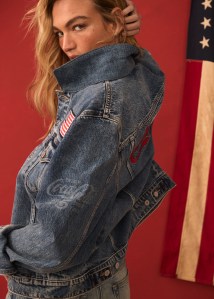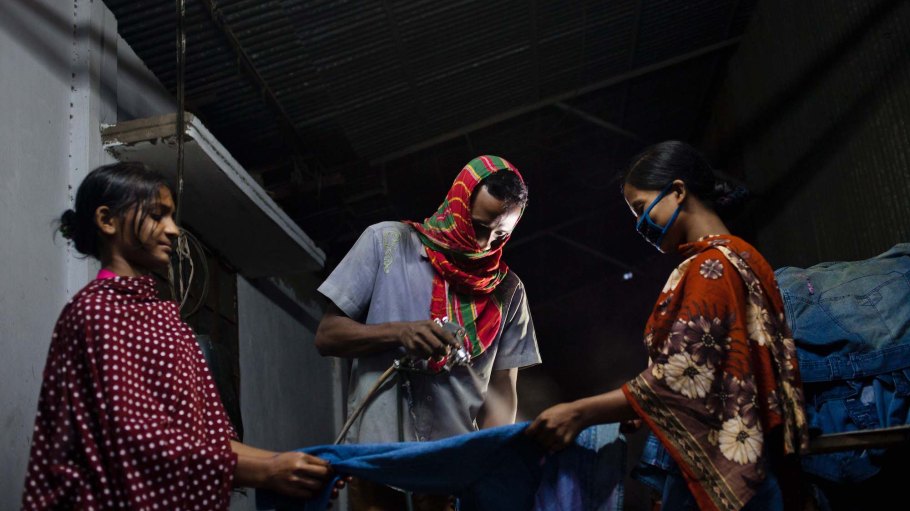
Consumers adore vintage-looking jeans, but potassium permanganate (PP), a chemical oxidizer that is used to accentuate worn, faded design elements on denim remains one of the denim industry’s dirty little secrets.
Though PP is not banned in any country, it is on the hazardous chemicals list of the United States Environmental Protection Agency and is classified as a hazardous substance by the European Chemicals Agency for being toxic to aquatic life, causing severe skin burns and eye damage, damaging a fetus and fertility and damaging organs through prolonged or repeated exposure.
Related Stories
In 2018, Levi Strauss & Co. took a major step forward in chemical management when it launched Project F.L.X., a future-led operation model digitizing denim finishing and eliminating manual techniques. Through Project F.L.X., the denim giant eliminated up to 90 percent of chemical formulations used in jeans finishing, reducing thousands of chemical formulations to a few dozen and phasing out of the use of potassium permanganate.
It is still a work in progress, however.
“Levi Strauss & Co. is committed to responsible chemicals management and to driving sustainable progress within the apparel industry. We have greatly reduced the use of aerosolized PP spray and continue to mandate strict usage guidelines in the places it has not yet been phased out, including the use of personal protective equipment and detailed safety protocols,” the company stated.
In Target’s 2025 Sustainability and Governance Report, the retailer said it made progress “designing out” potassium permanganate (PP) in all owned brand denim products, meeting its 2025 goal.
Indeed, the trajectory of the textile industry is increasingly aligned with environmental and health safety standards, which are steering away from chemicals like PP. Sumit Sarker, sustainable textile expert at Bluesign Academy, said this shift is driven by growing consumer advocacy for sustainable practices and the availability of safer, more efficient alternatives.
“Moreover, as regulations tighten globally, the industry is responding by innovating and adopting cleaner technologies,” he said. “This regulatory and market evolution strongly indicates that the use of potassium permanganate could very well be phased out in the near future.”
The chemical is in the Candidate List of the ZDHC MRSL V3.1, meaning that it is a potential candidate for phase-out and addition to the main list in the next update of the ZDHC MRSL. “The decision to include the substance in the Main List of the ZDHC MRSL V4.0 will be taken by the MRSL Council based on the possibility of scalable safer alternatives being available, as we always intend our MRSL to be a pragmatic standard that can be implemented by the global industry,” ZDHC stated.
Until then, ZDHC has a host of recommendations outlined in a training module on ZDHC Academy for chemical management in denim industry explaining exposure and emission controls as well as best practices for storage and handling.
“Our position is that potassium permanganate must never be used without appropriate engineering controls (such as water curtains and localized extraction) and workers must always use appropriate personal protective equipment. Suppliers are strongly encouraged to evaluate alternatives to manual spraying of potassium permanganate such as lasers, robotized spraying or safer chemical alternatives,” ZDHC stated.
Rather than prohibiting PP spray, a February 2024 report by Clean Clothes Campaign Turkey (CCC Turkey) said MRSL urges brands to take occupational health and safety measures when using it, which leads to signatories taking various approaches to PP spray in their supply chain.
For example, CCC Turkey said H&M implemented a PP spray ban at the start of 2024 and reported that Diesel is using alternative chemicals. In a questionnaire, Zara-owner and MRSL signatory Inditex confirmed to CCC Turkey that it uses PP spray but that periodic checks are made on its factories to examine whether sufficient safety measures are being made.
Other brands are less specific about their use of PP spray but highlight other sustainable technologies. CCC Turkey found that Guess and Pepe Jeans—both of which are not MRSL signatories—highlight their use of Wiser Wash technology. However, it is unclear if the technology is used in all jeans production.
“It is unclear whether any brand 100 percent moved away from PP,” said Bego Demir, Clean Clothes Campaign Turkey coordinator. “We have encountered instances of companies promising not to use PP in their products, but that products made by PP were nonetheless available in their shops.”
Any denim product treated with PP cannot be certified as a Bluesign product. The sustainable chemistry management system has taken a firm stance against potassium permanganate in the denim supply chain due to its significant health and environmental risks.
Bluesign System Partner companies are required to phase out the use of PP in denim finishing by the end of 2025. In the time remaining, Bluesign requires strict safety measures to minimize risks to workers. Additionally, wastewater treatment processes are required to limit the discharge of manganese into the environment. Partners must conduct substitution checks and develop a phase-out plan at their production sites.
“The ultimate goal is the complete elimination of potassium permanganate to ensure a safer and more sustainable denim industry,” Sarker said, adding the industry-wide shift reflects a “strong commitment to eliminating hazardous substances in denim processing.”
Making that transition is not without challenges. “While there is a strong movement among our system partners towards banning potassium permanganate, its use persists in many operations due to specific customer requests. Despite these challenges, there is a shared commitment across the industry to eliminate its use. Bluesign supports these efforts and is optimistic that, through collaborative efforts, we can fully achieve this goal,” Sarker said.
Saitex is committed to removing PP from its denim supply chain as part of its Bluesign-approved sustainability efforts. However, it is one of the partners that still uses it “in exceptional cases where no viable alternative exists and the application falls outside Bluesign’s scope,” said Jerome Lallouette, Saitex COO.
In these instances, Lallouette said the company ensures strict control measures, including a closed-loop water system to capture, treat, and safely dispose of the chemical, preventing environmental discharge and precision robotic spray application to ensure worker safety. “This approach balances sustainability goals with operational realities, ensuring that any necessary use of PP remains minimized, controlled, and environmentally responsible,” he said.
Cocktail solution
Most companies rely on a suite of solutions to replace PP.
Approximately 85 percent of Saitex’s production is PP-free. The vertically integrated denim manufacturer started removing the chemical from its manufacturing system eight years ago.
Saitex prioritizes laser technology, ozone treatments, and eco-friendly chemical alternatives to achieve vintage and worn-out denim effects without hazardous substances. Additionally, most of Saitex’s fabrics are designed to react well with the technology it uses to eliminate PP.
“There is no one-size-fits-all solution, but rather a combination of innovative techniques that can be applied case by case to achieve the desired denim aesthetics while reducing reliance on PP,” Lallouette said.
Sarker said ozone treatment is a widely used method, effectively bleaching denim with ozone gas, reducing water and chemical use. Laser technology provides precise fading effects without chemicals, improving worker safety. Enzymatic finishing also offers a biodegradable and eco-friendly approach.
Tonello, the Italian company specializing in sustainable technologies for denim and garment washing, dyeing, and finishing, offers multiple alternatives to PP.
One effective approach combines The Laser with Core and the All-in-One System. By using laser technology with ozone washing, Alice Tonello, R&D and marketing director for Tonello, said it’s possible to achieve similar effects without the need for hazardous chemicals. Additionally, the Core nebulizing system enhances these results by applying products that amplify the laser effect, creating an even closer match to traditional PP treatments.
Despite the options, Tonello said only some brands and clients see PP as a major concern. “It’s likely that potassium permanganate will eventually be banned, but the market expects a viable alternative that offers the same cost-effectiveness and ease of application. Until then, its phase-out will depend on the availability and adoption of safer, scalable solutions,” she said.
Reality hurts
Although there is a desire in the industry to replace PP with safer alternatives, in some cases, Sarker said the alternatives may not yet be feasible or effective technologically or financially for some companies.
“Brands are under constant pressure to reduce their use of potassium permanganate due to its environmental and health risks, and they are actively exploring and testing safer options. However, the transition is complex and requires significant industry collaboration and innovation to fully implement safer alternatives,” he said.
“I wouldn’t want to crush anyone’s dreams, but I believe that the majority of the industry still uses potassium permanganate in production,” said Luca Braschi, Soko marketing and technology manager.
A significant factor behind its popularity is its cost-effectiveness. PP is one of the least expensive and easiest products to apply. Price dictates the market and decisions, Braschi said, adding that if a product costs less and achieves the results every brand desires, producers must comply with this rule.
“We don’t have exact percentages, but a majority of brands are using PP, because it is very cheap and a fast process,” Demir said.
Most brands rely on supply chains of factories they don’t own but effectively control through their purchasing practices, he said. Their unrelenting demand for lower prices and the ability to take their business elsewhere leads to factories driving down their expenses including wages and measures for workers’ health.
“This also leads them to take the cheapest options to achieve the look a brand desires, unless certain methods are specifically excluded by brands and explicitly enforced by them,” Demir said. “Brands have thus far chosen the cheapest chemical option to reach a stressed denim look and have not felt an economic need to change to other methods. As long as their image is not at stake, the cheapest option will do.”
Inserting a new product within the production chain is never easy, as you are going to modify routinized and optimized processes, said Andrea Venier, managing director of Officina39.
“The situation is even more difficult if the product you want to replace has a low cost and at the same time has consistent performance over time,” he said. “Unfortunately, there are still many companies that use PP for denim productions and washes, but just as many that are trying to implement alternative solutions.”
The Italian chemical company is one of those changemakers. Though there is “no single solution,” Venier said there are several alternatives that include products without PP and heavy metals. Officina39 introduced ZeroPP last year, an integrated package of low-impact specialty chemicals that works in synergy with the latest machine technologies like laser, ozone and nebulization. The cost-neutral alternative completely replaces permanganate and achieves similar basic effects, Venier said.
However, companies also need to learn from their past mistakes to ensure that the alternatives are verifiably less hazardous. Demir noted how PP was intended to be a replacement for sandblasting which caused the occupational disease silicosis, a deadly illness that killed hundreds of workers. CCC Turkey reports that PP’s long-term effect could be similarly damaging and that studies are needed to determine whether it causes cancer.
Sarker said it is critical to ensure sufficient data is available on alternatives’ toxicity and environmental impact to prevent regrettable substitutions. Similar oxidizing agents that may pose occupational health risks and wastewater issues akin to PP should be avoided.
Preparing for change
Many experts in the industry believe PP will have the same fate as sandblasting.
In 2009, to halt the spread of silicosis, Turkey banned the use of sandblasting materials containing silica. The following year, Levi Strauss & Co. and H&M announced a global ban on sandblasting and encouraged others to join this ban in a move toward eliminating sandblasting as an industry practice.
“If brands now publicly commit to eliminating potassium permanganate, it will also be phased out from the industry. It is the collective responsibility of the entire industry—brands, manufacturers, and stakeholders—to drive this change and adopt safer, more sustainable alternatives,” Lallouette said.
“We are proud that most of our customers share this same vision, making the elimination of PP a key priority in their sustainability goals. This shared commitment strengthens our efforts to innovate and transition toward safer, more responsible production methods,” he added.
Driving change is challenging, but Venier predicts that PP will eventually be banned from the denim industry. Until then, he said it’s up to the supply chain to educate brands how to use alternative solutions through dedicated workshops.
“Education on sustainability and reducing environmental impact is a gradual process that takes time to be fully embraced,” he said. “If brands decide to eliminate this kind of product from their productions, they will consequently push their suppliers to replace PP in their productions. This certainly can help speed up the decision to eliminate and permanently ban the product. The less demand and need for a product, the easier it will be to eliminate its use.”
Change doesn’t come easy for denim, especially due to the distinct washes and finishes that are signature to the final product. While the transition away from PP is notably difficult for the denim category, Sarker is hopeful that increasing consumer demand for sustainability and tighter regulatory pressures will help brands make the leap to PP-free manufacturing.
“Brands are actively embracing innovative solutions like laser technology and plant-based dyes to overcome these hurdles. While there is some resistance due to the costs involved and traditional practices, the industry is gradually recognizing the long-term benefits of safer chemical practices. There’s a growing willingness within the industry to explore these new technologies, showcasing an evolving approach towards more responsible manufacturing methods,” he said.
This article was published in SJ Denim magazine. Click here to read more.