Amassing a cult-like following requires cultivating cult-like logic, and at Standard & Strange (S&S), that logic applies to both the brands it carries and the customers it serves.
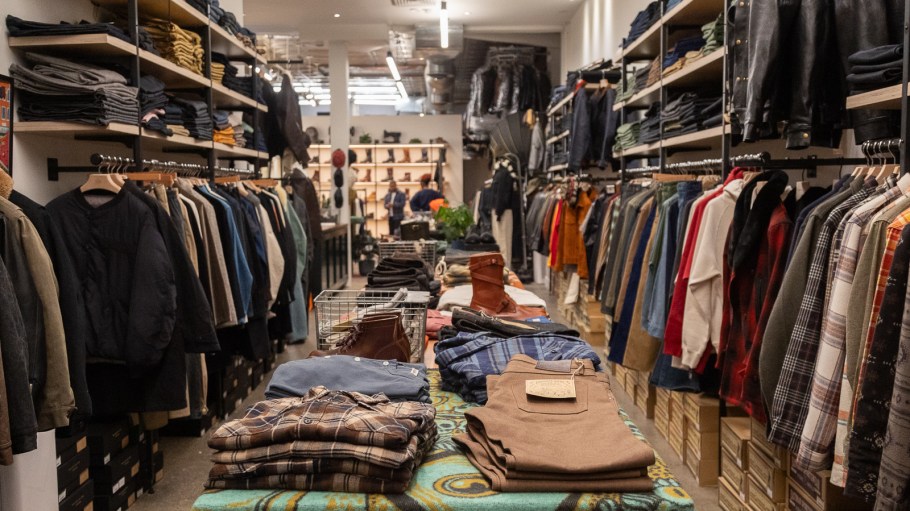
From a 200-square-foot stable in Oakland, Calif. to a trio of stores in Berkeley, Santa Fe and New York, the retailer has grown by upholding high standards on both sides of the counter—and across coasts. Brands must show commitment to craft and longevity before making it onto the shelves. Customers receive equally exacting service.
Related Stories
S&S began in 2012 on Oakland’s Temescal Alley, where Jeremy Smith and Neil Berrett were creating Cali-made merino wool jerseys. The two met through the Bay Area cycling scene. The partners positioned the shop, located in a rather hip district, as a hub for quality, made-in-America apparel—particularly for denim and heritage styles.
Berrett parted ways with the indie retailer earlier this year. Though the business has evolved, its mission remains unchanged. The once-small indie has grown into a bicoastal men’s wear destination, continuing its focus on USA-made goods and rare brands out of Japan and Europe.

“We have a number of criteria that all need to be met in order to carry a brand of denim,” Smith said. “At one point, we had around 50 choices for fit—probably 100 or more counting variations in denim per style.”
S&S follows a more pared-down strategy for merchandising nowadays. While S&S has tried to carry some big brands like RRL and Red Wing Heritage, the heritage powerhouses were never quite the right fit. “We need that personal relationship in order for the brand to succeed with the way we do business,” Smith said. “If we can’t sit down with the founder or owner and designers of a brand, it’s not for us.”
Also not for S&S? One-hit wonders.
“There are a number of brands out there that, for lack of better words, are rather cynical and opportunistic in their choice to make denim in our category,” Smith said. These are also the brands that tend to drop off, he added; another reason it’s never worth engaging. “We want to work with people who are dedicated to denim and willing to put in the years of work that it takes to make a truly great brand,” Smith said.
That’s also why onboarding brands need to offer something that S&S doesn’t already have.
“There are an infinite number of Japanese denim brands—and denim brands around the world all using Japanese denim,” Smith said. “Very few offer a unique perspective.”
Take, for example, the Vocalion from Black Sign. Made from 100 percent cotton, the high-rise, wide, straight leg jean boasts finished seams and bar tacks. It’s one of Standard & Strange’s top-selling jeans. “It’s a unique silhouette while still being legible as a five-pocket,” Smith said. “It’s wide without being overwhelming and has a shape that will still be wearable even after the fashion pendulum swings back to skinny jeans.”
Considering these “nice and hairy” 15-ounce Japanese selvedge jeans cost a cool $300, S&S requires excellence in fit, construction and materials. This is non-negotiable, per Smith, applicable regardless of price point.
“We have significant expertise across our team in denim; we can spot products that don’t meet our standards,” he said. “We also have in-house hands-on patterning and sewing knowledge, which further allows us to dig into how a pair of jeans is sewn.”
On that note, S&S provides hemming, tailoring and repairs for everything it sells. The retailer can renew almost any product it sells, too. As such, cultivating connections with players across the finish line (such as specialty leather shops and shoe cobblers) is of equal value—especially since most of those tweaks are made in-house.
So, what is Standard & Strange’s unique selling point, exactly? Combining stellar service with deep product and brand knowledge, while selling rare and hard-to-find brands from around the world.
“Our commitment to customer service runs deep and starts long before we enter into a relationship with a customer,” Smith said. “For every product online, we photograph it, measure it—by hand, not AI tools— write accurate and complete copy about the garments, and provide fit advice.”
That knowledge is used in-store as well, with staff staying current on all offerings. As it stands, S&S employs 16 people across the three storefronts. The bicoastal company brings as many team members to meet brands worldwide as possible and vice versa, Smith said.
A low turnover rate means employees have opportunities to build personal relationships with clients. These days, those clients are interested in taking things slow. The company’s most popular wash is “Used Wash” from OrSlow. The Japanese label takes its name from designer Ichiro Nakatsu’s desire to make the opposite of fast fashion.
“We mostly sell raw or one-wash denim, because that’s what we specialize in; the few heavily washed styles we have sell out quickly, but we don’t invest heavily in that category to avoid being stuck with excess inventory when the trend toward washed denim ends,” Smith said.
Other popular brands include USA-manufactured Freenote Cloth and the aforementioned OrSlow for its military-inspired Japanese workwear. For velocity, Ooe Yofukuten takes the cake; Smith said S&S typically sells an entire 80-pair delivery from the Ichinomiya, Japan-based husband-wife duo, within 20 minutes.
“Our current top selling fits are wider—but with a well-fitting waist, rather than an anti-fit streetwear aesthetic,” he added, noting demand for all fits due to the fragmentation of trends in recent years.
While specialized, S&S doesn’t have a single customer type and refrains from making assumptions based on who walks through the doors of its three stores. Granted, the merchandise is about 80 percent overlapped across the locations, with each assortment dialed in for the local customer base.
“Every time we think we’ve nailed our customer profile, we discover another one,” Smith said. “The only commonality is the appreciation and understanding of quality—whether expressed explicitly or implicitly.”
This article was published in SJ Denim’s fall issue. Click here to read more.