Bespoke denim is back on the menu.
Sene, the Los Angeles-based fashion tech company, announced last week that it restarted its bespoke denim service after pausing it in February due to price increases incurred from tariffs on Chinese imports to the U.S. At one point, co-founder Ray Li said the brand’s $199 jeans rose to $299.
Though consumers were still ordering jeans despite the higher cost, the price discrepancies were becoming a burden to the company’s accounting department. “At a certain point we had to ask ourselves if it even worth it to be selling the jeans,” he told SJ Denim.
Related Stories
Whereas traditional brands produce in large batches and generally know their costs at the time of import, Li aid it became incredibly difficult for Sene to accurately project COGS (cost of goods sold) because they’re producing on demand and making products daily.
For example, if it takes two weeks to produce something, tariffs might be one rate at the start but change by the time the product ships—and that volatility makes pricing unpredictable, he said. On top of that, Sene offers a perfect fit guarantee, so if a customer requests a remake, the cost to fulfill that remake might be significantly higher than the original, which adds another layer of complexity.
A combination of U.S.’s revised rate on Chinese imports and renegotiated shipping rates have helped Sene bring its jean prices back to $199.
The bespoke denim program is key piece of Sene’s “one-to-one” fashion model designed to reduce textile waste. The company also produces made-to-order suits, trousers, blazers, T-shirts and shirts.
To order the jeans, customers select a style online and fill out a short questionnaire about their height, weight, body shape and style preferences. Once the information is collected, Sene’s manufacturing partner in China laser cuts and hand-assembles each piece. Jeans are shipped to customers within 3-4 weeks.
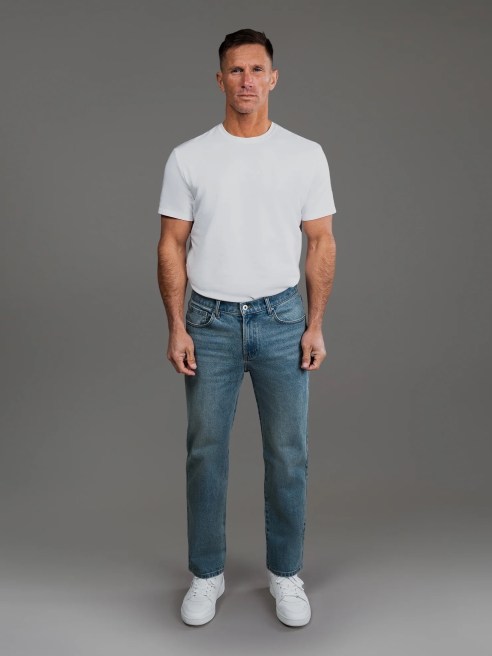
Sene’s jeans are made with two fabrics sourced from Japan: a 10.5 oz. super stretch and a 13 oz. rigid. Women’s jean styles include mom, relaxed, straight, bootcut, skinny and cigarette fits. For men, the brand offers straight and tailored fits.

Compared to traditional brands, jumping to a new sourcing hub to bypass extra costs is not an option. Sene is limited with the number of manufacturers it can work with to maintain its on-demand model. Additionally, reliable long-term suppliers who consistently meet fit and delivery expectations are crucial, especially since custom order require lot of technology and data integration.
“Thankfully we have enough hero products that are not impacted by the tariffs. All our tees, for example, are made in the U.S.—a move we made a few years ago,” Li said.
While on-demand models come with unique challenges, he pointed out how it provides flexibility during uncertain times. Sene can scale different product lines up or down in response to changing conditions, including tariffs.
“We can just turn off a product line and ramp up another product line as needed,” he said. “I really feel for brands that are sitting on next quarter’s inventory and unsure whether to ship or hold.”