LaundRE, the London-based, tech-driven laundry committed to reducing waste, is getting ready to flip the switch and launch. Founded by CEO Salli Deighton, the Docklands facility aims to provide U.K. brands with a local solution for small-batch laundry and finishing powered by laser, ozone and nebulization technologies.
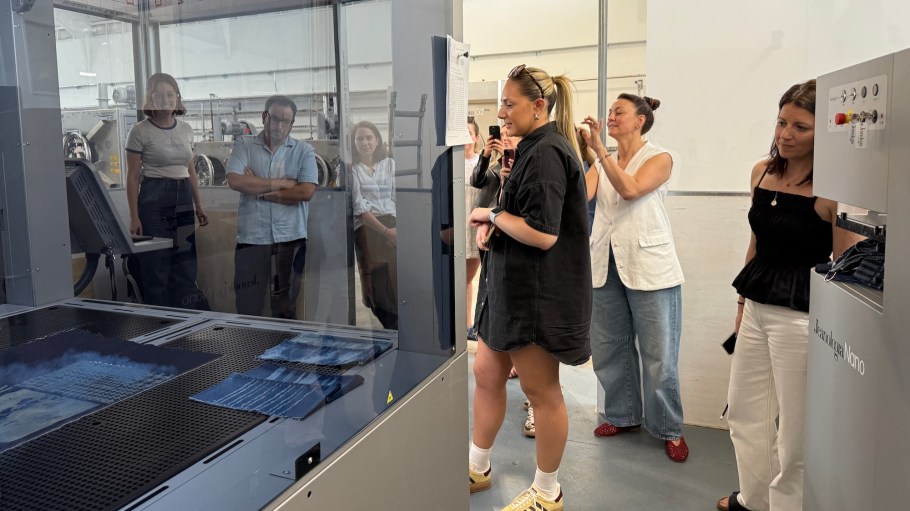
Deighton gave SJ Denim a virtual tour of the laundry floor outfitted with Jeanologia’s G2 and laser machinery and Yilmac’s Jeanius nebulizing systems and washing machines. Yilmac’s Rainforest washing machines reduce the usage of resources such as water, steam and chemicals and provides shorter process times. The drums can hold up to 70-120 pairs of jeans, which Deighton said suits brands’ request for low volumes. Two sample machines cater to brands that wish to offer bespoke and limited-edition collections.
Related Stories
Located in London’s Docklands, the former church turned laundry will have a capacity of 1,000 units a day by the end of its first year. However, a second shift can more than double the volume if demand is there.
The second floor offers dedicated space for educational programs, as well as showrooms for companies—such as fabric and fiber suppliers—whose products are compatible with LaundRE’s advanced washing and finishing technologies. “We’re not a conventional laundry. We won’t have pumice; we won’t have permanganate. We will be working slightly differently. It will give us a few restrictions, and we know that, but we believe the world is changing, and younger people are looking at clothing differently,” Deighton said.

Final audits and health and safety checks are expected to be completed in the upcoming weeks. Existing clients and potential customers are beginning to visit the space.
“We’re blown away with the amount of people who’ve asked to come and see it and people who want to collaborate. A lot of them want to do something different and having a laundry here is a problem-solving solution that helps companies be more tailored with what they do, more bespoke,” Deighton said.
Brands are also showing interest in using LaundRE in their reshoring plans by importing garments from places like Bangladesh and Pakistan and finishing them locally in small quantities to reduce overbuying and waste.
While every job is different—some clients want 300 jeans a week, others want to investigate rewashing existing products—LaundRE is in the process of standardizing its processes. Technicians from machinery companies are lending their support to train the crew. “We can only start testing the washing machines next week, but we’ve already been testing the laser and the ozone, so we know where we’re going,” Deighton said.
Green chemicals are used exclusively across LaundRE’s operations. Deighton said chemistry companies like Soko and Nearchimica have been especially invested in supporting the laundry’s launch, generously giving chemicals to run trials. Mills like Evlox have also provided textiles for testing.
A seven-person team will run LaundRE when it officially opens next month. Rowan Hunt, founder of Denim Research, will oversee R&D; Ivan Manzaneda, who previously led projects for Jeanologia’s Brainbox and Isko’s Creative Room in London, will focus on education; laundry expert Idrish Munshi will manage operations. Deighton said the company plans to add more technicians and apprentices soon, adding that finding qualified people is challenging because U.K. universities are not teaching processes like laser design.
“It’s a long time, and we feel very fortunate to be here,” she said about the female-led enterprise. “The way retail is operating and changing, I hope we give [clients] the ability to be more flexible. We won’t be the cheapest, but we’ve built our model sensibly.”
LaundRE was Deighton’s pre-pandemic pipedream. The idea was discussed seven years ago. A business plan was formed two years later. Momentum increased significantly over the past two and a half years with the arrival of Kelly Farewell, LaundRE’s CFO, who has led fundraising efforts with determination, even in the face of considerable challenges.
“In the U.K. women get about 9 percent of funding that is available. The men get the rest. So, I think we came up about against those challenges when we were raising money,” Deighton said. “Also, even though fashion is a big industry, denim is perceived as niche, and we were raising at a time when everybody’s wanting AI, which we are going to try and integrate into certain processes, but we were up about against big tech companies.”
LaundRE is continuing to raise money and apply for grant funding it wasn’t previously eligible for. Deighton noted that the business was able to get up and running without having to give up significant ownership or control. “Now we have that behind us. We’ve got lots of opportunities and we’re going to work hard to impress the industry, to get them and attract more investment as we move forward,” she said.
LaundRE is located next to ReSkinned, a U.K. textile recycler with over 20 years of experience in recycling, resale and repurposing pre-owned clothing. The E.L.V. Denim and Ahluwalia collaborator has become a big sister to LaundRE, providing fabrics for testing and access to essential equipment such as forklifts. Meanwhile, LaundRE’s nebulizing machines have proven to be useful for sterilizing ReSkinned’s textiles.
Together, these like-minded companies form a hub for sorting, mending, re-washing, and more—offering a glimpse into the future of circular design. The collaboration also highlights the close-knit, supportive nature of the U.K. textile community, which Deighton experienced firsthand throughout the long journey to launching LaundRE.
“We’re such a tiny country. It feels like they’ve got your back,” she said. “There’s quite a lot of people in the U.K. who genuinely really care about making positive change in manufacturing. I think everybody’s trying to pull together to make it happen.”