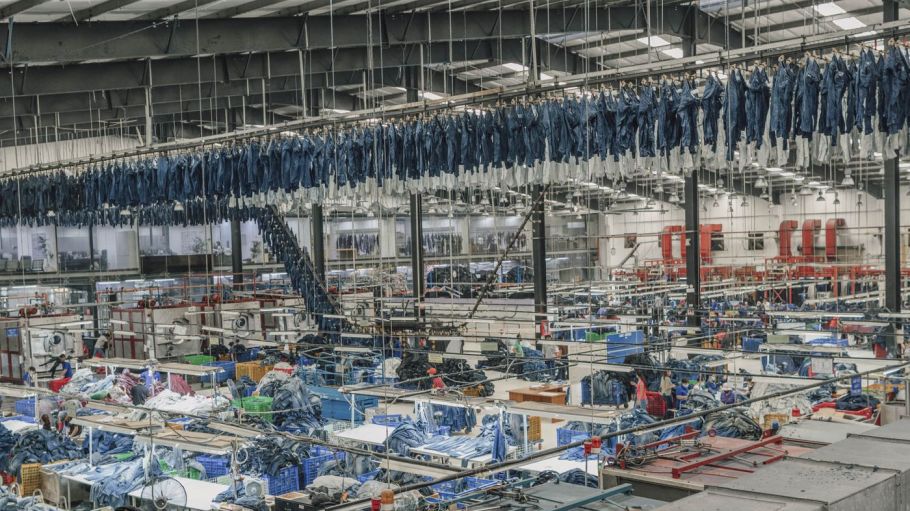
Saitex is scaling business in a sustainable way.
The Vietnamese denim manufacturer released its 2024 Impact Report, highlighting measurable progress toward net-zero operations and renewable energy expansion across its vertically integrated business.
“Our mission has never been about incremental change, but about systemic transformation,” said Sanjeev Bahl, founder and CEO of Saitex. “Our 2024 results exhibit that scale and sustainability are not in conflict. We’ve demonstrated growth can align with measurable reductions in carbon, water, and waste. As a vertically integrated ecosystem, we’re committed to sharing both our successes and shortcomings transparently.”
Related Stories
The report details how Saitex is laying the ground work for brands to offer more sustainable denim.
In 2024, 18 percent of the fabrics produced by Saitex Fabric Mill were primed for Cradle to Cradle Certified denim products at Gold level. This is a 59 percent increase in volume compared to 2023. The same percentage of fabrics were Bluesign Approved.
Additionally, “a stable customer base and more coordinated certification renewal schedule” allowed Saitex to reduce the number of third-party audits from 79 in 2023 to 70 in 2024.
Production at Saitex’s apparel manufacturing division grew 25 percent. However, the company cut carbon emissions by 18 percent largely due to “targeted process optimization” and the implementation of solar roofs at its sewing facility. Saitex’s laundry dry processing and finishing, packing, and warehousing facilities are scheduled for solar installations in 2025. These sites are expected to reach 19 percent and 50 percent solar coverage, respectively.
Steam usage per garment decreased by 26.8 percent in 2024. The company has long-term plans to modify washing machines to indirect heating systems to enable higher percentage of steam recycling. Saitex notes this will require significant investments which will be prioritized after the solar installations.
The popularity of coatings and “3D fashion trends” led to a 16 percent increase of gas usage per garment. Saitex’s water consumption also increased 7.29 percent per garment, due to scheduled maintenance needs for the firm’s Reverse Osmosis (RO) system, which requires filter replacement every three years. The aged filters led to a 21.4 percent of water discharge.
While waste increased 1.1 percent per garment due to the testing of new chemical formulations, Saitex recycled 40 percent of the total sludge generated into bricks for garden paths and concrete blocks for retaining walls.
Production at the company’s mill grew 124 percent, but carbon emissions and electricity consumption decreased 18 percent, respectively.
The mill runs on a 70 percent renewable energy mix, 34 percent which comes from a solar rooftop installation. Saitex reports that it has reached the maximum licensed rooftop solar capacity and are now exploring partnerships with the industrial park and external stakeholders to further increase its renewable energy inputs.
Steam decreased 33 percent and gas consumption decreased 12 percent—both due to more consistent production flows.
Though production more than doubled, Saitex reported that total water consumption remained consistent with the previous year due. All wastewater is treated in cooperation with the industrial park, but the mill aims to have a closed-loop wastewater system by the end of 2025.