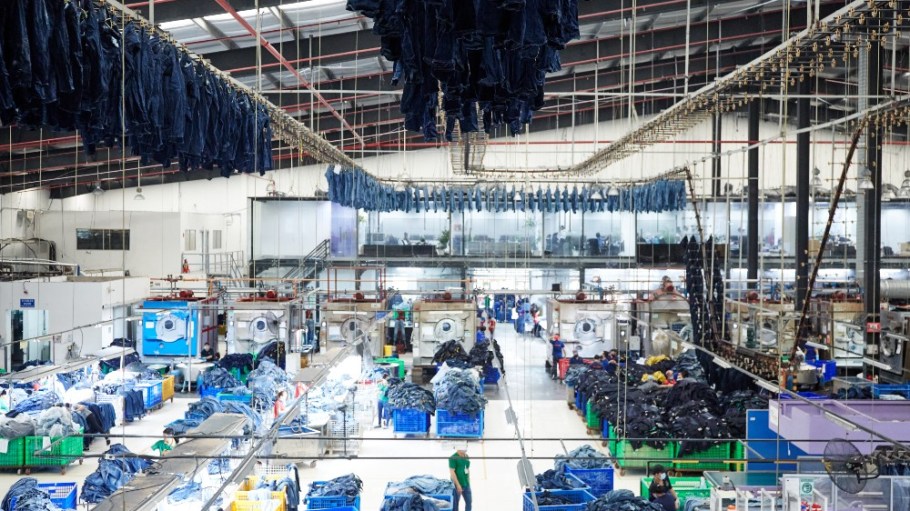
Vertical denim manufacturer Saitex is scaling circularity through its ecosystem of sustainable companies and initiatives.
The B Corp’s 2023 Impact Report provides a transparent account of the impact Saitex Apparel Manufacturing and Saitex Fabric Mill in Vietnam have made across raw materials, fabrics and manufacturing. The firm aims to set benchmarks in sustainable denim production through collaboration with leading global brands including Everlane, Madewell, Slvrlake, A.P.C. and more.
Related Stories
“Sharing our impact—whether positive or negative—is essential for progress,” said Sanjeev Bahl, Saitex CEO. “Our evolution as a circular system depends on setting ambitious goals and continuously improving where we fall short.”
One area where Saitex Apparel Manufacturing fell short is in electricity consumption, which had a negative trickle-down effect.
Saitex said a 29 percent decrease in production units in 2023 resulted in a 41 percent increase in electricity consumption per garment. The manufacturer said this “counterintuitive situation occurred due to several factors such as a minimum of energy needed to maintain the factory compressor, cooling, wastewater treatment and other ancillary systems.”
With increased electricity consumption, Saitex Apparel Manufacturing also experienced a 133-percent increase in total CO2 emissions and a 78 percent increase per garment on steam consumption.
The company is making progress toward its goal of running fully on renewable energy by 2027, however. The roof of the cut and sew facility was reinforced in June for solar panel installation, and Saitex has roof work planned for the rest of it’s the facilities. Currently, Saitex Apparel Manufacturing is running on 55 percent renewable energy mix from the national grid, where 29 percent is hydro-power based.
Additionally, Saitex Apparel Manufacturing is working on garment developments that can be washed in a single step to reduce the need for steam. In the longer run, Saitex said it would like to adjust washing machines to indirect heating systems to enable higher percentage of steam recycling. The company said these machine modifications, which require significant investments, will be prioritized after the solar installation.
Stelapop, Saitex’s division that upcycles waste into consumer products, continues to be instrumental in waste reduction. In 2023, Stelapop transformed textile waste into wood replacements, created more interior objects and furniture and launched a line of garment trims.
Underscoring Saitex’s commitment to transparency, the report states that Saitex Apparel Manufacturing saw a significant increase third-party visits in 2023, receiving 79 visits in total, including 19 audits for certification purposes. This averaged approximately 1.5 visits per week. Saitex said the increase was due to more frequent visits from existing customers and additional audits.
Saitex is seeing the benefits of being an early adopter of sustainable initiatives and technologies. In the report, the firm said 25 percent of all fabrics produced in the Saitex Fabric Mill, which opened in 2022, were “primed for Cradle to Cradle Certified denim products at gold level.”
This builds on Saitex Apparel Manufacturing’s experience in producing gold level Cradle to Cradle denim products for G-Star Raw since 2019. In 2023, the factory expanded Cradle to Cradle Certified gold products for G-Star and introduced new items for Polo Ralph Lauren.
Saitex Fabric Mill’s environmental impact will stabilize as business grows. The mill’s energy consumption decreased 29 percent in 2023 despite its production more than doubling compared to 2022. However, Saitex noted that its electricity consumption remains “suboptimal” because it isn’t running at full capacity. “This is due to the basic requirements of maintaining a minimum cooling and humidity control in the spinning and weaving facilities,” the mill stated.
Saitex Fabric Mill’s production output increased 238 percent from 2022 to 2023, resulting in an overall 220-percent increase in waste. Of this waste, 90 percent was recycled, 7 percent incinerated, and 3 percent sent for safe landfilling. The report noted that recycled waste is processed in collaboration with partners who use fabric waste to make carpets and fiber and yarn waste to create new open-end yarns.
Although production more than doubled, Saitex said its steam usage increased just 1 percent from 2022 to 2023. This is because the mill was mainly running samples in 2022, which required more frequent stopping and cleaning of the machines. In 2023 this was stabilized with start of the production runs.
The mill is working toward filling capacity, which will help decrease its CO2 impact and use of steam.