For a quarter of a century, Pantone Color of the Year (COTY) has helped shape trends and capture the culture zeitgeist.
A rotation of warm reds, nostalgic yellows, mystical purples, rejuvenating greens, joyful pinks and soothing blues, the chosen hues reflect the times.
That wasn’t Pantone’s plan, however.
The COTY program began when the color institute’s PR firm pitched the idea to pick a “color of the millennium” to celebrate 2000. The color would be an opportunity for Pantone to highlight the relationship between color and culture. Enter Cerulean, the sky blue intended to calm nerves about Y2K and the future.
Related Stories
“We never expected this to be an ongoing program,” said Laurie Pressman, vice president of the Pantone Color Institute. “It was the color of the millennium. It wasn’t the color of the year. And then when the reception was so positive, we thought, okay, this is great. Let’s do this on a yearly basis.”
Since then, the Pantone COTY has become a highly anticipated announcement, serving as a pseudo crystal ball into the consumer mindset for the year ahead.
“There are certainly new influences that we did not have in 1999 when the program started.” Pressman said. “Technology plays a huge role. Social media didn’t exist in the way we know it today. You didn’t have all the different technologies that were influencing materials. Now there are a lot of new materials, finishes and digital effects that are influencing color.”
Pantone’s global team relies more on technology to share ideas and inspiration. They look at color more on screen, but the process to select the COTY and its purpose has remained the same since 1999. “The goal of the program has always been to engage in a conversation around color, to be able to select the color that we see bubbling across all areas of design—a color that we feel is meeting the moment and capturing the global zeitgeist,” Pressman said.
Conversations about the following year’s COTY begins in February and gets more serious around April, Pressman said. Pantone’s team begins by focusing on a color family. Then they distill it down to a specific color that serves as an expression of the mood and reflects what people are looking for and what they feel they need. “It’s an ongoing conversation. It’s never been a meeting in a room,” she said, adding that the Pantone team “live their lives through the lens of color… it never really goes away.”
“I think the difference now is that there’s a lot more conversation than there had been, a lot more sharing. It’s still people talking, it’s still people on a trend team working together to come up with this decision,” she said.
A global perspective is key. Pressman recalled how the events of September 11 weighed on their decision to name True Red the 2002 COTY. “It was symbolizing strength, symbolizing power. It’s a deep, vivid red hue that’s infused with courage—a commanding color. And even though what happened was in the United States, many nations around the world include red into their flag. It’s a color of passion, internalized energy, and we looked at it as a color that reflected the wave of emotion that swept the globe in the months following 9/11,” she said.
The reasoning behind other color selections have been less obvious. For example, Marsala, the 2015 COTY, was intended to be a reassuring color after the financial crash, but Pressman said some likened it to dried blood. Rose Quartz and Serenity, Pantone’s first duo for COTY in 2016, posed its own set of challenges when the public began focusing on the colors’ association with gender.
“Internally we said we really need to explain ourselves better when we go out with this message about the why behind our selections,” she said. “I think it took on a whole different intensity internally and a whole different level of thoughtfulness in the messaging that we put out. The confluence of the gender blur at that time—even though it wasn’t the only reason for the selection of the two shades—certainly played a role, but social media really brought so much more attention to this program.”
However, most COTY selections land. Living Coral, the 2019 COTY, arrived during a time Pressman said people began to bridge the digital space and the physical world. Greenery, the 2017 COTY, stands out in a positive way, she noted, because it captured how consumers were digital detoxing by escaping to the outdoors. The color continues to thrive as a symbol of the Charli XCX-approved brat aesthetic.
“Every year, the engagement goes up,” Pressman said. “Some colors are received more positively than others, and sometimes people have reactions that absolutely have no bearings at all to what anybody was thinking. But that goes back to their own personal their belief.”
From colors that spark creativity and self-expression to colors that provided a sense of stability and calm during uncertain times, here’s a look back at 25 years of Pantone Color of the Year.
2024: Peach Fuzz Pantone 13-1023
Nestled between pink and orange, the 2024 Pantone COTY Peach Fuzz was chosen for its ability to evoke the sense of tenderness, community and comfort during a time of turmoil, the color authority stated. A departure from the jewel tones that dominated in the years prior, the “heartfelt” and “gentle” peach hue provided calming and healing qualities that struck a chord with consumers’ focus on wellness and mental health.

2023: Viva Magenta Pantone 18-1750
Described as a balanced and animated crimson red, the 2023 Pantone COTY Magenta Pantone 18-1750evoked a rebellious spirit. Powerful, empowering, electrifying, audacious, witty and inclusive of all, the red encouraged experimentation, strength and self-expression without restraint.
2022: Very Peri Pantone 17-3938
What does the “happiest and warmest of all the blue hues” look like? Very Peri Pantone 17-3938, the 2022 Pantone COTY. However, to land on the spritely, imaginative and dynamic color, Pantone had to create it, making Very Peri the first ever color created for COTY. The purple-blue color promised to help consumers get out of their pandemic funks with its “carefree and joyful attitude.”
2021: Ultimate Gray Pantone 17-5104 and Illuminating Pantone 13-0647
A duo of colors, Ultimate Gray Pantone 17-5104 and Illuminating Pantone 13-0647, were selected for Pantone’s 2021 COTY. Amid the pandemic, the colors served as a visual metaphor for finding silver linings and more optimistic days ahead. Ultimate Gray provided a firm foundation that felt dependable and resilient, while Illuminating, a bright and cheerful solar yellow, brought sparkling and warm qualities.
2020: Classic Blue Pantone19-4052
Inspired by indigo plants, Classic Blue Pantone 19-4052 played into consumers’ growing desire for natural ingredients and sustainability—a topic that was gaining steam in 2020. Selected for being a universal, genderless and timeless hue, Classic Blue resonated with the growing demographic of conscience shoppers who were keen to keep their clothes longer and avoid the churn brought on by the fast-fashion fad.
2019: Living Coral Pantone 16-1546
Described as “an animating and life-affirming coral hue with a golden undertone that energizes and enlivens with a softer edge,” Living Coral Pantone 16-1546 was chosen to bring comfort amid a period of widespread uncertainty. The 2019 Pantone COTY possessed qualities that promoted immersive experiences and human interactions, countering the onslaught of digital technology and social media happening during this time.
2018: Ultra Violet Pantone 18-3838
A rise in spirituality and mindfulness led Pantone to select Ultra Violet Pantone 18-3838 to be the 2018 COTY. The enigmatic purple was a nod to “mysteries of the cosmos, the intrigue of what lies ahead, and the discoveries beyond where we are now,” Pantone stated.
2017: Greenery Pantone 15-0343
Greenery Pantone 15-0343, the 2017 COTY, symbolized consumers’ desire to reconnect with nature through outdoor activities. The zesty yellow-green shade resembled the beginning of spring, encouraging individuals to feel rejuvenated and to harmonize with the environment.
2016: Rose Quartz Pantone 13-1520 and Serenity 15-3919
Rose Quartz, a warm rose tone, and Serenity, a cool tranquil blue, challenged traditional perceptions of color. Selected during a period of societal movements toward gender equality and fluidity, the two 2016 COTY colors promoted self-expression and freedom of judgement.
2015: Marsala Pantone 18-1438
Marsala Pantone 18-1438, an earthy wine red, was chosen for its hearty yet sophisticated qualities. Notable, the 2015 Pantone COTY translated easily to fashion, beauty, industrial design, home furnishings and interiors.
2014: Radiant Orchid Pantone 18-3224
Radiant Orchid Pantone 18-3224 was named the 2014 COTY for its enchanting harmony of fuchsia, purple and pink undertones. A symbol for growth, renewal and prosperity, the purple hue encouraged expanded creativity and originality—valued qualities in a sea of sameness on social media.
2013: Emerald Pantone 17-5641
Despite being a vivid verdant green, the 2013 Pantone COTY Emerald Pantone 17-5641 promoted balance and harmony. The color’s association with precious gemstones and luxury as well as healing, renewal and growth, made it a powerful and universally appealing color for a variety of product categories. As the most abundant hue in nature, Pantone noted that the human eye sees more green than any other color in the spectrum.
2012: Tangerine Tango Pantone 17-1463
Tangerine Tango, a spirited reddish orange, was chosen as the 2012 Pantone COTY to provide consumers a boost of energy to move forward. Described as sophisticated, dramatic and seductive, the sunset-inspired orange hue emanated heat and warmth, making it an exciting and lively color to add to fashion, home and beauty.
2011: Honeysuckle Pantone 18-2120
Honeysuckle Pantone 18-2120, was chosen to embolden consumers to “face everyday troubles with verve and vigor.” A dynamic and nostalgic reddish pink, Pantone said the uplifting color “elevates our psyche beyond escape, instilling the confidence, courage and spirit to meet the exhaustive challenges that have become part of everyday life.” The color was called out for being an especially important hue for the wedding industry.
2010: Turquoise Pantone 15-5519
Pantone kicked off the new decade with Turquoise Pantone 15-5519 as the 2010 COTY. The universally flattering hue exuded the serene qualities of blue and the invigorating aspects of green, calling to mind soothing tropical water and tranquil landscapes. Pantone noted the color’s significance in many cultures as a protective talisman, describing it as a “color of faith and truth.”
2009: Mimosa Pantone 14-0848
A warm, engaging yellow, Mimosa Pantone 14-0848 was a spot of sunshine during an otherwise complicated period. “In a time of economic uncertainty and political change, optimism is paramount and no other color expresses hope and reassurance more than yellow,” Pantone stated. The 2009 Pantone COTY was a versatile shade that coordinated with many other colors.
2008: Blue Iris Pantone 18-3943
Described as a “beautifully balanced blue-purple,” Blue Iris Pantone 18-3943 was selected for blue’s calming and stable qualities and purple’s link to mystical and spiritual worlds. Pantone noted that the 2008 COTY was anchoring and mediative and also a reliable color for the fashion sector.
2007: Chili Pepper Pantone 19-1557
A deep, spicy red, the 2007 Pantone COTY Chili Pepper struck a high note for fashion and personal expression. The bold, eye-catching color reflected consumers’ desire to confidently stand out from the crowd. The color also represented an awareness of the melding of diverse cultural influences, Pantone stated.
2006: Sand Dollar Pantone 13-1106
Pantone played it safe in 2006 by choosing a neutral to be the COTY. Sand Dollar Pantone 13-1106 was a reliable color during uncertain economic times and suitable for investment pieces and seasonless fashion.
2005: Blue Turquoise Pantone 15-5217
Pantone loves a good turquoise. In 2005, the color authority chose Blue Turquoise Pantone 15-5217 to be the COTY. The tranquil and joyful hue evoked the relaxing feeling of leisurely sitting poolside.
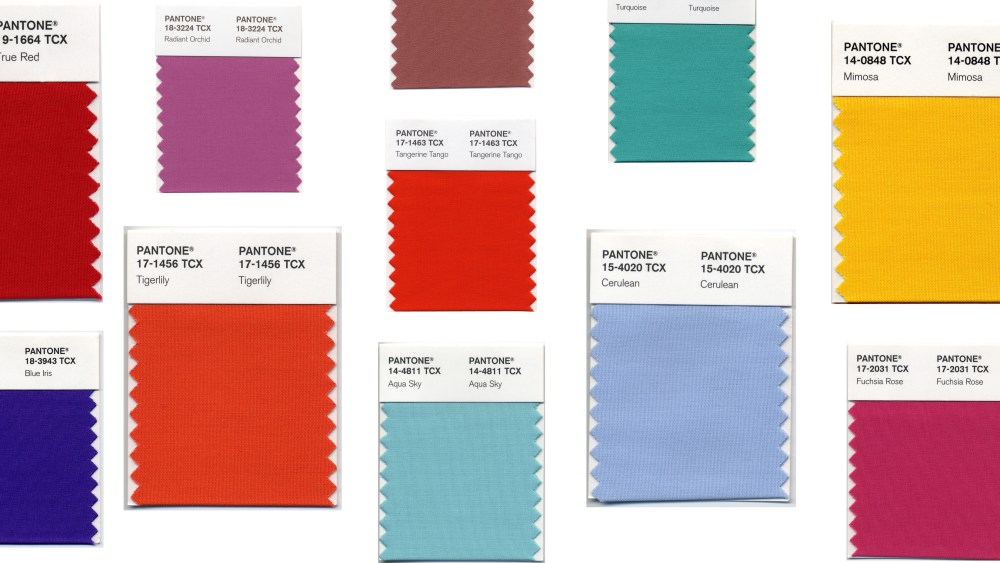
2004: Tigerlily Pantone 17-1456
The impact of nature was evident in Pantone’s selection for the 2004 COTY. Strong and confident, Tigerlily Pantone 17-1456 was inspired by the flower of the same name. The saturated hue meant to ignite creativity.
2003: Aqua Sky Pantone 14-4811
The first of several water-inspired hues selected for COTY, Aqua Sky Pantone 14-4811 was chosen for its sense of hope, serenity and clarity.
2002: True Red Pantone 19-1664
True Red Pantone 19-1664, the 2002 COTY, was chosen for its connection to love, courage and strength. The intense color was a patriotic symbol following the tragic events of September 11, 2001.
2001: Fuchsia Rose Pantone 17-2031
Fuchsia Rose Pantone 17-2031 walked so Barbiecore could run. The cheerful and punchy 2001 Pantone COTY was a soft and feminine contrast to the sleek and tech-inspired Y2K trends that dominated this period.
2000: Cerulean Pantone 15-4020
Cerulean Pantone 15-4020, the color firm’s first-ever COTY, became known as the “color of the millennium.” Tranquil yet futuristic, the shade of sky blue represented peace, calm and unlimited possibilities. It went on to become the focal point of Meryl Streep famous monologue about fashion trends in the 2006 movie, “The Devil Wears Prada.”