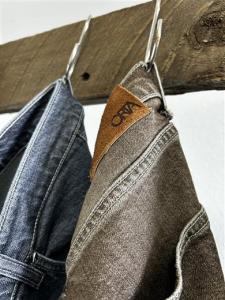
As consumers increasingly prioritize sustainability, fully integrated textile manufacturer Panther Denim is expanding its eco-friendly offerings to help retailers meet this growing demand. One innovation helping push the needle forward is its Planet Indigo line, a collection offering a sustainable alternative to conventional denim. Developed in partnership with Shuise Dyeing House, this project combines traditional dyeing techniques with modern sustainability practices to engage both consumers and denim communities.
Here, Tim Huesemann, sales director at Panther Denim, discusses the company’s new additions to its Planet Indigo line and why retailers must increase their sustainable initiatives to remain competitive in an ever-evolving market.
Related Stories
RIVET: Starting from the top, what’s in the works for Spring/Summer ‘25?
Tim Huesemann: We are thrilled to announce the expansion of our Planet Indigo line to include kaki dye, derived from persimmon—which is a deep, rich orange with reddish undertones, essentially a vibrant shade of orange that leans slightly toward red—with the potential for additional natural dye colors in the future.
The unique hue of persimmon comes from its tannins, which are traditionally known in Japan as Kakishibu. Highly valued among denim enthusiasts, this natural dye has been used in the Asian market for years, offering a distinctive fading effect similar to indigo. Like our Planet Indigo dyes, kaki dye is entirely chemical-free, and any leftover dye residue can be composted to enrich the farm.
Additionally, while currently in limited production, we aim for natural dyes to account for 5 percent of our total production by 2030. Reaching this ambitious goal will require intensive research and development (R&D) and strategic collection development. Despite the higher cost of natural dyes compared to synthetic ones, we see this as a crucial and achievable step toward sustainable production.
Speaking of sustainability, Panther’s printing mill has a monthly output of 2 million yards of printed fabric. With that in mind, how does the company ensure its production process stays sustainable?
T.H.: What sets us apart is our dedication to sustainability through innovative technology. Our production plant is designed to minimize waste and maximize resource recycling, with 30 percent of our energy needs met by in-house solar panels. Located in a small town with a population of 700,000, our facility has been carefully adapted to protect the nearby lake and natural resources. We work closely with the local community to ensure our factory not only avoids harming the environment but also contributes to improving local welfare.
How do you see the demand for eco-friendly denim evolving in the next few years? Are there any specific trends or shifts you anticipate in sustainable denim design and production?
T.H.: Sustainability standards are constantly evolving. For instance, while organic cotton was once the gold standard, regenerative cotton is now gaining prominence. Likewise, recycled polyester has its limitations, as it can only be recycled once. As consumers and innovators uncover new challenges, the focus is shifting toward solutions that embrace true circularity.
Rather than simply recycling materials, the future lies in continuously circulating resources, whether previously used or discarded. We are optimistic that ongoing research and technological advancements worldwide will help tackle these challenges and drive meaningful progress toward circularity.
Looking ahead to 2025, what do you see as the key sustainability challenges and opportunities for the denim industry, and how is Panther preparing to address them?
T.H.: As sustainability expectations grow, consumers are demanding more from retailers. Simply labeling garments with an “organic cotton” tag is no longer sufficient to claim sustainability.
Customers now prioritize authenticity, transparency and a secure supply chain from the brands they support. Successful brands are those that take control of their materials, build trust and demonstrate genuine accountability.
As a denim mill, we are dedicated to collaborating with innovative sustainable fiber suppliers to provide the most advanced and eco-friendly fibers and elastane options. This commitment ensures our customers have access to materials that meet the highest sustainability standards, helping them stay competitive in the market.
To learn more about Panther Denim, click here.