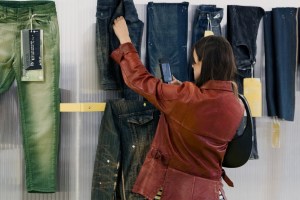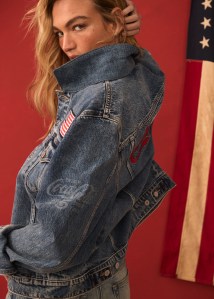
How do you make lower-impact jeans? The answer starts with choosing the right fiber foundations, including stretch materials.
Conventional spandex is made from fossil fuel-based inputs, a finite resource and major contributor to greenhouse gas emissions. Offering an alternative, The LYCRA Company has adopted bio-based inputs. This year, the material maker began manufacturing LYCRA® EcoMade made with Qira®, a dent corn-based 1,4-butanediol (BDO) produced by Qore. Per a screening life cycle assessment, this ingredient swap cuts emissions by 44 percent. Despite using different inputs, the performance and physical properties of the Qira®-based fibers are identical to conventional LYCRA® spandex.
Related Stories
LYCRA and Qore are creating commercial-scale capacity for the fiber ahead of its market launch in the first quarter of 2025. Among the early adopters of LYCRA® EcoMade made with Qira® is Turkish denim mill Orta Anadolu, which used the yarn in its Spring/Summer 2026 collection. “Orta is one of our key partners, and they are a leading company who understands consumer needs and has a very good capability of addressing those needs with required innovations,” said Ebru Ozaydın, global product director and category lead – denim, wovens and ready to wear at The LYCRA Company.
Here, Ozaydin and Oktay Okuroglu, director of sales and marketing at Orta, discuss how LYCRA® EcoMade made with Qira® can be incorporated into denim and why bio-derived fibers are poised for growth.
RIVET: What makes bio-derived LYCRA® made with Qira® such a good fit for denim in particular?
Ebru Ozaydın: The introduction of LYCRA® EcoMade fiber presents a significant investment and an opportunity for denim brands to meet growing demands for sustainability while maintaining the same stretch and recovery performance. With 70 percent of content sourced from annually renewable dent corn, LYCRA® EcoMade made with Qira® reduces reliance on fossil fuels, aligning with industry goals to reduce environmental impact. This shift toward more eco-friendly materials will help brands meet regulatory expectations, particularly in Europe, while also responding to rising consumer demands for responsible fashion.
For denim brands, transitioning to bio-derived LYCRA® fiber isn’t just a step forward in sustainability but also a way to stay competitive amid sluggish market demand. As sustainability becomes a core expectation rather than a luxury, denim brands will want to integrate innovations like bio-derived LYCRA® fiber into their production to ensure they remain resilient, accountable and flexible in an evolving market. We aim to empower the denim sector to embrace these materials as part of a more responsible and innovative future.

Why did Orta decide to take up LYCRA® with Qira®?
Oktay Okuroglu: It is in Orta’s DNA to constantly search for innovative solutions for a better future of denim. Within our sustainability strategy, we are after the regenerative denim solution that we define with three main aspects: longevity, circularity and regenerative materials and solutions. The fabric first needs to be a long-lasting product to stay in the material circle as long as possible. It should either be recyclable or contain recycled content, and it should be engineered with regenerative materials and processes.
Our collaboration with Lycra® furthers our commitment to this regenerative movement. As the first and only mill in our region to adopt this innovation, we see it as an optimistic path toward the reinvention of net-positive denim, which strengthens our handprint mission to use less to create more—more value, more performance and a greater abundance of goodness.
What has been your experience working with this stretch fiber?
O.O.: When we go for a new innovation, it is important to not lose parameters from our production process, such as energy consumption or waste generation. In the case of bio-derived LYCRA®, we did not change any parameters in our production compared to conventional LYCRA® fiber, and that is the beauty of this innovation. When you can easily apply a new technology into your production, it will have an easier path to grow.
What types of fabrics did Orta develop using LYCRA® with Qira®?
O.O.: As a start, we developed cotton-rich fabrics with three different constructions at different stretch levels—comfort, stretch and power stretch—to analyze and show our customers the applicability of this new fiber. We launched this collaboration within our SS26 collection at Kingpins Show Amsterdam in October, and we will showcase it at the upcoming Denim Première Vision show in Milan on Dec. 3 to 4, 2024. We also have exciting brand collaborations that will be launched in early 2025, so stay tuned.
As you look ahead toward the commercial launch of LYCRA® made with Qira® next year, what is the future for the bio-based segment of the spandex market?
E.O.: At the end of the day, what’s really important is the reduction in environmental impact. We’re confident with bio-derived LYCRA® fiber that we can make a significant reduction in emissions and provide transparency and traceability around both the product and our supply chain, which we know are very important to our customers as they strive to meet their own sustainability goals. Also, the scalability of bio-derived LYCRA® offers a positive solution for the industry as bio-derived inputs become more sought after as an alternative to fossil-based offerings.
 |  |
Click here to learn more about Orta. Discover more about LYCRA® with Qira® here.