NSF, the Los Angeles-based women’s denim brand founded by Nick Friedberg in 2004, is transforming into a venture that blends practicality with creativity.
“NSF as a company—the IP, trademark, and brand—is still entirely mine. It never went through a transition or bankruptcy; I just decided to hit pause so I could reset and refresh,” Friedberg told SJ Denim.
After covid, Friedberg said the traditional wholesale model became a challenge. The retail landscape shrunk, and the remaining stores mostly bought from the same 12 brands. “The formula is broken,” he said. “No one wants to take any chance anymore. There are no moments of discovery.”
Related Stories
Retail, he added, has landed in a strange phase, “where everyone is being marketed by the same brands, buying the same brands and following the same people.”
The brand’s last full collection was for Fall 2025. Last year Friedberg began to pivot NSF into an agency service business. With President Trump’s tariffs introduced around the same time, suddenly he said people were reaching out for help with global and L.A. production.

Now he’s focused on concept development, product creation, production management, and sourcing—helping brands and retailers, especially those with multiple stores who want their own label or those looking to expand into new categories. His services are not limited to jeans; Friedberg is working with brands on leather, denim, silk, hand beaded and embroidered blouses, sweater knits and more.
“I spend most of my day dealing with designers, pattern makers, tech designers, product development, production, people from other brands and we all speak this unique language that’s specific to our world. I’ve realized how much this is what I needed it. This is what I do best,” he said.
It’s also a fading area of expertise despite it being necessary to build a successful brand. With technology and social media dominating the lives of younger generations, Friedberg said there’s a knowledge gap in how to cultivate relationships with factories, how to use the correct terminology and how to choose souring destinations for specific product categories.
Having a foot in both worlds resonates with the NSF motto: “no set formula.” Though the moniker originated from Friedberg’s initials, it has evolved into a strategy that frees him and the brand from being tied to one specific lane.
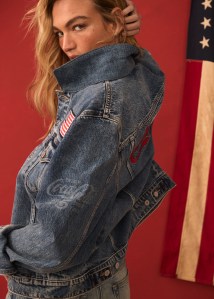
While NSF the agency pays the bills and keeps Friedberg in the ever-evolving sourcing sphere, NSF Studio, the brand, is where his creativity runs wild. NSF Studio consists of a dozen “new build” best-performing “Made in L.A.” styles that customers keep coming back and limited-edition drops of upcycled vintage garments.
The collections are sold direct-to-consumer online. Friedberg added that his return customer rate is over 60 percent.
Though designers often talk about how much they’re influenced by vintage, he explained that the scale of the traditional fashion model—and its reliance on consistent, repeatable production—makes it difficult to truly incorporate vintage into their process. With NSF Studio, Friedberg can “resurrect and reconstruct” vintage and deadstock without those constraints. Styles are upcycled in a myriad of ways, from added stud and crystal embellishment to paint splatter, to transforming “grandpa size 40 pants” into unique double waistband pleated trousers.
“There’s so much rad clothes out there,” he said. “And what can be more sustainable than taking something that was found in a collector’s warehouse and never distributed from the ’70s, sanitizing it, washing it, recreating it, refitting it, making it cool again and offering it to a customer, all while eliminating the entire process of manufacturing.”
There’s no set formula or cadence to the vintage drops. Friedberg has a handful of vintage suppliers in the U.S. that might come back with a “load of duck camo from a collector in Arkansas.”
It’s that element of surprise, which Friedberg said is missing in retail, that excites him about NSF Studio’s future. He’s also sampling a variety of finishing techniques on old Levi’s 501s and western Wrangler shirts. He added that there’s no shortage workwear or US. military because it’s built to last.
“To me, the satisfaction is in the build—it’s not the end result,” he said. “It’s the process, the planning and the gathering of materials, and the mistakes and the failures and the successes that occur along the way.”