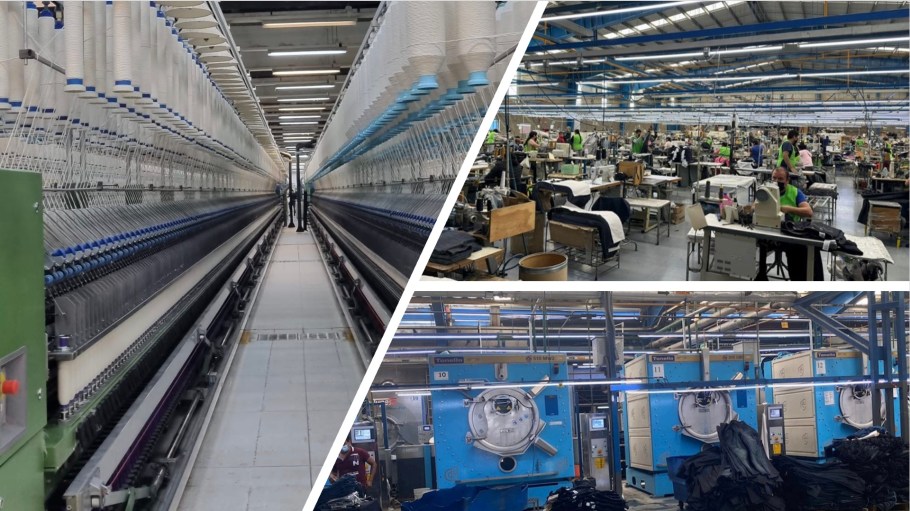
A newly established nearshoring cluster in Mexico is designed to reduce lead times and lower minimum order quantities, all while supporting local businesses.
Mexmakers is a collaborative network of Mexican textile and apparel manufacturers dedicated to delivering comprehensive, sustainable, and traceable full-package products. This innovative group offers end-to-end services, from product development to logistics, enabling clients to streamline their inventories and enhance agility within their market niche.
Related Stories
Patricia Medina and Graham Anderton, both principals of Aztex Trading, a Mexico-based denim manufacturer, serve as Mexmakers co-directors. Medina’s son, Daniel Morales Medina, is coordinator. They launched Mexmakers in July. The group consists of 30 companies including yarn, textile and garment manufacturers. As a unified group, they’re working to rebuild what the country lost to cheaper manufacturing in Asia and help brands establish their supply chain in Mexico.
Medina said two large brands in Mexico are already working with the group.
“We don’t want to have an enormous group, but we want to have the best of the best,” Anderton said. “When we promise a brand something, we know we have to deliver.”
Though the North American Free Trade Agreement (NAFTA) in 1994, which created a free-trade zone between Canada, Mexico, and the U.S., led companies to establish a manufacturing footprint in Mexico, that business dried up by 2005 as companies relocated to Asia. “Directly and indirectly, there were close to 750,000 jobs lost within a period of six months in 2005,” Medina said. “Obviously, we knew that was not going to be the way of the future.”
Following the manufacturing exodus, Mexico faced a lack of organization in its industrial landscape. Unlike countries like Italy, which benefit from dedicated associations that promote and support various sectors, Mexican manufacturers were largely left to fend for themselves. As Anderton noted, they struggled to forge business connections, promote their services, and navigate the complexities of exporting, resulting in a fragmented approach with no cohesive message.

“We have a lot of good components in Mexico, but nobody in Mexico coordinated,” he said. “Through Mexmakers, we’re integrating the components of the supply chains that already exist in Mexico but haven’t been fully utilized.”
The supply chain challenges exacerbated by the pandemic highlighted the advantages of nearshoring. However, external factors are adversely impacting Mexico’s domestic market. Many products rejected by the U.S. from China are being dumped in Mexico, creating additional pressures. Medina estimates that companies are currently operating at only 50 percent of their capacity.
For Mexmakers, the renewed interest in nearshoring coupled with a depressed domestic market is an opportunity to remind brands of Mexico’s capabilities in men’s, women’s, denim, uniforms and more.
“We are working together in a symbiotic way, so that the T-shirt and sweatshirt manufacturers can wash their products in a very sustainable way in the laundries that were only washing for jeans. We have access to other companies’ infrastructure like digital printing. We’re combining forces to be able to offer products that are unique, good quality and obviously traceable and sustainable,” Medina said.
In the process, the cluster is breaking down walls and building relationships. In many cases, it is the first time Mexmakers members are meeting and working with each other, even for some third-generation companies.
“They’ve survived all of the ups and downs we’ve gone through in Mexico,” Anderton said. “In many cases, we’ve worked with the parents. Now we’re working with basically the children. So, these are very, very reliable people.”