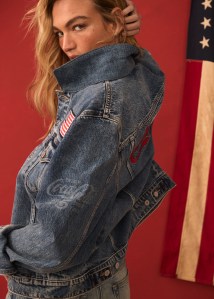
Stretch denim isn’t just for skinny jeans anymore.
Stretch fabrications are getting a rebrand, according to Ebru Ozaydin, strategic marketing director of denim and ready-to-wear for The Lycra Company, the maker of XFIT technology. “Comfort stretch fabrics are pretty trendy nowadays across different silhouettes,” she said. “We want to offer the industry a way to use stretch fabrics across more different styles and silhouettes.”
Ozaydin believes Lycra’s XFIT technology could represent the future of bi-stretch denim fabrics. The patented innovation relies on a double-beam technology, wherein a bottom beam is used for rigid indigo warp yarn and the top beam is used from stretch covered yarn. The process allows Lycra fibers to be buried inside the fabric to provide a more integrated stretch, allowing the denim’s natural cotton texture and aesthetic to shine.
Related Stories
XFIT dispels many of the preconceptions about stretch denim, eliminating common problems like a “gummy” or “spongy” hand-feel. Unlike conventional bi-stretch denim constructions, Lycra XFIT fabrics do not require a core spun yarn in the warp direction. Instead, any type of warp indigo yarn and weft yarn can be employed to create an array of textiles, all imbued with high-recovery stretch. Ozaydin said the fabric also exhibits less compression than other bi-stretch formulations on the market, making jeans more comfortable to wear.
“Our test results show that adding stretch in the warp not only increases vertical stretch, but also impacts the surrounding area as well, resulting in true 360-degree fabric flexibility, she said. The double-beam approach creates a result that is more stable and exhibits less shrinkage after washing or bagging out following wear.

The fabric also displays “better dyeing uniformity,” with the ability to create “saturated, deep beautiful blue shades with improved color fastness.” Mills can also easily control the fabric dimension and the size consistency, allowing them to specify stretch level and other characteristics.
XFIT hit the market three years ago, but the innovation has been gaining traction in recent seasons with the return of in-person expos and events. “Last Intertextile Shanghai, we relaunched it to make people to remember what the technology was like in person,” Ozaydin said, speaking of the trade show that took place in August. China-based mills were the technology’s earliest adopters, as it requires an upfront investment in the double-beam technology. “China as a region has always been very eager to apply new innovations,” she added.
Last year, several mills in Pakistan also began exploring the possibilities of XFIT. “Since 2022, we have seen more mills in South Asia investing in double beam technology” with an interest in producing not only conventional denim, but colored jeans and woven products, the strategic marketing director said. “Currently, we have Lycra XFIT technology approved fabrics available from Advance Denim, Seazon, Prosperity, Blue Diamond, Black Peony, and Yuanji in addition to AFM, Artistic Milliners, and Soorty from Pakistan.”
Ozaydin said Lycra XFIT has augmented the company’s sustainable offering as a part of its Lycra XTRA Life brand of durable fibers that help extend a garment’s lifecycle. “The technology reduces bag and sag and delivers a better fit to ensure an enhanced wearing experience so the wearer can love their jeans longer,” she said.