The olfactory nerve is so tied to the brain’s limbic system, including the amygdala and hippocampus, that the merest whiff can trigger a powerful rush of memories.
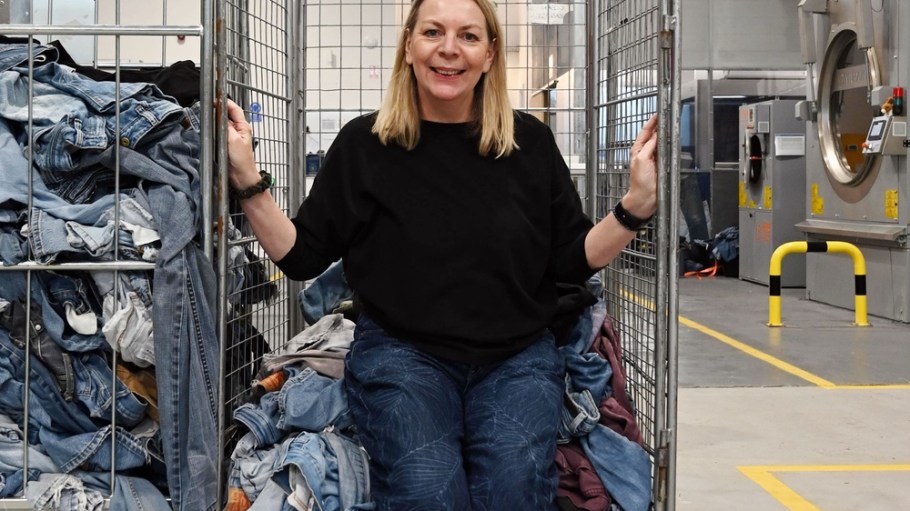
Even on a still East London afternoon, Salli Deighton, founder of LaundRe, can remember stepping into the sustainable denim finishing company’s future premises as if it were yesterday.
“It smelled,” she said of the former church—which had been defaulting on its bills—when she first stepped within its red-bricked premises last January, unsure of what she had gotten herself into. “It was so dirty you wouldn’t have wanted to be in here, and it was absolutely full of rubbish.” The pitched roof leaked.
Related Stories
But the unit’s landlord—Ross Barry, co-founder of the textile recycling firm LMB Textiles and its consumer-facing platform Reskinned—offered Deighton a deal on the rent, not only in view of the Herculean clean-up job involved, but also because they were simpatico in their desire for more circular systems in the United Kingdom.
So Deighton did the only thing she could do: she rolled up her sleeves and got to work.
The place LaundRe now calls home sits just beyond the A13 flyover in Canning Town, a district of West Ham north of the Royal Victoria Dock. Before the 19th century, when the dock’s development made it necessary to house the newly employed dockworkers and their families, the area mostly comprised marshland, approachable only by boat or a toll bridge.
LaundRe is built on similarly boggy ground: garment production in the United Kingdom decamped to cheaper foreign shores decades ago. Besides an “old-fashioned washer up in Birmingham,” Deighton said, there’s nothing like what she’s trying to build.
When Deighton started as a young designer for Wrangler in the late ‘80s, however, jean production was still a domestic pursuit. Visiting the facilities where denim was milled and finished, albeit using “very dirty” techniques involving stonewashing and harmful chemicals, was how she cut her teeth. When everything fled offshore and she pivoted to consultancy work—“I’m down in everyone’s phone as Salli Denim because nobody can spell Deighton”—she would get calls from brands whenever there was a denim problem.

It was a few years before Covid-19 hit, when she was helping a prominent high-street brand engineer more sustainable jeans at an affordable price, that Deighton realized how difficult it was to rapidly respond to changes—thereby avoiding huge inventory gaps—because there was “no onshore backup.”
Another brand—also a household name—had the opposite problem: too much stock in warehouses. But Deighton, too, found herself “running around” the United Kingdom, trying to find somewhere to refinish the stock, such as “changing a pair of jeans into a pair of shorts, changing the finish on a jacket or doing anything else so we could resell that stock.” Of the few factories that did remain, she said, most wouldn’t pass an audit in Bangladesh.
“It was just like, ‘Where’s my laser machine? Where’s the ozone? Where’s the technology?” Deighton said. “Why, when I’m working with all these brands to improve factories overseas, is it acceptable in the U.K. to only have a pair of scissors and a leaky old washer that’s 20 years old?”
What the United Kingdom needed, she decided, was a green, clean and tech-driven version of what it had before—if only on a smaller, more agile scale—to help refinish low-volume stock. As someone who has seen where unwanted textile waste ends up, Deighton also felt that denim, as a whole, needed to be kept in circulation longer. It was one of LaundRe’s early pilots with Jeanologia involving an end-of-life denim bale from LMB Textiles, “to see how many jeans were just dirty,” that crystallized its purpose.
“We sterilized the jeans on a PPE level, and all the body in the fabric started to come back, and then we refinished with laser and did a post-wash,” she said, using an acronym for personal protective equipment. “We surprised ourselves even then. As an industry, we take a beautiful vintage jean and we copy that wash on a brand new jean, using all that water, all that dyestuff, every process we do. If we can actually take old jeans and make them as new, why not?”
Deighton and her eight-person team—which includes Yeliz Haciosmanoglu as chief commercial officer, Kelly Farewell as chief financial officer, Idrish Munshi as chief operations officer and Rowan Hunt as chief technology officer—moved quickly to get their facility running, stripping the building to its studs and scrubbing the walls and floors with bleach.
They employed reclaimed materials partly to stay in line with LaundRe’s sustainable ethos, but also because they were on a budget. The floor is fitted with recycled carpet tiles from an office redo. Old packing crates still marked with the symbols for “fragile” and “keep dry” serve as wall dividers. Even some of the furniture was purchased from Isko when the denim manufacturer shuttered its development center in Park Royal. All that remains of the old church is the DJ booth, now used for sample storage.
“We got the unit last January, we started installing in March, we started getting the machines in June and we went live in July,” she said. “All the machines came when it was very hot and now it’s very cold.”
The phalanx of equipment that washes, nebulizes, steams and laser-etches is all new—and completely state-of-the-art—so that everything uses less water, energy and chemistry. If there’s one rule of thumb at LaundRe, however, it’s “no pumice, no permanganate, no nasties,” Deighton said. Damp towels, with or without bio-based solutions, are thrown into the drums to “wash down” darker denim. To get abraded effects, it uses mechanical friction, ozone and laser processing. Stains on existing jeans can be disguised with a strategic overtint.
The laser machines have been particularly transformative, firing up not only traditional effects such as whiskers and fades but also fun all-over graphics like stripes, animal prints, paisleys and even the Santa Claus heads that adorned a batch of oversized jeans that were left over after an organization switched uniform styles. The idea, Deighton said, is for brands to use waste and overstock as “their new fast fashion” rather than incinerating it or offloading it overseas.
“So if you’ve got basic stock, one week you can have tiger, the next week you can have snake, and then you can have leopard,” she said, checking off the options. “And we can just knock that out for you each week. It’s helping you grow sales, but in a very sustainable way. And you’re not overbuying and taking a risk. You can test and trial and do limited drops, which is very appealing to the U.K. customer. It’s also cost-effective. We are costing cheaper than Turkey at the moment with what we’re doing.”
Not to mention, refinishing a pair of jeans that have already been written off is half as expensive as making a new one.
“We’re not here to take orders from Turkey and Bangladesh,” she said. “We’re here to help and support buyers and suppliers because there’s nowhere for anybody to do less than 500 pieces. We want to help the little brands, ethical brands and mid brands, and that’s where it works because they want to buy 100, 200, 300 pieces and that’s what we do. Or we can support a brand with a recipe they can back up in Bangladesh.”
What Deighton is most eager to show off, however, is the Fulton VSRT steam boiler: a squat, matte-black contraption that sits unobtrusively in the corner of the factory floor, its servo motors whining steadily.
“Some people get a dog; I got a boiler,” Deighton quipped. London maintains an emissions limit of 40 micrograms per cubic meter of nitrogen dioxide. LaundRe operates between 11 and 14, “which is just above domestic levels,” she said, before adding, “We must be one of the lowest-emitting factories in the U.K.” It also purchases renewable energy from the grid, which costs more but “stands by our beliefs.”
The Metropolitan Water Board, which has been monitoring the facility’s water quality, too, is impressed. “They can’t believe we’re so clean compared to an industrial laundry that does like hotel towels and bedding,” Deighton said.
Next up is a project “to do a bit of fiber capture” because one thing that concerns her about vintage clothing is that it sheds slightly more. She’s keen to explore further efficiency tweaks, such as setting up water recycling because “we don’t have that at the moment.”
Every day, LaundRe thinks about how it can “compact the process.” The operation is still modest—it can wash 1,000 jeans a day and laser-process up to 600—but it plans to scale, first by tacking on a second shift and then expanding elsewhere.
LaundRe also anticipates closing a round of Series A funding within two to three years. Already, Deighton’s been fielding calls from North Carolina to Australia asking for their own version of LaundRe, “so maybe it’s a local solution, but globally” if the setup can be refined. So far, the company has been relying on angel investments and grant money, including from the Cotton Textiles Research Trust, One Planet Capital and HSBC.
Upstairs in the meeting area that doubles as a showroom, where the lilac-red flooring and nicotine-stained glass have since faded into the past, Deighton brought up another passion of hers: education. Nearly 500 visitors have tramped through LaundRe since it threw open its doors. Yet even among people who work for denim brands, roughly 80 percent don’t understand how a pair of jeans is finished, she said.
“We have a culture in the U.K. where they tend to move you around departments,” Deighton said. “And until you get to be a buyer or a designer, you’re not traveling. So where do you go to see a laundry and denim being produced?”
Deighton delights in teaching, organizing sessions on Thursday afternoons for buyers, designers and students when things are quieter. Buyers today just pick what they want from samples, she said, but when you switch up a wash, and “if you don’t know what you’re asking for, you don’t know what you’re paying for.”
“For us, we want to teach every part of our process,” Deighton added. “The one thing I say to everybody that comes in is, if you’re buying a house, you wouldn’t want that house not to be built by somebody qualified as an architect. We are the architects of fashion. And we can make beautiful fashion from what we already have.”
Deighton looked around at what she’s created with the support around her, her pride palpable. She pointed out that her daughter helped with some of the paintwork when LaundRe was still setting up shop. Hunt, her technical guru, used denim scraps to make the stuffed turtle that was perched on a table. (He’s done bees, too.) “We’re a problem-solving hub more than anything else,” she said.