One denim maker is contouring its sustainability strategy to meet the demands of the market.
Kontoor Brands, which owns Wrangler, Lee and Rock & Republic, has been on a mission to better both its own operations and change the industry as a whole.
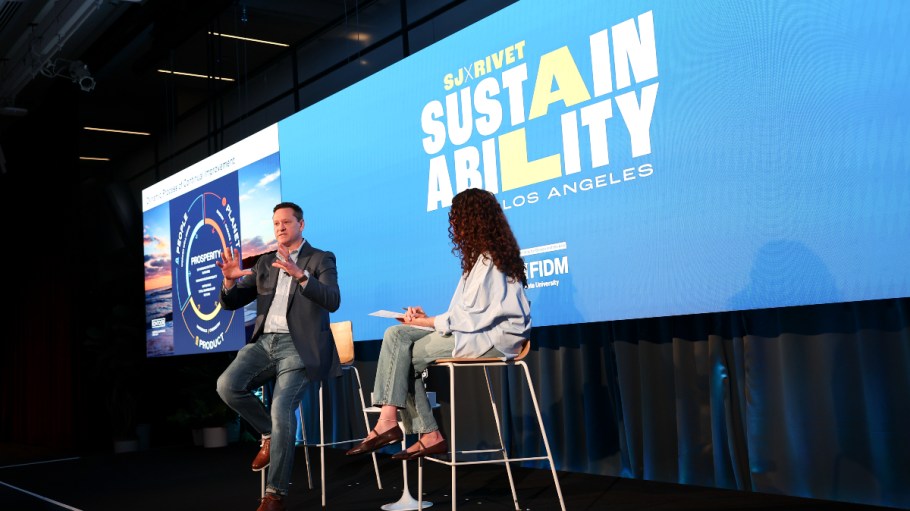
On a panel moderated by Angela Velasquez, Rivet’s executive editor, at Rivet and Sourcing Journal’s first Los Angeles Sustainability event, Jeff Frye, vice president of sustainability, innovation, global procurement, global product development for Kontoor Brands, spoke about the company’s various projects meant to encourage a greener production process, both for denim and non-denim garments.
Related Stories
“We believe very clearly in safe people, safe products and safe planet,” Frye told the audience.
Kontoor Brands spun out of VF Corp in 2019. Upon its successful separation, Frye said, the team began working to define sustainability—a task that proved difficult given that the concept remains a moving target for most brands today. Instead of pigeonholing the company into one specific set of standards, the team decided on a more fluid definition.
“It’s a dynamic process of continual improvement, because first things first, we’ll never get to sustainability. It’s going to keep moving; it’s very dynamic. Every day we come to work and it’s something different,” he said.
From there, the company focused on making the most tangible impact possible. Frye said moving the needle, even slightly, can make a difference to the at-large organization—and the planet. Accordingly, Kontoor has set forth a bonus structure integrated with sustainability objectives, so team members are “highly attuned, highly interested and highly motivated to make progress.”
“The first thing we did [was] a double materiality assessment to figure out what’s important for our internal stakeholders and what’s important for the external stakeholders,” he told the audience. “Then we built very robust goals, and we figured out how to get action, because…you could have all the best ideas in the world, but without action and results, it’s really meaningless.”
Upon setting benchmarks, Kontoor worked quickly to build out programs that would make a splash—a waterless one, anyway. Upon finding out that one of the top-ranked concerns on the materiality assessment was water consumption, Frye’s team got to work on creating a solution—not just for Kontoor, but for the at-large industry.
“[We tracked] the locations of our textile mills, our garment manufacturers, our distribution centers, our corporate headquarters. We aligned that to the water stress map, and what we learned was that 88 percent of our suppliers are in water stress locations. Suffice to say, that is a major driving point for us,” he said.
The Indigood Program, Kontoor’s water conservation effort, aids in bringing concerns about water consumption to the fore. The program helps denim mills monitor their freshwater consumption as they work to decrease their reliance on it. Over 30 mills are enrolled in the program, and the expectation is that they work to reduce their consumption over time, culminating in a more than 90 percent decrease in freshwater consumption over the course of multiple years. The mills’ efforts are then awarded a third-party certification for their efforts—either bronze, silver or gold, depending on what amount of progress they have made toward the eventual goal.
“We do everything that we can to advance their business, and from a perspective of how we all win together, this work that we do in terms of putting the spotlight and putting the focus on using less water, we all win as an industry,” he said.
As the company moves forward, it has also been re-evaluating its materials. Frye shared an anecdote about his time at Gap in the late ‘90s and early 2000s. At the time, he and a colleague wanted to create jeans suitable for snowboarding.
“We grabbed PFAs and some resin, and we exhausted it on the jeans, and we had wonderful, water-resistant jeans,” he said. “Back then, we had no idea about the impact from an environmental standpoint. Today, we do, and the things we’re designing [at Kontoor] are really, really focused on that.”
Part of that laser focus on material impact has come because of varying regulations; during his discussion with Velasquez, Frye called out California’s PFAs bans and recycling restrictions, the pending SEC climate rules and the EU’s Corporate Sustainability Reporting Directive (CSRD), all of which brands now need to consider as they make decisions that impact their material makeups, their carbon footprints and more.
“The next steps…[are] about really understanding this legislation that’s in front of us, [and] how it’s going to impact each and every one of us,” he said.