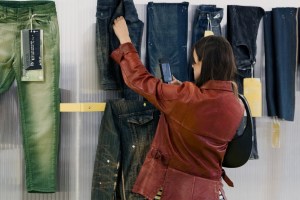
Though they were there to start planning for the Fall/Winter 2026-2027 season, President Donald Trump’s upheaval of global trade policies was weighed on the minds of exhibitors and attendees at Kingpins Amsterdam last week. Many exhibitors said Trump’s reciprocal tariff spree and subsequent 90 day pause on duty hikes, excluding China which soared to 125 percent on April 12, have put clients in a holding pattern.
A representative for Marmara Hemp compared the mood at the trade show to the quiet week between Christmas and New Years. There’s a lot of excitement about products but no one wants to do business yet.
Related Stories
The standstill is discouraging for the French company which has been expanding its cottonized hemp program—90 percent of their denim mill clients were exhibiting at the show—and building buzz for Smart Linen. Made from spinning waste, it is the first pre-consumer GRS certified linen.
While existing customers like Levi’s have pre-booked their orders for the company’s cottonized linen the rep said he anticipates that most companies will wait to see how negotiations unfold before making any new commitments.
“Brands are waiting to see what’s next,” said Aydan Tuzun, Naveena Denim Mills SVP of sales and marketing. Approximately 40 percent of the Karachi, Pakistan-based mill’s business is in the U.S. Clients have not asked for discounts, but Tuzun said she’s heard of stories from other manufacturers about brands requesting mills to share the burden of the extra costs.
Having facilities that can produce the same type of products in China, Mexico and Vietnam is an advantage for Twin Dragon. A representative for the mill said no one is making drastic moves yet however they could shift their production from one region to another if they choose.
Likewise, Ebru Ozaydin, The Lycra Company’s global strategic marketing director for denim and wovens, said the company’s global reach and its ability to produce fibers in five countries helps balance the effects of turbulent economies. “Since we’re at the very beginning of the supply chain, we have to wait and see how brands and the end consumer react,” she said about the company’s next moves.
Despite the uncertainty, Ozaydin remains optimistic, noting how momentum is building for Lycra’s latest technologies. In the last six months, the company introduced FitSense technology, its targeted sculpting innovation, to the supply chain and launched it in the market with Spanx. The men’s category is proving to be a major opportunity for its Adaptiv. Additionally, the first jeans made with bio-derived Lycra EcoMade just hit the market. The fiber, which is partially made with corn, is used in four Spring 2025 Agolde styles.
“Brands are still trusting us and trusting innovation,” she said.
While Italian machinery company Tonello is scaling its business by recently acquiring its competitor Flainox and diversifying its capabilities, Alberto Lucchin, Tonello’s marketing and sustainability manager, said the company is bound to feel the impact of tariffs, albeit indirectly. Many of Tonello’s clients are based in Pakistan and Bangladesh and produce for U.S. brands.
AGI Denim is in preparation mode. Though the Pakistani mill showcased premium fabrics like a new silk blend, it balanced its collection with value added fabrics and the Flexible Collection, a family of fabrics that are almost always in production. Henry Wong, AGI Denim’s VP of product development and marketing, said this allows clients to quickly place orders. “If there’s a reprieve on tariffs, you want to be able to buy fast,” he said. “It’s unclear what will happen so brands and mills are positioning themselves for success.”
Trump’s ever-changing policies make it difficult to navigate solutions, but Keith O’Brien, Isko senior PR manager, said it is positive that companies are having open conversations about the realistic impact of tariff increases. He said clients are being cautious this season. The Turkish mill is responding to this mindset with more practical technologies like We’Raw, a fabric family that maintains its raw look after home washes, and FitWise, an easy to cut and sew fabric with low shrinkage.
“We’re trying to be more democratic with what people want,” he said.
Whether companies make good on their promise to “circle back” after the 90 day pause ends in June remains to be seen. Many doubt the probability that the U.S. will negotiate new trade policies with 57 countries within the time frame. Others anticipate more chaos and unpredictability from the administration.
“Many people are looking for alternatives, but no one can make moves right away,” said Luca Braschi, Soko’s marketing and technology manager. The Italian chemical manufacturer’s global distribution helps mitigate the impact of business lost in one region versus another, but Braschi anticipates that affects will be felt worldwide. However, U.S. companies may be the most vulnerable. “Trump could have said the tariff increases would go into effect in 2026 or 2027, which would have given U.S. companies time to strategize and other countries time to negotiate,” he said. “Instead, he chose to drop a nuclear bomb on the economy.”