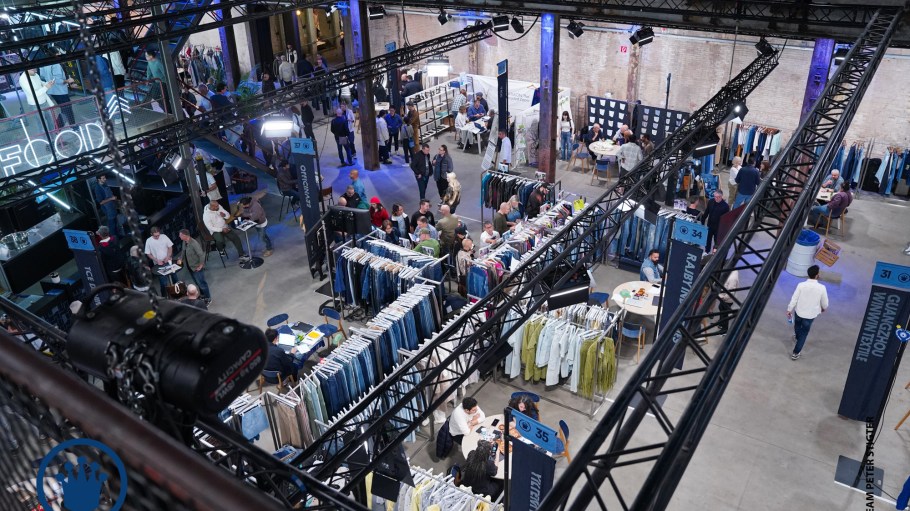
Last week, Kingpins Amsterdam marked a decade of excellence with a celebration that featured a creative fashion show, an engaging happy hour, and a venue buzzing with the denim industry’s foremost experts unveiling their innovative concepts for Spring/Summer 2026.
Here, Rivet shares how mills, fiber producers, chemical companies, and technology innovators are responding to the market’s demand for comfort, sustainability, and exciting denim fashion.
Fibers in focus
Bangladesh-based textile recycler Cyclo, which has made its mark in socks, towels and home textiles, is stepping into denim. The company presented its first line of denim garments made with 50 to 98 percent traceable recycled cotton. Cyclo partnered with Spanish design firm Dreüss to develop the trend-forward collection.
Related Stories

Isko made its Kingpins Amsterdam debut. All the fabrics in the Turkish mill’s S/S ’26 collection use recycled polyester and recycled cotton from its sister recycling firm Re&Up. The circular fibers are applied to Isko Iconic, a line that experiments with finishes and coatings to add sheen and raw resin looks to fabrics, and Isko Craft, a line of lightweight fabrics (12 oz. and lower) with heritage and vintage looks.
Fiber blends are an important aspect of Soorty’s collection. The Pakistani mill presented fabric that blends Umorfil’s collagen fibers into denim for enhanced comfort and care for sensitive skin and Roam, a line of high-performance fabrics made with Coolmax EcoMade. Additionally, Roam uses biomimicry finishing innovations from Rudolf Chemicals, including anti-microbial properties, water repellency, and enhanced breathability. The partners are also working toward the creation of self-cleaning denim.
Calik’s new Blue Voyager collection uses advanced fibers and technologies including graphene and Coolmax. Fabrics offer durability and temperature regulation through special finishing techniques, the mil stated. Fabrics also boast antibacterial and anti-odor features, which promotes more sustainable at-home laundry care.
Naveena Denim Mills showed Canna-Denim, a line made with cottonized hemp. The fabrics offer natural anti-bacterial properties while using fewer resources than cotton. They are also lightweight and breathable, making them perfect for varied climates.
Stretch abilities
Stretch is back, though many would say the walls of skinny and slim jeans that remain in a cross-section of retailers is proof that the fabrication never disappeared.
Naveena Denim Mills’ Flex-Ease is a high-performance stretch solution that offers excellent recovery, reduced puckering, and a wide fit window for various body types. Artistic Milliners’ EnMotion collection uses Lycra dualFX technology and includes fabrics with up to 60 percent stretch.
Hyosung continues to innovate stretch offerings for denim by expanding its regen BIO Spandex offering comprised of new regen BIO+ and regen BIO Max Spandex—both made with a higher amount of renewable resource content.
The company also showcased RCS-certified, 100 percent recycled regen spandex made from industrial waste; Creora 3D Max spandex that delivers excellent stretch and recovery with a very small portion of spandex content allowing the garment to be recycled; and Creora Slip Free spandex with improved seam slippage that reduces waste.
“Sustainable strategies vary widely among brands—whether it is recycled, bio-based or recyclable, so it’s important to provide solutions to meet their individual needs,” said Simon Hong, Hyosung’s global denim marketing director.
Creora’s bio-based spandex is part of AGI Denim’s S/S ’26 collection. The mill also introduced fabrics with The Lycra Company’s FitSense technology, allowing brands to customize jeans with targeted compression shaping. Fabrics made with Outlast, a functional fiber that curls away from the wearer, allows for more air flow in warm temperatures.
The Lycra Company showed the first denim fabrics and garments made with Qira, the bio-derived BDO from Qore. Qira makes up approximately 70 percent of the Lycra fiber by weight. This reduces the carbon footprint of Lycra fiber by up to 44 percent, the company stated.
Orta, Artistic Milliners, Naveena Denim Mills, Vichunha, Canatibia and Advance Denim are among the first mills to use the drop-in product. The first production of Qira will take place in the U.S., however Lycra has long-term goals to bring it closer global manufacturing hubs.
Fashion trends
The effect the pandemic had on consumers’ perception of comfort was evident in the number of collections that focused on softness.
The combination of yarn spinning techniques and fiber selection powers AGI Denim’s new Soft Serve collection. Spanning approximately 20 constructions, the fabrics use cotton, PCR and Tencel to achieve its drapey look and feel. Additionally, the Pakistani mill introduced a new color, Seaweed Blue, to its popular Kaleido collection of color yarn dye fabrics and new novelties such as garment dye fabric with Lurex and fabrics with crepe effects.
Rigid constructions and fabrics with a soft hand feel are prominent in Kalex’s collection. The fabrics are ideal for wide-leg and ballon-shaped bottoms. The Mexico-based mill is also seeing interest in herringbone stripes for a subtle update to basic blue jeans.
In general, stripes are prominent in S/S ’26 collections. AGI Denim showed herringbone stripes, railroad stripes and custom stripes. One style had hidden hearts in the construction. Artistic Milliners showed stripes in its Railroad Bill collection modeled after vintage workwear from the ’30s to ’50s.
Coatings are trending up. Officina39 introduced Marvel Coating, a new line of versatile coatings that can transform denim and other fabrics with distinctive effects. The range offers solutions for, reptilian textures, vintage effects, leather-like draping and shiny colors.
Naveena Denim Mills offers a sleek, glossy appearance with Glaze, a collection that “combines the best of premium fashion with the comfort of denim.” The glossy effect has a polished, modern look for versatile styling. High-shine fabrics are a focal point in Calik’s Denique line for luxury brands. Special yarns and spinning technologies give the fabric family its unique shiny look and soft touch.
Artistic Milliners’ second Shogun collection inspired by Japanese culture spanned selvedge with yarn dye, coated selvedge and selvedge for shirting to coated chambray, paisley discharge prints and 3×1 herringbone PFD. The collection also introduced Frozen Blue, a pale blue fabric with a soft hand.
The clean and raw aesthetic of Japanese denim inspired Calik’s Maxymove collection, a line of fabrics based on the authentic look of denim from the ’50s and ’60s with hidden freedom of movement. The fabrics look rigid but have 80-100 percent elasticity and superior recovery performance. The Turkish mill said Maxymove offers a blend of “activewear comfort and genuine denim aesthetics while creating the perfect harmony between functionality and style.”
Lenzing’s collaboration with Roica by Asahi Kasei and Kaihara Denim explored what the future of Japanese denim looks like with more recycled content. The Kaihara fabrics blend Lenzing Ecovero viscose fibers with Refibra technology and Roica EF recycled stretch yarn. Made of pre-consumer recycled content, Roica EF has excellent stretchability, flexibility and comfort. Lenzing Ecovero viscose fibers with Refibra technology comprise up to 20 percent of post-consumer textile waste, which is sourced from cellulose-rich materials or polyester-cotton blends, supporting the natural softness and bulkiness of the denim fabric.
The collection offers three levels of stretch to meet brands’ different needs. Dennis Hui, global business development manager, denim at Lenzing, said some customers want the stiffness of rigid fabrics while others ask for more drape.
Lenzing also showed “fancy denim” produced by mills from across the world. Hui said the collection is intended to show that denim doesn’t have to be boring. Concept fabrics spanned knit denim and corduroy, fabrics enhanced with metallic yarns, dobby constructions and jacquards.
Isko Luxury by PG received the memo for no boring denim. Designed by Paolo Gnutti, the collection updated popular concepts for warmer weather, including flocked denim and Godmother, a lightweight collection of striped fabrics made with wool, silk and linen blends.
The Agency, the creative arm of AGI Denim, played with tints. Some options pull color away from the fabric; others add more. The creative firm also showed designs with layers of effects like laser drilling, tinting and surface applications like embroidery.
Finish line
Lenzing updated its Tencel Denim Laundry Manual for the first time in 20 years. Available to laundry professionals, the free manual offers dos and don’ts for using next-gen technologies like laser, ozone and nebulization on Tencel denim fabrics.
Italian technology firm Tonello continues to build on Dyemate, a patented indigo garment dyeing technology that creates authentic, vintage looks through a combination of sulfur and indigo dyes. The latest version achieves denim-like effects on ready-to-dye garments. Indigo is added to the sulfur dye process, resulting in garments with rich workwear-inspired colors and indigo contrasts on the seams.
The concept is the reverse of Tonello’s first iteration of the technology. Dyemate was originally used to apply sulfur dyes to indigo to create unique red, green and black casts.
Tonello also collaborated with Piero Turk and Cone Denim for One Denim, an ongoing project that takes one fabric each season and finishes it with multiple applications to show its versatility, and Sake, a creative project by Sadia Rafique and Matt Duckett that fuses art with finishing technology.
Jeanologia, which recently entered a partnership with the Hong Kong Research Institute of Textiles and Apparel (HKRITA) and the H&M Foundation, marked the 25th anniversary of its laser technology with a timeline installation. The Spanish technology company presented a digital version of “old new designs” with hyper-realistic laser details, denim elements and bleach-like stains. Jeanologia said this “nostalgic approach invites the reinterpretation of the past through updated historical models that encapsulate the idea of continuous evolution and improvement in laser design.”
Laser is just one example of the industry’s continuous work to shed harmful processes and chemicals.
Italian chemical company Officina39 presented Zero PP, a new package of technologies designed to eliminate potassium permanganate (PP) from denim finishing. The integrated solution allows for the same worn, vintage look traditionally achieved with PP. By combining advanced laser, ozone, waterless and nebulization technologies, Zero PP offers an eco-friendly alternative that balances visual effects, productivity, and cost-efficiency, the company said.
Soko debuted Soko Authentica, a new non-acidic potassium permanganate alternative, to achieve garments with a worn-in appearance. Luca Braschi, Soko’s consultant and denim finishing expert, said Soko Authentica “turns the page” in finishing by enabling local fading and creating natural vintage effects. Additionally, the potassium permanganate replacement is easy to manage in production.
The technology was applied to traditional denim in addition to the Italian firm’s knit denim collaboration with Adriano Goldschmied.