Jeanologia knows a thing or two about quenching the denim industry’s infamously thirsty demands.
In recognition of World Water Day on Saturday, the Spanish textile technologist shared its Ecological Profit and Loss Account report to “reaffirm” Jeanologia’s commitment to dehydrating and detoxifying the textile sector. While SJ Denim could not obtain a copy of this report, the Cone Denim collaborator said its findings validate just how positive of an impact its sustainably innovative solutions had in 2024.
Related Stories
“The textile industry faces a historic opportunity to reinvent itself and prove that fashion can be produced without harming the planet,” Enrique Silla, CEO of Jeanologia, said. “The future of the sector relies on the deeper integration of circular and efficient solution.”
The Valencia-based finishing firm’s technologies reportedly saved about 5.5 billion gallons (roughly 20.9 million cubic meters) of polluted water. That’s the comparable of nearly 8,500 Olympic-sized swimming pools; a contribution equivalent to how much water a city, not unlike Valencia, consumes each year.
Jeanologia also reported a reduction of about 217 million pounds (98.4 million kilograms) of carbon dioxide emissions. That’s equal to the amount of carbon absorbed annually by a forest covering 16,000 hectares—roughly 22,400 football fields.
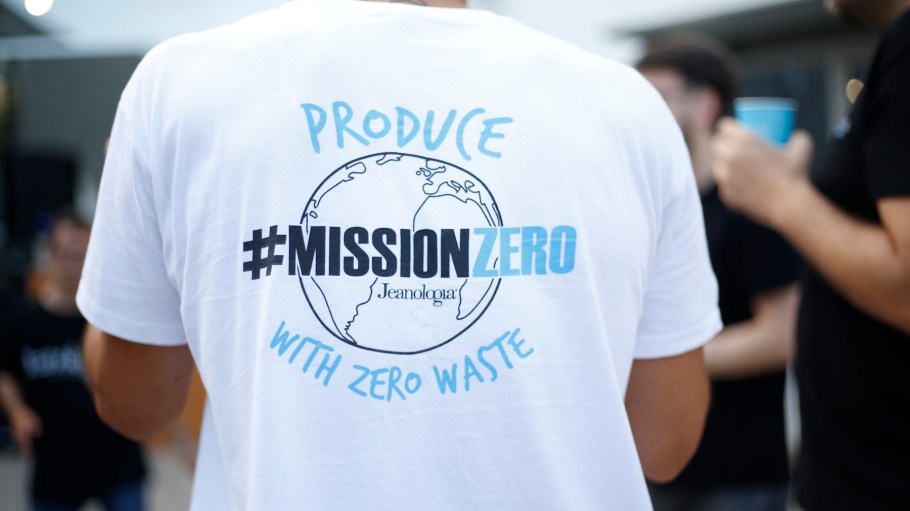
These results, according to the minds behind #MissionZero, validate the possibility of responsibly producing clothes without compromising on creativity or profit.
“There’s no innovation without implementation,” Silla said. “Every cubic meter of water we save from pollution, every kilogram of CO2 we prevent, proves that the industry can—and must—be part of the solution.”
As evidence of these solutions and further incentive to join the “denim revolution,” Jeanologia highlighted its “integrated ecosystem of technologies” at the denim industry’s disposal. This includes H2Zero: a closed-loop system designed to reduce water consumption and offer the best productivity and performance with minimal electric consumption in a production center.
Jeanologia’s eFlow tech uses nanobubbles of air to carry chemicals into a garment instead of its traditional, water-based transportation. Refined over the last 25 years, Jeanologia’s laser technology now offers a fully automated process to replace hazardous, incumbent techniques. Countering the laser is the G2 Indra technology, what the Open Lab initiative member called the “perfect partner” in the sustainable finishing process. Instead of washing with water and chemicals, G2 Indra uses air to decrease chemical usage and water consumption.
The Spanish Fashion Academy Award winner reportedly implemented these technologies in 80-plus countries, working with manufacturers worldwide to reposition the sector’s promise(s) of sustainability to a measurable reality.
“The challenge is global, and the response must be collective,” Silla said. “We invite the industry to join this real transformation, where innovation and sustainability go hand in hand.”